


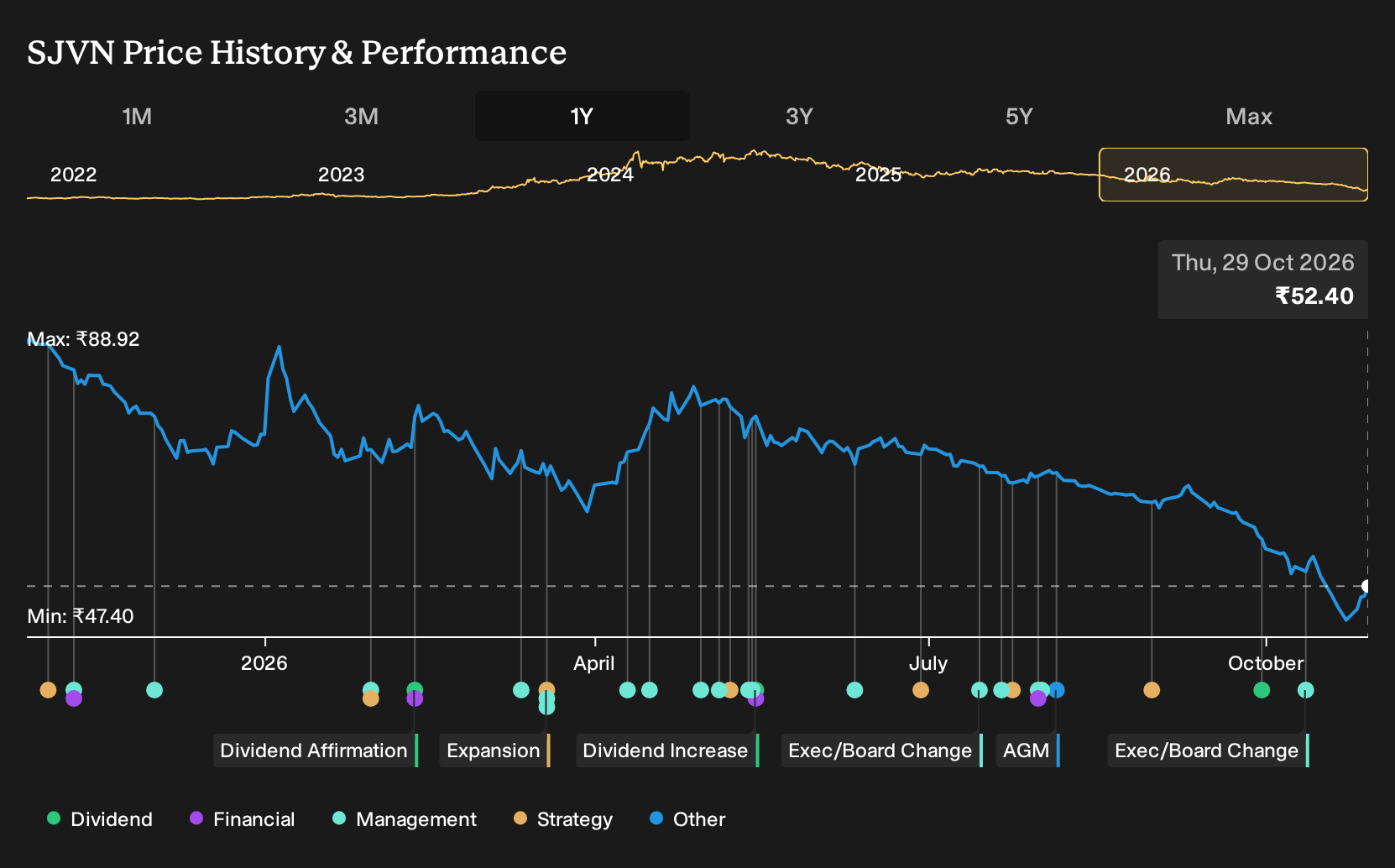
If you had hesitated over SJVN in late October 2025, wondering whether the bullish and bearish write ups really mattered, the past year gives a stark reference point. Holding SJVN over the past year would have meant a 39.4% loss, including dividends. Recent quarterly figures show higher revenue but a sharply weaker net margin. If that outcome now feels painful, which assumptions and warnings already on record would you want to scrutinise more closely?
If the move has made SJVN harder to judge, start where the gap is still open and scan 191 high quality undervalued stocks.
The Two Stories Investors Had To Choose Between On SJVN
The shares cost ₹88.92 at the start of the period, and anyone looking at SJVN then had to decide which of two very different stories felt more realistic.
On the bullish side, the upbeat case pointed to a Fair Value of ₹97.0. This is the notional price if its upbeat assumptions played out, built on SJVN using its Renewable Energy Implementing Agency role and PM Surya Ghar position to secure higher margin, government backed power sales.
The bearish narrative argued for a Fair Value of ₹46.0. This is again an implied price from its own forecasts, centred on execution setbacks around projects such as Arun 3 and Bikaner continuing to delay revenue and squeeze net margins.
What The Results Changed For The SJVN Thesis
The clearest fresh fact was SJVN reporting Q1 2027 revenue of ₹13,943.8m against ₹9,174.5m a year earlier, while net income stayed broadly flat and net margin slipped from 24.8% to 16.1%. Higher sales with weaker profitability challenged the bullish case that premium, government backed projects would lift margins. The cautious thesis, which focused on pressure on earnings quality, found more support.
The lesson is simple. When a story leans on better profitability, do not just watch the top line. Track net margin and profit alongside revenue and test whether they move together.
What SJVN’s Lower Price Now Asks You To Believe
With SJVN now at ₹52.4 after a 39.4% loss over the past year, the selected Narrative’s Fair Value sits above the current price and leans on earnings quality improving rather than sheer capacity growth.
The crux is simple. Anyone buying today would need to believe underused projects and the Renewable Energy Implementing Agency pipeline convert into efficiently run, cash generative assets.
"The main requirement is that new and awarded projects, including Buxar thermal, large solar plants and the renewable agency portfolio, move from loss-making or delayed status into efficiently utilised assets with firm offtake. The current valuation suggests that SJVN’s rising finance costs, depreciation, curtailment issues and slower capacity target reset are weighing on the share price more than the scale of its commissioned and under-construction pipeline."
One Narrative has put a figure on that disagreement. → See the Narrative with its higher Fair Value, assumptions and all
Beyond SJVN’s Turbines
SJVN depends on steady power demand, but your attention can look sideways too.
Big users such as data centers focus less on dams and more on dependable long term electricity contracts.
One large US based generator targets that need, combining retail supply with nuclear, gas, solar and storage.
Its plan emphasizes serving heavier computing loads, while retiring older assets and upgrading existing plants.
If these contracts reshape how projects are chosen and financed, that could quietly reorder which power operators matter most.
That argument has a Narrative and a number behind it. → See the company one Narrative values 46% above its price
Have feedback on this article? Concerned about the content? Get in touch with us directly. Alternatively, email editorial-team@simplywallst.com