


The Zhitong Finance App learned that after the US stock market on Thursday EST, Amazon (AMZN.US) announced financial results for the third quarter of fiscal year 2026: operating profit margin reached a record high of 13.9%, and AWS revenue surged 39.3% year on year to the fastest growth rate in nearly five years. However, capital expenditure in a single quarter reached 77.26 billion US dollars, far exceeding Wall Street expectations. Free cash flow changed from positive to negative and outflows of 42.4 billion US dollars over the past 12 months, and management predicted that 2027 spending would “increase significantly”. Dragged down by this, the stock price plummeted by more than 11% after the market — and on the previous trading day, Google's parent company Alphabet (GOOGL.US) had just recorded its biggest one-day decline since listing due to almost the same “AI capital expenditure eating up cash flow” problem. The two sharp declines resonate. The market is repricing “huge AI capital expenses” from “fuel for growth” to “burdens with questionable returns,” and the impact has spread from individual stocks to the entire AI infrastructure industry chain.
According to financial reports, Amazon's Q3 net sales were US$2019.04 billion, up 12% year on year, slightly lower than market expectations; after dilution, earnings per share were 1.89 US dollars, down about 3% year on year, not as much as expected of 1.96 US dollars. Net profit of US$20.685 billion fell by about 2%, mainly due to the inclusion of pre-tax investment income of US$9.5 billion in Anthropic in the same period last year, which raised the comparative base. The real highlight is profit quality: operating profit of US$28.076 billion, a year-on-year increase of about 61%, and the operating profit margin of 13.9% was the highest in the company's history.
By business, the performance of cloud and retail is clearly divided. AWS's net sales were US$45.98 billion, up 39.3% year on year, the fastest quarterly growth rate in the past five years, with operating profit of US$17.8 billion, an increase of about 55%; sales in the North American division increased 6% and the international division increased by 5%. In contrast, retail and advertising are clearly weak: online sales only increased 2% to about 68.5 billion US dollars, the lowest increase since the beginning of 2023; advertising revenue increased 11% to 19.64 billion US dollars, the slowest growth rate since the separate disclosure in 2020. Management attributed the slowdown in retail sales to the second quarter of Prime Day to avoid the July FIFA World Cup, adding that the revenue growth rate in the third quarter will be about 400 basis points higher after excluding this impact.
One of the most critical figures: negative free cash flow of $42.4 billion
What really shook the market was not revenue or EPS that fell slightly short of expectations, but rather cash flow data. According to financial reports, although Amazon's operating cash flow in the past 12 months (TTM) increased to US$168.3 billion, a year-on-year growth rate of 29% (US$13.7 billion in the same period last year), free cash flow in the past 12 months changed from +14.8 billion US dollars in the same period last year to an outflow of 42.4 billion US dollars.
This is the second consecutive quarter that Amazon recorded negative free cash flow. The company recorded free cash flow of -$7.6 billion last quarter.
The company clearly stated that this gap “is mainly due to a year-on-year increase of 94.8 billion US dollars in property and equipment purchases (net after sales and incentives)” and that this increase “mainly reflects investment in AI.”
The capital expenditure for a single quarter is more intuitive. According to the company's cash flow statement, it spent 77.26 billion US dollars on property and equipment purchases in the third quarter. This figure was 35.1 billion US dollars for the same period last year, far higher than analysts' estimates of about 58.7 billion US dollars. This means that Amazon spent more than double the amount of money on data centers, chips, and computing power infrastructure in a quarter compared to the same period last year, and significantly exceeded Wall Street expectations.
This creates a “earn more, spend more” gap: the operating side continues to generate large amounts of cash, but capital expenditure is eating away at a faster rate. Dave Wagner, portfolio manager at Aptus Capital Advisors, said that free cash flow “is an unsightly part of this financial report. The operation generated a large amount of cash, but capital expenditure completely swallowed it up, adding that the trend was “quite steep and quite negative,” and “the alarming point of this report.”
Why did negative cash flow cause stock prices to plummet
Amazon's stock price showed signs of fatigue before earnings were released: it fell $10.81 to close at $243.79, or 4.25%, during the regular trading session on Thursday. After the financial report was announced, it plummeted by more than 11% after the market. The significance of putting Amazon's stock price response in a larger time frame was really highlighted — just earlier in the same trading day, Google's parent company Alphabet experienced its biggest one-day decline since its listing for almost the same reason.
According to information, after the US stock market on Wednesday EST, Alphabet announced financial results for the third quarter of 2026. Financial reports show that the company's revenue was US$127.58 billion (+25% YoY), which was lower than the forecast of US$128.2 billion; net profit decreased by about 24%-25% year-on-year. The more critical cash flow data is: free cash flow of US$9.07 billion for the third quarter, negative for the second consecutive quarter (US$5.9 billion in the previous quarter), far below analysts' expectations of US$2.7 billion; capital expenditure for a single quarter was US$51.36 billion, an increase of more than double the previous year.
As a result of this financial report, Alphabet's stock price plummeted by more than 13% during the Thursday session, and the market capitalization evaporated by more than 500 billion US dollars in a single day, setting the record for the biggest one-day decline since listing in 2004.
After Thursday's market, Amazon relayed to release financial reports. Free cash flow also turned negative to $42.4 billion (TTM caliber), capital expenditure for a single quarter exceeded expectations by 77.26 billion US dollars, and stock prices fell in response.
In other words, during the two trading days of Wednesday and Thursday, the market has successively seen two tech giants with a market capitalization of trillions of dollars suffer a severe setback due to the same logic that “AI capital expenditure is eating away at free cash flow.” The collapse of the two forms a clear resonance — it sends a signal to the market that the huge capital invested by hyperscale cloud vendors in AI infrastructure is being repriced from a “fuel for growth” to a “burden with questionable returns.”
The key to this resonance is that the two companies' cash flow problems have a common, quantifiable mechanism: the growth rate of capital expenditure far exceeds the growth rate of operating cash flow. Amazon's operating cash flow TTM increased 29%, but property equipment purchases increased by 94.8 billion US dollars year on year, directly leading to negative free cash flow; Google's capital expenditure in a single quarter doubled year on year, and the approximately 42.3 billion US dollars of cash generated from operations could not be covered.
These spending figures also surpassed market expectations. Amazon's capital expenditure in a single quarter was 77.26 billion US dollars, more than 30% higher than analysts' estimates of 58.7 billion US dollars; although Google's capital expenditure of 51.36 billion US dollars was slightly lower than some estimates of about 55.1 billion US dollars, free cash flow (-9.07 billion US dollars) was still far short of the forecast of about -2.7 billion US dollars. What really unsettles investors is the mismatch between “the speed at which money is burned” and “the visibility of returns.”
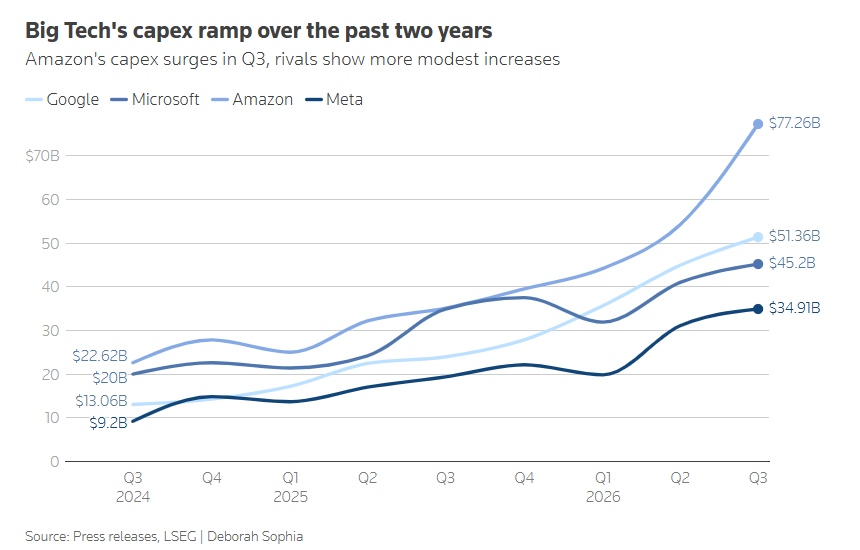
Furthermore, what worries the market even more is that the two tech giants look forward to continuing to increase their forward guidance in 2027. Neither company is signaling a slowdown in capital expenditure — Google's CFO clearly stated that capital spending will “increase significantly” in 2027, and the Amazon CEO also expects 2027 spending to “increase significantly” compared to 2026.
Amazon maintains $220 billion capital expenditure guidance and predicts a “significant increase” in 2027
Contrary to the market's expectations of “stepping on the brakes,” Amazon clearly maintained its cash capital expenditure guideline of about 220 billion US dollars for the full year of 2026 unchanged in its financial report. According to the XTB research report, given that Amazon has already spent a total of about 172 billion US dollars in the first three quarters, this full-year guideline means that capital expenditure for the fourth quarter will either drop sharply from 77.26 billion US dollars in the third quarter to about 48 billion US dollars, or the full-year guidance will be overspent. Therefore, the agency called this assumption “relatively conservative.”
CEO Andy Jassy told analysts on a conference call that he expects 2027 capital expenditure to be “significantly more” (significantly more) than 2026, while saying that Amazon “has a clear sense of obtaining attractive financial returns.” This statement is almost the same as the Google CFO's statement on a “significant increase” in capital expenditure in 2027.
At the same time, capital expenditure discipline among hyperscale cloud vendors is diverging. This week, another tech giant, Microsoft (MSFT.US), lowered its annual capital expenditure forecast from $175 billion to $170 billion. This fragmented pattern, combined with market anxiety triggered by Alphabet's collapse of more than 13% in a single day, is amplifying the question of “whether return on capital expenditure can be realized” from individual financial reporting events to sectorial variables affecting risk appetite throughout the AI infrastructure industry chain (chips, servers, electricity, data centers).
The structural background that needs to be added is that, according to Alphabet's financial report, its long-term debt has risen significantly from last year's low base; Amazon's long-term debt has also risen to 173.1 billion US dollars (about 65.6 billion US dollars last year), indicating that both companies have begun to use debt to support the capital requirements of the AI expansion period.
According to reports, Alphabet has disclosed future procurement commitments totaling more than 1 trillion US dollars (covering data centers, equipment, energy, etc.), and has restarted its first equity financing plan in decades, while suspending annual stock repurchases. This series of changes means that “cash-rich hyperscale cloud vendors” are collectively shifting to a “capital-intensive” business model, and the costs are gradually showing in cash flow and balance sheets.
The core of the market divide: Can AWS's “accelerated growth” cover “accelerated depreciation”
AWS is the only and brightest highlight of this financial report: revenue +39.3% year-on-year, operating profit of 17.8 billion US dollars, and operating profit margin improved to around 38.7%. In the earnings press release, Jassy emphasized that “our investment in AWS functionality and infrastructure is working” and expects the AWS revenue growth rate to “exceed 40%” in 2027 and 2028; at the same time, he proposed that AWS is expected to become a “trillion dollar revenue business” within the next five to ten years.
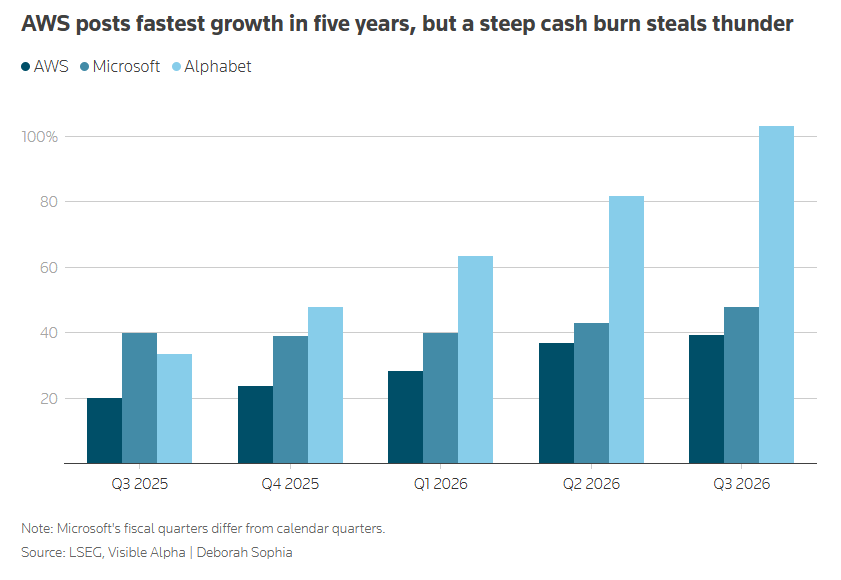
However, there are clear differences in the market's pricing. The essence of the difference is: Can the increase in AWS profit margins cover accelerated depreciation and amortization, as well as the continued rise in new capital expenses?
Morgan Stanley listed the tech giant as the preferred stock before Amazon's earnings report was announced. The target price was raised from $335 to $350, predicting that AWS revenue will grow 47% in 2027, 42% in 2028, and the AWS operating margin will rise to 42% in 2027 and 44% in 2028. UBS also raised its target price to $348, but at the same time raised Amazon's 2027 capital expenditure forecast to over 300 billion US dollars (originally about 250 billion US dollars), and clearly stated that higher spending “may cause free cash flow to zero or turn negative in 2027.”
In contrast, Emarketer analyst Sky Canaves pointed out that the accelerated growth of AWS “failed to meet raised expectations and fell below the higher competitive threshold set by Microsoft and Google,” and that the improvement in profit margins in the cloud sector “may not be enough to ease the market's concerns about a surge in capital expenditure and the resulting sharp drop in free cash flow.”
XTB financial market analyst Michał Jóźwiak believes that the market's response to selling pressure has been “exaggerated,” and that the AWS' 38.7% operating margin and quarterly operating profit of 17.8 billion US dollars, combined with management's continued guidance on AWS's high growth, provided a solid basis for “huge capital expenditure to eventually turn into profit growth.”
It is worth noting that in the various opinions mentioned above, even the most optimistic Morgan Stanley's bullish logic is based on the premise that “AWS revenue growth rate exceeds 40%”; while raising the target price, UBS just revealed the risk exposure of “negative free cash flow.” This shows that bullish on AWS and bearish on cash flow are not a logical contradiction, but rather two sides of the same coin — the essence of institutional disagreement is a judgment on the “capital expenditure return cycle” rather than a judgment on AWS demand itself.
Slowdown in retail and advertising: beyond Prime Day, consumer signals to be seen
In addition to the impact on cash flow, the slowdown in Amazon's retail and advertising business has also sparked discussions about US consumption.
Online sales were only +2% year over year to about 68.5 billion US dollars, lower than analysts' estimates of about 69.7 billion US dollars, the lowest increase since the beginning of 2023. Ad revenue was +11% year-on-year to US$19.64 billion, lower than agreed expectations, and the slowest growth rate since 2020 was separately disclosed.
Management and analysts disagree on the cause of the slowdown: Amazon attributed the main reason to the shifting effect of moving Prime Day from the third quarter to the second quarter; M Science analyst John Tomlinson believes that the relative weakness in retail is “likely” due in part to this schedule adjustment, which was a one-time disruption.
However, Emarketer analyst Sky Canaves has a different opinion, arguing that the Prime Day shift “does not fully explain the weakening growth of online stores and advertising”, which may indicate “as consumers reduce spending in places where they can save money, consumption pressure is becoming more obvious.”
The bleak guidance for the fourth quarter adds to this disagreement. Amazon expects net sales for the fourth quarter to be between US$240 billion and US$247 billion (up 12%-16% year over year), with a value of about US$243.5 billion, lower than Wall Street's estimate of US$244.5 billion; operating profit guidance is US$28.5 billion to US$33.5 billion. By contrast, the National Federation of Retailers (NRF) earlier this month still predicted a 4.2% year-on-year increase in total sales during the US holiday season. Whether Amazon's relatively cautious outlook for the holiday season is a lagging effect of the Prime Day shift or a leading sign of weakening margins in US consumption, it may still be necessary to use the fourth quarter implementation data as a verification anchor.
Taken together, Amazon's three-quarter report is essentially a “high profit, negative cash flow” split financial report: operating profit margin reached a record high, and AWS's growth rate was the fastest in the past five years, but free cash flow was negative at 42.4 billion US dollars, capital expenditure in a single quarter exceeded expectations of 77.26 billion US dollars, and it will “increase significantly” in 2027.
In the current environment, investors' choices are clear — the market values the latter more. This choice resonated with Google's sharp decline on October 29, amplifying the risk of “AI capital expenditure eating up cash flow” from a single company to questioning the entire hyperscale cloud vendor community. When Microsoft received a relatively positive response from investors due to lower capital expenditure guidelines, Amazon and Google's “bucking the trend” were interpreted by the market as greater uncertainty about returns.