


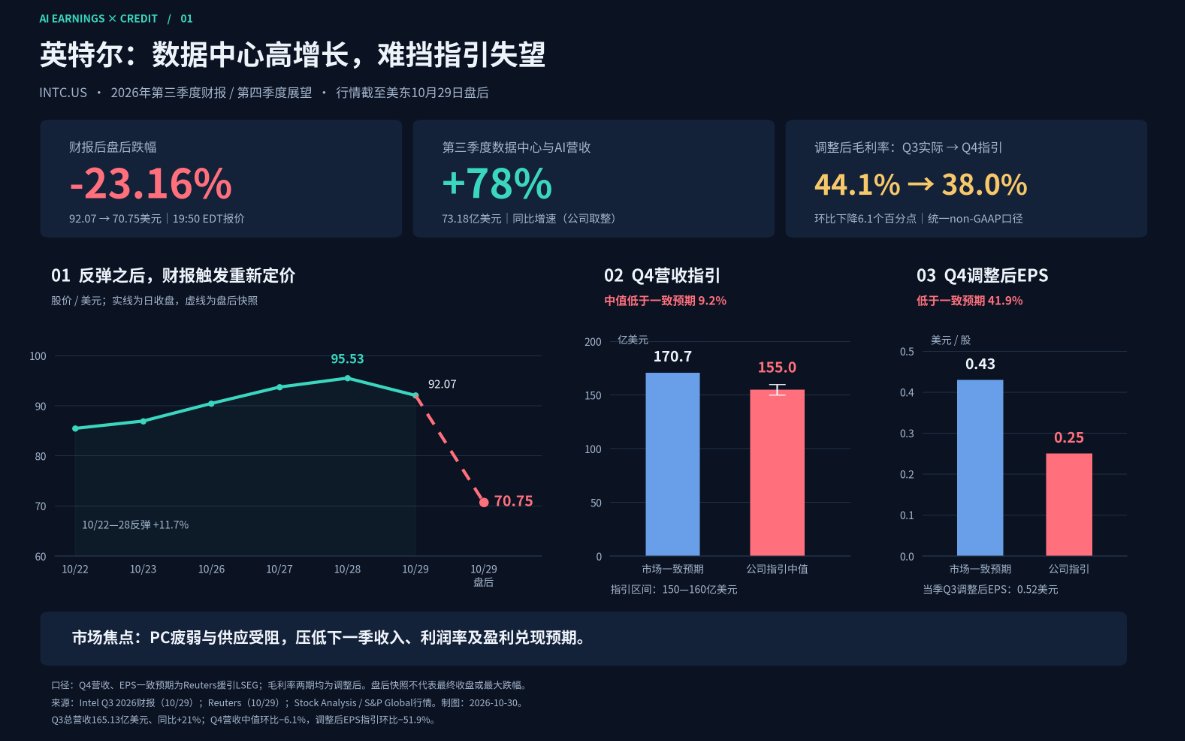
After Intel (INTC.US) announced clearly flawed earnings reports, the stock price plummeted more than 23% after the market. At the core of this revaluation is the expected gap between current growth and future profits: data center business revenue surged 78%, which still failed to offset the combined impact of significantly weakening revenue and profit margin guidance in the fourth quarter, sluggish PC demand, and limited supply chain of computing power.
The Zhitong Finance App learned that under the heavy pressure of AI financing costs and a record AI credit market sell-off storm, institutional investors such as Wall Street hedge funds turned negative on a large scale in the free cash flow of large cloud computing giants that can be called “the most core force in AI application revenue generation led by AI agents”, as well as factors that increased the scale of AI computing infrastructure related to AI computing infrastructure against the backdrop of surging AI financing costs, completely overshadowed the strong growth trajectory of Amazon's AWS cloud computing business and revenue related to Google Cloud Computing and Microsoft Azure cloud computing businesses The optimism brought about, such an extremely pessimistic market view began to form — that is, the core selling target of the AI computing power sell-off storm and AI bubble bursting arguments — the collapse of CoreWeave (CRWV.US) equity bonds was actually the first Domino that triggered the AI bubble to burst.
It is worth mentioning that Google's parent company Alphabet (GOOGL.US, GOOG.US) plummeted by more than 12% on Thursday, the biggest one-day decline since its launch in 2004. The market value evaporated by about 500 billion US dollars; Amazon also fell more than 10% after announcing strong growth in AWS. The core contradiction revealed by these sharp declines is that demand for AI computing power is still actively expanding, but the ability of enterprises to turn demand into delivery, profit, and free cash flow is becoming the basis for market repricing. The record-breaking sharp drop in the stock price of Google's parent company Alphabet and the sharp fall in Intel's after-market share price also occurred at a time when the cash return on AI investment was being scrutinized more strictly.
If CoreWeave, the leader in AI's new cloud, was the first to reveal the financing vulnerability of highly leveraged computing power expansion; Intel's latest financial report and performance outlook revealed the problems of strong demand, limited capacity expansion and computing power delivery chains, shrinking traditional businesses, and large-scale cash consumption in the context of AI computing power infrastructure expansion.
Intel's real alarm: the profitability of data center CPUs is accelerating, but the Group's cash return timeline is constantly being delayed
Intel did not “completely exceed expectations” in the third quarter like TSMC, Asmack, and Vertiv's AI computing power industry chain leaders: quarterly revenue of US$16.513 billion, up 21% year over year, basically in line with Reuters/LSEG's US$16.5 billion forecast; the adjusted EPS was US$0.52, compared to $0.23 the previous year, 30% higher than the $0.40 forecast. The adjusted gross profit margin was 44.1%, an increase of 4.1 percentage points over the previous year. The main negative in the market is the speed at which profits can be realized in the next phase, rather than the improvements already achieved this quarter.
DCAI, the data center and AI business, remains the strongest core of Intel's profit growth: the business unit's revenue was US$7.318 billion, up 77.8% year on year; operating profit was US$3,039 billion, up 215.2% year on year, and profit margin rose from 23.4% to 41.5%.
CCPG's client-side computing and physical AI business had revenue of US$8.097 billion, down 5.1% year on year, lower than LSEG's US$8.98 billion forecast of about 9.8%; operating profit of US$2,285 billion, down 15.2% year on year. The 35% increase in AI PC revenue is still insufficient to offset the contraction of the overall PC market. This means that Intel is experiencing server recovery and client decline at the same time. It is clearly inappropriate for some Wall Street analysts who have long been optimistic about Intel to use the “AI computing power infrastructure and AI intelligence frenzy beneficiary stocks” label to cover up the revenue structure.
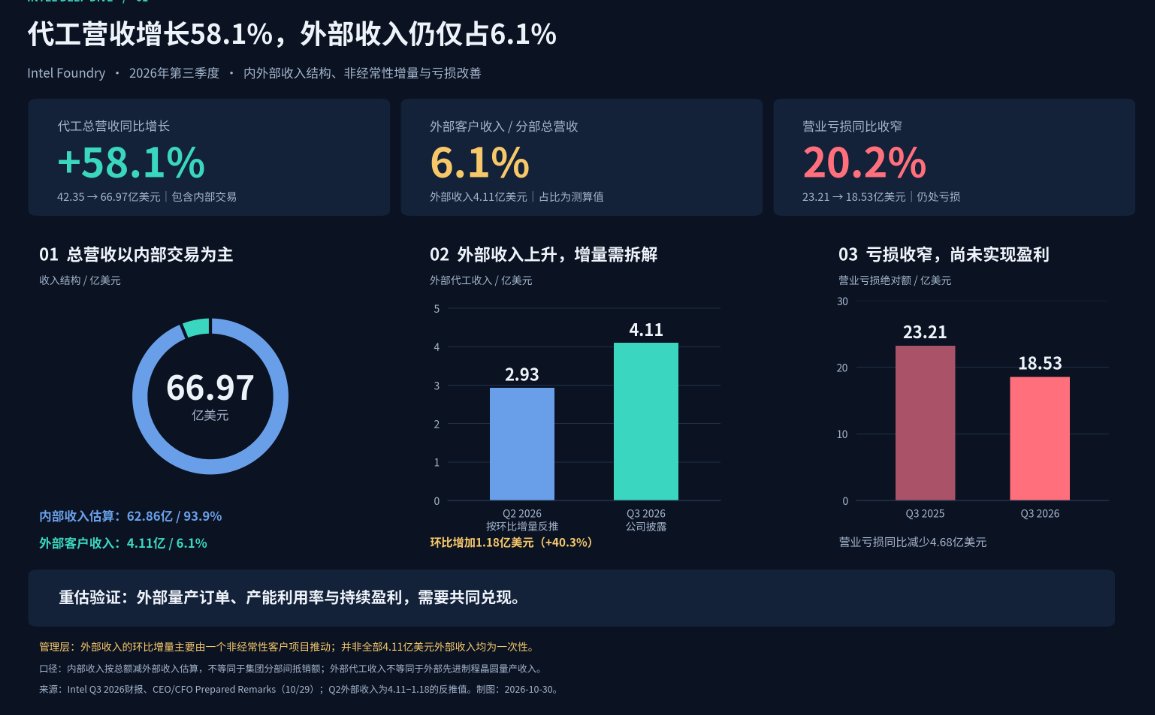
The OEM business revenue was US$6.697 billion, up 58.1% year on year, but included a large number of internal transactions; operating losses still reached US$1,853 million, although narrower than the previous year's US$2,321 billion. External customer revenue was only $411 million, and the month-on-month increase was mainly due to one-time customer projects. Therefore, the increase in total OEM revenue does not prove that the external business model has matured; what really supports the revaluation should be the simultaneous improvement of external mass production orders, capacity utilization, and continuous profit. The division's operating profit and reliable consistent expectations for the AI GPU independent business have not been publicly disclosed, so it is inappropriate to apply the Group's expected machinery to the business segment.
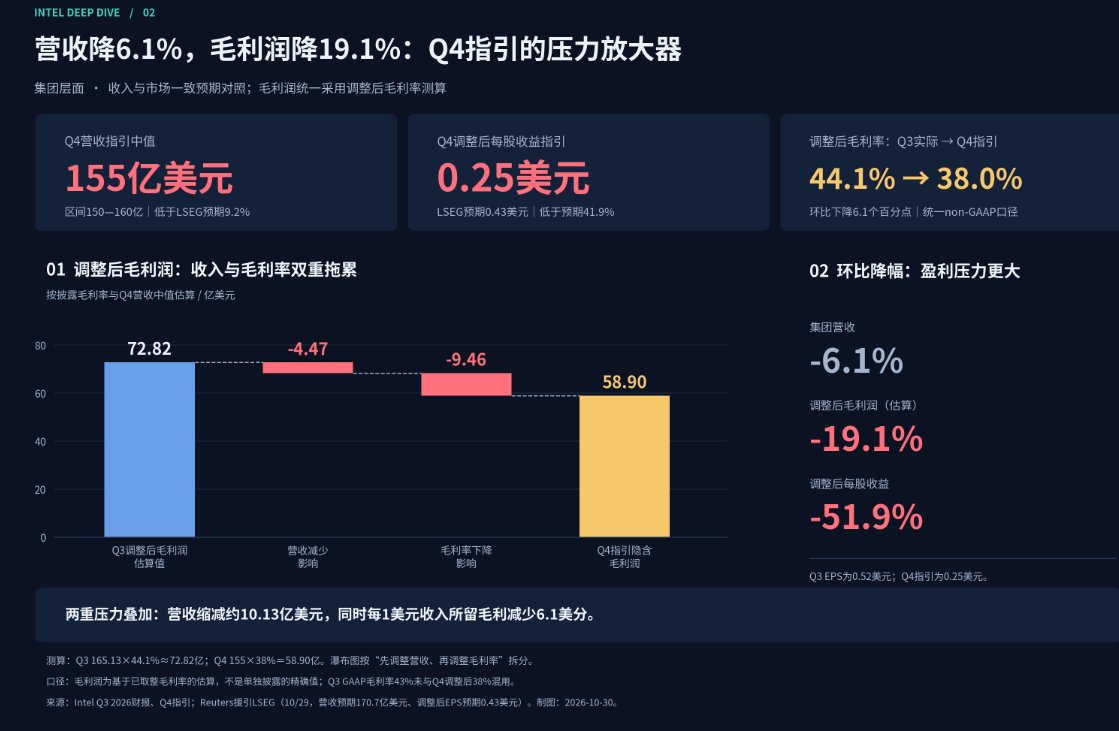
The fourth quarter guidance is the direct explanation for the sharp decline: revenue of US$15-16 billion, with a median value of US$15.5 billion, down about 6.1% from the third quarter and lower than LSEG's US$17.07 billion forecast of about 9.2%; the adjusted EPS was US$0.25, down 51.9% from the third quarter and lower than the US$0.43 forecast of about 41.9%. Gross margin should be uniformly compared to the adjusted caliber: 44.1% fell to 38%, which meant a significant decline of 6.1 percentage points. 43% of GAAP in the third quarter was a different caliber from 38% after the fourth quarter adjustment. Based on the median guideline calculation, quarterly gross profit will decrease by about 19% month-on-month, which is significantly faster than the decline in revenue, reflecting negative operating leverage under fixed costs.
The results call revealed a triple continuing squeeze. First, memory shortages and price increases drive up overall machine costs and reduce PC sales under limited IT budgets; the company expects the PC market to drop by about 12% in 2026 and another 10% in 2027. The weakness will continue until at least the first half of next year. CCPG revenue for the fourth quarter is expected to drop by more than 20% month-on-month. Second, the discontinuation of production of Israel's Fab 28 is expected to reduce revenue by about 300 million US dollars in the fourth quarter and the first quarter of next year, respectively, and drag down gross margin by about 2 percentage points in the fourth quarter; this is a loss in delivery, not a loss in customer demand. Third, although there are strong orders for high-performance hardware product lines associated with data center servers, supply constraints such as wafers and packaging substrates still limit shipments. DCAI's revenue for the fourth quarter is still expected to increase by about 15% month-on-month, but this cannot fully offset the decline in clients.
Nor are technological advancements an immediate solution to financial stress. The yield and cost improvements of the Intel 3 and 18A will help future profits, but PC production cuts have weakened fixed cost absorption, and the rapid growth of dedicated custom chip PBS has changed the product portfolio. PBS is not a data center power chip business; Intel's main AI exposure is still CPUs, accelerators, custom chips, advanced manufacturing processes, and packaging. D-series GPUs target memory-intensive reasoning and use LPDDR5X up to 480GB to try to improve deployment costs and energy efficiency; however, the company has not disclosed large-scale revenue, profit, or 2027 quantitative revenue guidelines that can be independently verified, and the overall growth of DCAI cannot be attributed to AI GPUs.
Cash flow determines how long the transformation will take. Operating cash flow for the third quarter was US$5.082 billion, minus capital expenditure of US$4.219 billion, and the simple-caliber free cash flow was approximately US$863 million; the company's adjusted free cash flow was US$1,639 million, which also included partner funding, government incentives, and financial lease payment adjustments. Capital expenditure in 2026 is about $20 billion, and 2027 will increase significantly. The CFO defines next year as an “investment year,” and it is expected that it will be difficult to achieve positive free cash flow. The company's approximately US$54 billion in cash and short-term investments provide a buffer, but buffer funds cannot replace long-term capital returns. The market's original deal was to accelerate the implementation of transformation results. Needless to say, Intel's latest financial report and guidance range can be described as further delaying this aggressive implementation timeline.
Why is the global AI computing power and semiconductor-themed rebound trajectory blocked once again: cloud revenue verifies demand, cash recovery redivides winners
The Federal Reserve maintained an interest rate range of 3.75% to 4% on October 28. Walsh said that the economy was not overheated and did not release aggressive hawkish signals that clearly exceeded expectations, but this did not eliminate the high interest rate expectations/10-year US Treasury yields, which are still near historic highs, a major funding cost constraint for capital-intensive AI projects. The Philadelphia Semiconductor Index, which has the title of “AI computing power trading weather vane”, rebounded for four consecutive days after plummeting 6.72% on October 22, with a cumulative recovery of 8.87% as of the 28th; the NASDAQ 100 index had a cumulative increase of 2.95% from the 26th to the 28th.
By Thursday, October 29, EST, the US stock market closed. Driven by a record sharp drop in Google's parent company Alphabet's stock price, the two fell by 1.42% and 1.38% respectively, ending four consecutive increases, and is still more than 20% lower than the mid-year high. As a result, the market experienced a restorative rebound driven by strong profits from the leaders in the AI computing power industry chain, which was then once again tested by rising AI financing costs and major tests on cash flow and performance guidelines.
Intel itself went through a similar process: a cumulative rebound of about 11.7% from October 22 to 28, and regular trading closed at 92.07 US dollars on the 29th; after the financial report was announced, it fell to 70.75 US dollars as of 19:15 EST and 7:15 Beijing time on the 30th, and the post-market decline widened to 23.16%. The direct trigger for such drastic adjustments was that fourth-quarter revenue, profit margins, and EPS guidelines fell short of expectations, while anxiety about AI financing greatly increased investors' sensitivity to execution flaws. Furthermore, it is important to note that the long-term weak PC demand and factory capacity accidents unique to the company cannot all be attributed to stock trading and credit market pressure associated with CoreWeave.
The financial reports of the three major cloud giants show that a sharp increase in revenue associated with AI can occur simultaneously with pressure on cash flow, but the extent is clearly different.
Google Cloud's third-quarter revenue was US$30.709 billion, up 103% year over year, exceeding expectations; operating margin rose to 36.2%. However, Alphabet's free cash flow for the quarter was negative $9.065 billion, with outflows for two consecutive quarters; search revenue growth of about 12% fell short of expectations. Furthermore, cloud growth includes revenue from overseas sales of TPU systems. Preparation first consumes working capital, improving order visibility and increasing pressure on capital turnover at the same time.
Microsoft's performance was the most stable: Azure's revenue was US$33.17 billion, up 48% year on year, exceeding expectations; free cash flow was about US$18.6 billion; its US$25 billion bond was unexpectedly subscribed to about US$115 billion, and its stock price fell only slightly by 0.16%. However, the lower capital expenditure than originally planned was due in part to delays in the delivery of production capacity by a third party, and should not be entirely due to efficiency improvements.
Amazon AWS's revenue was $45.984 billion, up 39.3% year over year; operating margin was 38.7%. However, free cash flow for the past 12 months was negative about 42.4 billion US dollars, and capital expenditure for the whole year is expected to be about 220 billion US dollars. Strong growth has not stopped the market from lowering its cash recovery expectations.
CoreWeave shares plummeted, and the credit market took the lead in showing red light
Free cash flow pressure from Alphabet and Amazon, combined with the ever-expanding financing needs of cloud giants such as Microsoft, is causing the market to pay more attention to the time gap between capital expenditure and cash recovery; the strong growth of Google Cloud, Azure, and AWS is no longer sufficient to support the valuations of all related companies alone.
Against the backdrop of a surge in energy costs catalyzed by the Middle East, Russia, and Ukraine geopolitics and the surge in AI financing costs, the AI debt issuance frenzy and AI financing costs are becoming more aggressive. Therefore, in the negative macro context of the AI industry chain where AI financing costs are high and some credit assets continue to be under pressure, a more destructive risk problem has emerged: Will the double death of CoreWeave's equity and debt become the first domino card to burst into the AI bubble?
For investors in the stock and bond market, the message they really need to be wary of is that tight financing forces computing power operators to postpone construction and procurement, which in turn reduces the profit expectations of suppliers, causing credit pressure to erode the expansion of the industry — disappointing Intel's own guidance does not prove that this chain has started, but it shows that the market's tolerance for “continued strong demand for AI computing power resources is enough to support expensive valuations” is declining.
The credit market, on the other hand, can be described as revealing in depth this fragmentation of the stock and debt market and the problems where demand for AI computing power continues to be strong, production capacity expansion and computing power delivery chains are limited, and large-scale cash consumption coexists in the context of business contraction that technology companies are proud of, and the expansion of AI computing power infrastructure. The financial market situation can be described as showing the tension of a major rebound in semiconductor-led technology stocks and the fragmentation and division of capital shown by the corporate credit bond market. The recent worsening geopolitical conflict between the Middle East, Russia, and Ukraine has led to a surge in energy costs and a surge in US bond yields, which in turn has catalyzed a surge in AI financing costs. This has also made the credit market more fearful about the AI credit storm and potential crises related to the “bursting of the AI bubble.”
Financing anxiety caused by CoreWeave's stock and debt slash is intertwined with the test of profit fulfillment in the AI industry chain. Intel's data center business grew rapidly, but was violently sold off due to supply constraints, weak PCs, and disappointing forward-looking guidance; some cloud giants are under pressure from expanding capital expenses and deteriorating free cash flow while cloud revenue is growing at an accelerated pace. Both types of shocks point to the problem that the market is repricing: no matter how strong the AI demand associated with AI computing power resources is, can companies complete deliveries in a timely manner and allow commercial repayments to catch up with capital investment and financing costs? If credit tightening further forces computing power operators to cut procurement, cracks on the financing side could be transmitted to upstream orders and profits — this is the truly lethal crisis logical framework behind the pessimistic pricing logic of “whether CoreWeave is the first domino driving the AI bubble to burst.”
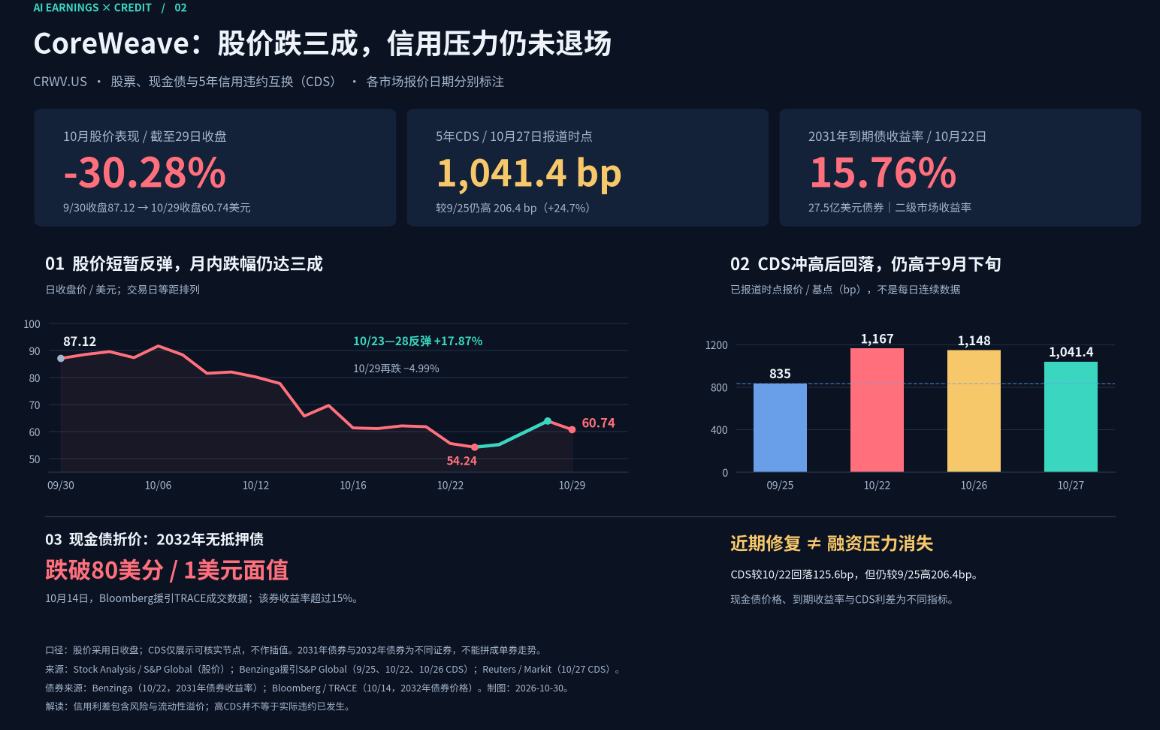
Against the backdrop of rising energy costs and US bond yields, the wave of bonds issued by AI companies is driving up financing costs. CoreWeave's 5-year CDS is about 1,148 basis points (with a 40% recovery rate implying a 5-year cumulative default probability of about 62%, including risk premium); the yield on its bonds due in 2031 is about 15.76%; SoftBank's 5-year CDS reached 432 basis points, and the coupon for newly issued US dollar bonds was as high as 9.75%.
The core mechanism behind the sharp decline in CoreWeave equity bonds and the surge in CDS interest spreads is that AI data center construction requires cash payment in advance, and computing power revenue is gradually formed with delivery; rising interest rates and credit spreads together will increase financing costs and reduce project returns. CoreWeave's current position is the first exposure point in AI financing risk reassessment, rather than the bursting of the bubble — evidence that the transmission chain (project delay → chip procurement slowdown → supplier profit decline) has not yet been fully launched, Microsoft's bond issuance has been oversubscribed, and the three major cloud businesses are still growing at an accelerated pace. However, it is worth being wary that the credit market may lose patience ahead of demand for computing power: once cash recovery cannot keep up with purchases and debt payments, growth will increasingly rely on external financing, and falling stock prices and credit contraction may cause negative feedback.