


Recently coincided with the Fed's interest rate meeting window. Although the overall market does not have the conditions for a systematic reversal, since it currently coincides with the ESMO annual meeting and the intensive disclosure of Q3 financial reports, the Hong Kong stock innovative drug sector is still expected to usher in structural opportunities after the fall.
Driven by sector beta, Tianchen Bio-B (01779) also experienced a sharp rise in a single day after a long absence.
After the bears' kinetic energy declines, when will the market stabilize?
There is no doubt about the short-term positive significance of the stock price surge on October 28 for Tianchen Biotech.
Since opening this year, Tianchen Biotech's stock price has increased markedly under the dual influence of market liquidity and fluctuations in the Hong Kong stock innovative drug sector. However, in recent months, when the Hong Kong stock innovative drug sector has once again entered a correction period, the PE (TTM) sector has once again returned to 28-30 times, at a very low ranking of 15% to 25% in history. It is not only lower than A-share innovative drugs (40-50 times), but also lower than the US biotech sector, with an adequate margin of valuation safety.
Under this influence, since September 24, although many of its swing indicators have entered the historical oversold zone, it has also made demand for a short-term technical rebound in Tianchen Biotech's stock price even stronger.
The recent “ignition” of the beta sector has made Tianchen Biotech's stock price tend to stabilize. On October 28, the Hong Kong stock innovative drug and CXO sectors collectively recovered, and the innovative drug purity index strengthened intraday. The corresponding ETF had a net inflow of about 100 million yuan in a single day during the pullback range.
The Zhitong Finance App observed that Tianchen Biotech's stock price opened higher in early trading on the same day, and the highest increase within 10 minutes of opening. Although the subsequent increase fell significantly, the stock price increase even fell back to less than 1% at one point after the afternoon session, but the strong rise before the final closing of 606 brought its stock price back to HK$60.95, and the increase was fixed at 7.59%.
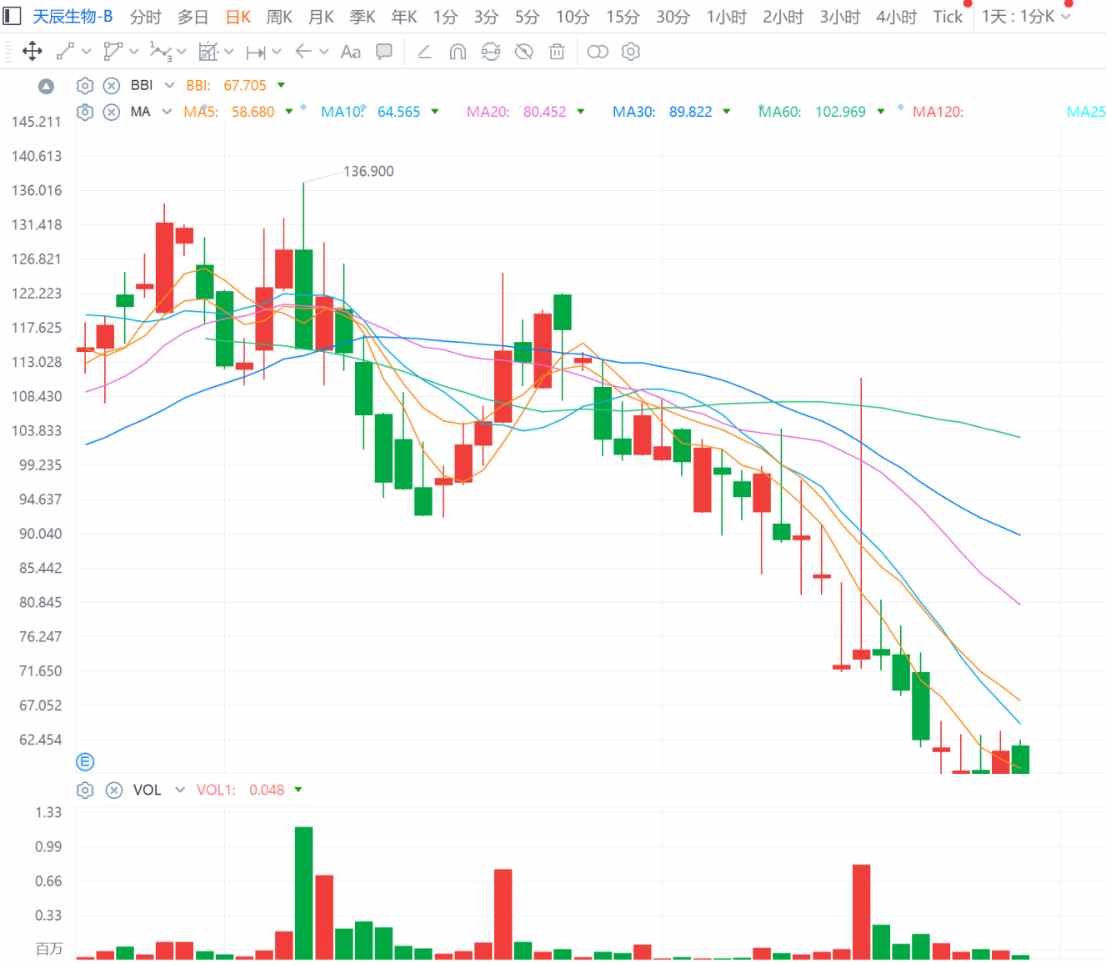
Although Tianchen Biotech's stock price fell again the next day after the sharp rise on October 28, the positive significance of its single-day rise was to confirm the “decline in bear momentum” trend.
From a technical point of view, in the market for the past month, Tianchen Biotech's market showed a typical bear-dominated market with a complete balance of bears, continuous OBV outflow, and extreme energy contraction. Even on October 16, there was a clear volume market and an extreme upward line. The sluggish mood in the market can be seen.
However, from October 28 to 29, thanks to sector beta, Tianchen Biotech returned to the 5-day EMA with a closing price of HK$60.95. The intraday stock price rose from a low point, showing a long-lost signal of stability. In terms of momentum indicators, although the MACD double line is still below the zero axis, the MACD bar has continuously converged in the past 5 trading days; on the RSI indicator, its RSI6 has fallen from 27.11 to 23.66, which indicates that Tianchen Biotech's stock price may be recovering from extreme overselling, and signals of “weakening downward momentum” have begun to appear.
Looking at it now, Tianchen Biotech's stock price surged on October 28. If the stock price of the former sky side can stabilize the 5-day EMA while recovering its intraday high of HK$63.35 on October 28 to further absorb the upward and downward pressure in the intraday market on October 28, Tianchen Biotech's stock price is expected to technically confirm a new round of stock price repair and rebound.
Topline data was read, but does the market place more importance on commercial implementation?
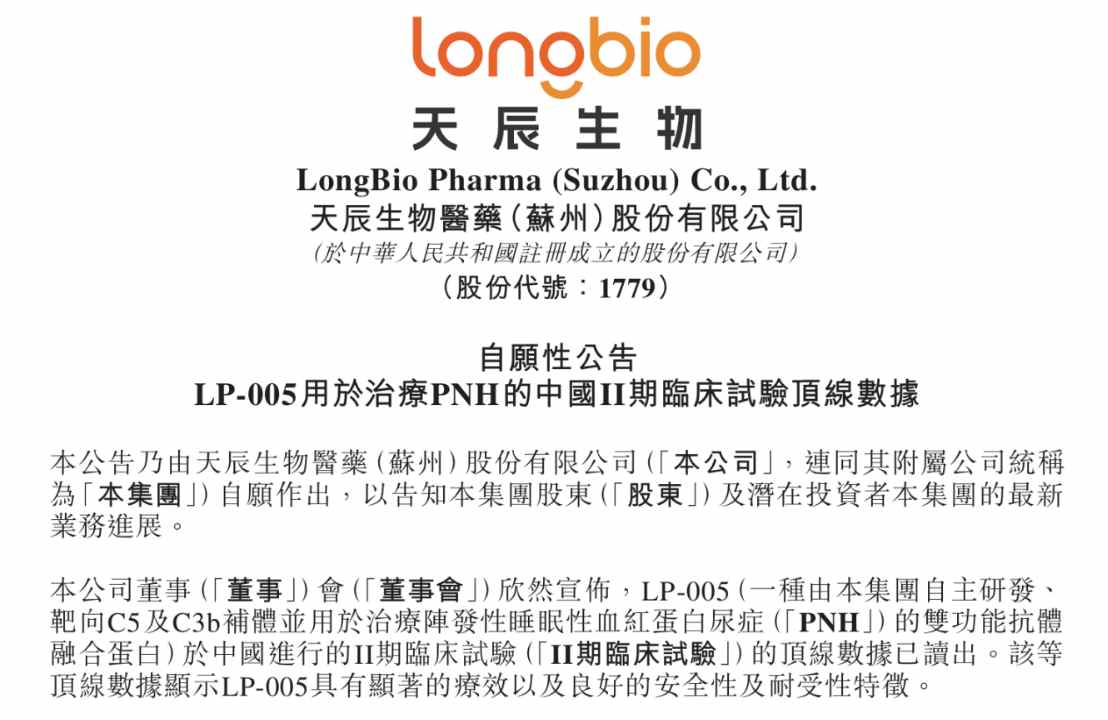
On October 21, Tianchen Biotech announced that its self-developed C5+C3b bifunctional antibody fusion protein LP-005 has read top-line data from the Chinese multi-center phase II clinical trial for the treatment of paroxysmal nocturnal hemoglobinuria (PNH).
According to the Zhitong Finance App, this study was a multi-center, randomized, open label design, with three dose groups of 900 mg, 1200 mg, and 1500 mg, with intravenous infusion every 4 weeks (Q4W), for a total course of treatment of 48 weeks; the main endpoints were changes in serum lactate dehydrogenase (LDH) relative to baseline after 12 weeks of use, and the proportion of patients who did not need blood transfusions and hemoglobin (Hb) increased by ≥2 g/dL from baseline at 24 weeks. A total of 30 patients with PNH were enrolled, and 27 patients completed 24 weeks of treatment.
The study showed that in this study, the 12-week hemolysis control rate (LDH<1.5 × ULN) in the 1200 mg and 1500 mg dose groups reached 100%, showing significant curative effect of not losing first-tier drugs; while the three-dose group had a blood transfusion avoidance rate of 100% and no breakthrough hemolysis; 85.7% (6/7) patients in the 1500 mg group achieved a hemoglobin increase of ≥2 g/dL in 24 weeks without blood transfusions.
In terms of safety, no treatment-related serious adverse events (SAEs) were reported in this study. Overall, LP-005 shows good safety and tolerability characteristics.
In response, Guojin Securities released a research report stating that in a non-head-to-head comparison, the performance of the LP-005 clinical data shown by Tianchen Biotech this time is basically similar to Novartis IPTACopan's APPOINT-PNH study (92%/63%), which is a benchmark for the “near-port single drug administration” route in the field of PNH indications, and that LP-005 also has the convenience advantage of Q4W intravenous administration.
According to the research report, competition for complementary drugs is extending from single-target blocking to multi-node intervention, and LP-005's C3b/C5 dual-target layout has potential for differentiation. Currently, LP-005 is expanding complement-mediated nephropathy and periodontitis. Phase II of lupus nephritis, anti-glomerular basement membrane nephritis, and thrombotic microvascular disease has already been carried out, and it is expected that data will be read out one after another. Based on the above reasons, although Guojin Securities did not give a target price in this research report, it maintained the “buy” rating of Tianchen Biotech.
However, on the other hand, the market's competitive pattern for supplementary tracks has actually been priced for a long time. Guojin Securities suggested in a research report that Jasper's KP104 is also a bifunctional complement molecule. If IgA nephropathy data is positive at the end of the year, it may drive the market's attention to bifunctional complement molecules. In other words, if the competition data is stronger, it will weaken LP-005's subsequent scarcity expectations to a certain extent.
Judging from the performance of the secondary market after October 21, it is clear that market traders have yet to trade the positive impact of LP-005's top-line data. This is probably because the beta market in this round coincided with the end of the ESMO annual meeting and the intensive disclosure of the three quarterly reports. The launch of the innovative drug sector was mainly supported by the dual support of incident catalysis and performance verification. In other words, the core of investors' pricing of innovative drug brands is still in terms of commercialization.
For Tianchen Biotech, the pace of commercialization of its LP-003 anti-IgE antibody is the company's core pricing anchor at this stage. According to the Zhitong Finance App, on August 20 of this year, the CDE official website showed that Tianchen Biotech's self-developed LP-003 injection was officially accepted. The declared indication was seasonal allergic rhinitis (SAR). This is also Tianchen Biotech's first Class 1 innovative biopharmaceutical to be commercialized.
As an anti-IgE antibody with a novel sequence design, LP-003 mainly binds free IgE in blood and tissue with high affinity, blocks its binding to the high affinity receptor FcepsilRI, and blocks IgE-mediated allergic cascading reactions at the source. CSU II head-to-head data is superior to omalizumab, which further strengthens the logic that LP-003 has potential for differentiation.
From a market perspective, allergic rhinitis is a non-infectious chronic inflammation of the nasal mucosa. The number of patients in China has exceeded 246 million. Although nasal glucocorticoids and second-generation antihistamines are first-line standard treatments, about 60% of moderate to severe patients still face poor efficacy, so there is a huge unmet clinical need.
If successfully approved, LP-003 will become the first innovative anti-IgE antibody drug to be marketed in the world in more than 20 years since omalizumab was approved, directly leveraging the huge domestic allergy treatment market. Recent institutional opinions also emphasized that LP-003 has BIC potential, and indicated that the company's revenue elasticity after 2027 comes from commercializing LP-003.
Therefore, the progress of LP-003's BLA review and subsequent commercialization may be an important catalytic factor that is expected to drive Tianchen Biotech's stock price from steady recovery to reversal in the short term.