


The Zhitong Finance App learned that according to a recent research report released by Metals Focus, an independent precious metals consulting agency headquartered in London, England, shows that gold and silver are both under significant selling pressure brought about by high interest rates and rising US bond yields, yet silver is also facing additional drag from weakening investment demand and a recovery in usable physical inventory, so it may continue to outperform gold.
Metals Focus analysts emphasized in the research report that as the physical market weakens, the price trend of silver compared to gold may further weaken. Gold held a key support level of around $4,000 per ounce, but silver has fallen to a low point during the year. Metals Focus analysts said on Thursday that weakening investment demand and improved liquidity in the physical market are suppressing prices, and silver may face further selling pressure.
Metals Focus said in its latest precious metals report that silver's poor performance has pushed the gold-silver ratio to 76 points for the first time since December last year and briefly above that point, higher than the 60-70 range where it was for most of this summer. Although the ratio is still below the average of 82 between 2020 and 2025, analysts from the agency believe there is room for further growth in the gold-silver ratio as silver continues to face significant adverse factors.
According to the report, central bank purchases and allocations made by long-term investors to prevent geopolitical and macroeconomic uncertainty have helped support the price of gold; in contrast, silver is more susceptible to industrial demand and speculative investment capital flows.
Metals Focus said that the serious liquidity constraints that drove silver to record highs in 2025 and early 2026 have now largely subsided. The agency pointed out that by the end of September, the London Treasury's silver inventory had increased to 932 million ounces, the highest level in nearly four years.
Analysts said more importantly, usable inventory after excluding metals held by physical support ETFs has increased to 267 million ounces, nearly double the October 2025 low.
On Thursday, US GDP data was stronger than expected and the Federal Reserve's favorite inflation data — the core PCE inflation data is still near recent highs, strengthening the market's expectations that US interest rates and the 10-year US Treasury yield curve will continue to rise in the future, and gold and silver futures will fall accordingly.
Tadeu dos Santos, a senior analyst from Infinox, said in a report: “The market continues to incorporate interest rate hikes in December and further tightening policies after the end of the year in pricing, which supports yields and puts pressure on gold.” He also added: “Higher oil prices continue to drive inflation and may further strengthen restrictive monetary policies.”
Gold holds $4,000 and still has not maintained confidence at the bottom: expectations of the Fed's interest rate hike suppress room for a rebound
Gold purchases and long-term safe-haven allocations by central banks around the world provide a more stable demand base for gold compared to silver; however, the cautious opinions of J.P. Morgan Private Bank and UBS precious metals sales desks suggest that buying around $4,000 is not enough proof that the price of gold has been adjusted. What is currently lacking in the market is a continuous driving force formed by expectations that interest rates will peak and financial investors re-increase their positions.
In terms of the latest dynamic data on gold prices and silver prices, recent gold trends reflect this pattern of “acceptance and weak rebound” — gold prices plummeted on October 22, falling below $4,000 in the market on the 23rd, hitting a three-month low; despite subsequent repairs, COMEX's November gold futures fell 0.5% on the 29th, settled at 4017.70 US dollars per ounce. On Friday (October 30), gold spot prices in the Asian market fell below the 4,000 US dollar mark. Currently, it is hovering around 4004 and 4005 US dollars. On the same day of October 29, November silver futures fell 2.4% to $52.191, setting the lowest settlement price since November 25, 2025. Gold is still repeatedly contending for a critical threshold, while silver is already looking further downward for support.
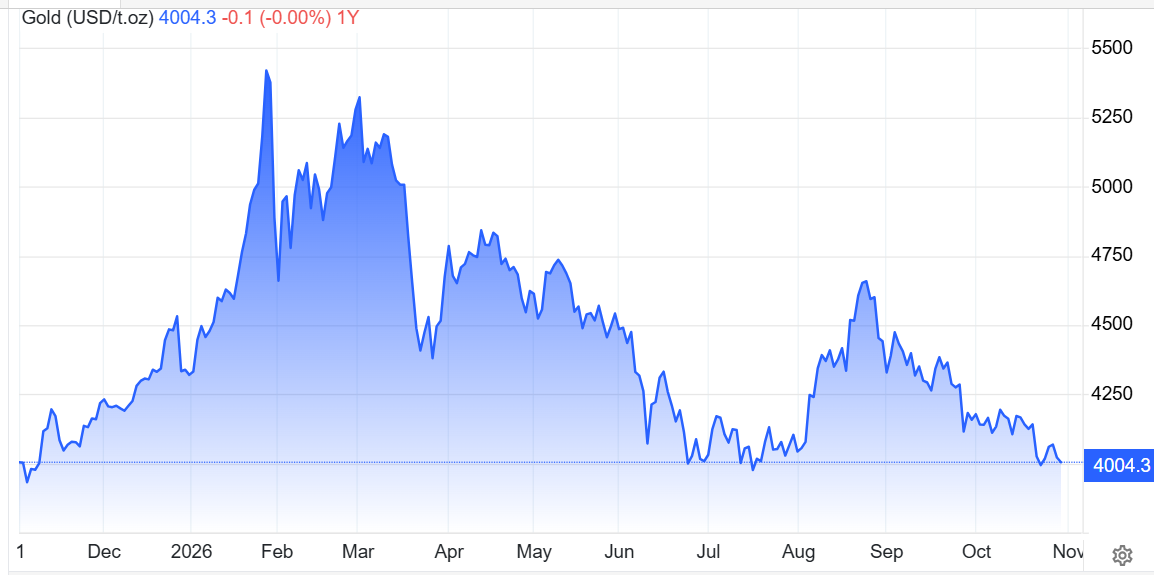
Macro restraints did not go away with the Federal Reserve's suspension of interest rate hikes. On October 28, the Federal Reserve kept the policy interest rate at 3.75% — 4%; it was later announced that the real GDP of the US for the third quarter increased by 3.4% month-on-month, up from 2.2% in the second quarter. Economic resilience compounded energy inflation, making the market likely to continue trading further in December and beyond. As far as gold is concerned, the safe-haven and inflation-hedging demand brought about by rising oil prices may be partially offset by higher interest rates, stronger dollars, and financing holding costs; especially when policy tightening pushes up real interest rates and the yield on long-term US bonds of 10 years or more, the relative appeal of unpaid gold will be suppressed.
The cautious judgment of Yuxuan Tang, head of Asian interest rate and foreign exchange strategy at J.P. Morgan Chase Private Bank, is based on the fact that peak interest rates have not yet been clarified. It expects the Federal Reserve to continue to raise interest rates in December and the first quarter of 2027, and the 10-year US Treasury yield may reach 5.25% to 5.5% in mid-2027. Therefore, it is believed that the bottom of the gold is still difficult to confirm, and the technical undertakings below $4,000 are weak. According to J.P. Morgan Chase, it is not necessary to wait until the last interest rate hike is completed before buying, but the logic of careful allocation of gold falls into place — as long as the market continues to raise the peak yield and delay the peak, it is easy for gold to rebound under new opportunity cost pressure.
The UBS Precious Metals Sales Desk explained why the rebound has been slow to continue in terms of financial behavior: as the end of the year approaches, more customers tend to protect their annual earnings and are less willing to take the initiative to increase risk exposure; at the same time, strong physical gold purchases from central banks around the world, such as the Central Bank of China, still provide support. Although Jason Perl, senior precious metals technical analyst at UBS, has turned bullish, his repair path needs to break through $4082.80 to further open up space to about $4,400; technical levels such as 3975.75, 3923.24, and $3870.74 are still listed below.
Is silver losing its “scarce premium”? Inventory return and capital withdrawal are under double pressure
The changes that silver is currently facing are not only following the decline in gold, but the physical tension that previously supported prices is easing. Metals Focus notes that the London Treasury's silver inventory reached 932 million ounces by the end of September, the highest in nearly four years; the London Bullion Market Association (LBMA) officially announced 28,985 tons, an increase of 1.95% over the previous month, in line with this amount. More importantly, Metals Focus estimates that usable inventory after excluding physical support ETF holdings increased to around 267 million ounces, nearly double the October 2025 low.
The “improvement in physical market liquidity” here means that metals that can be traded, leased, or delivered are easier to obtain, and it does not mean that the financial system's financing environment has become looser. As ETF holdings are reduced and inventories flow back to the trading market, even if mine production does not increase rapidly at the same time, marginal usable supply may increase, weakening the price premium caused by lack of spot and tight positions. Excluding ETFs, inventory may still include metals from other long-term holders, and not all of them can be considered for immediate sale, but in terms of direction, it does mean that the level of supply tension has decreased previously.
Weakening investment demand is reinforcing this process. Metals Focus predicts that global physically-backed silver exchange-traded products (ETP) positions have declined by about 60 million ounces since the beginning of the year. Capital withdrawals not only weaken financial purchases, but may also release metals previously held by investment products. At the same time, high prices push industrial customers to reduce the amount of silver used per product or use alternative materials, and the photovoltaic sector is particularly noteworthy. The agency anticipates that the silver supply and demand gap will narrow further this year and may turn into a supply surplus in 2027.
As a result, the gold-silver ratio (Gold-Silver Ratio) broke through 76, which is more reflective of current market choices than simply observing the decline in silver prices: in the face of common interest rate pressure, investors are more willing to pay a premium on the monetary attributes of gold and central bank demand, while silver is also affected by changes in industrial demand, speculative capital, and physical inventories. The average ratio of gold to silver from 2020 to 2025 is only a historical reference; it is not inevitable that it will return to the target; the gold-silver ratio continues to rise, and it is also entirely possible that it will occur in an environment where gold and silver fall at the same time, and silver falls more at the same time.
According to the Metals Focus analyst team, gold has a relative defensive advantage, but trend reversals still require improvements in interest rate expectations and capital flows; silver also has to wait for investment demand to return and inventory pressure to ease in order to enhance the sustainability of the rebound. Treating silver as “gold that has dropped more and is therefore cheaper,” it is easy to overlook the demand structure where the two are diverging.