


The Zhitong Finance App learned that during the Asian trading session on Friday, the rise in US Treasury bonds further accelerated. Technology stocks in the US and even the global stock market, including AI computing power leaders and the semiconductor sector, were sold off on a large scale, driving global investors to actively turn to US government bonds to seek safe havens. US bond yields fell by at least 2 basis points across the board, continuing the downward trend during the New York trading session. Australian, Japanese, and New Zealand bonds followed the rise, and the yield on their respective benchmark 10-year treasury bonds fell by about 5 basis points.
The disappointing performance and future prospects of big tech giants focusing on the AI cloud computing field, such as Google's parent company Alphabet and Amazon, have greatly strengthened the market's doubts about AI trading topics and pessimistic stance that the AI bubble is about to burst, driving the accelerated flow of safe-haven funds; at the same time, Binance, the world's largest cryptocurrency exchange, is suspected to have been hacked, further increasing risk aversion. The benchmark treasury yield index for the US Treasury bond market (that is, the 10-year US Treasury yield index with the title of “the anchor of global asset pricing”) has dropped sharply by nearly 40 basis points in October, and is expected to record the first significant decline in monthly levels since February.
Kenneth Crompton, head of interest rate strategy at the National Bank of Australia in Sydney, said: “After technology companies announced their results this week, a new round of risk aversion once again drove bonds up and yields down this morning.”
During the Asian market trading session on Friday, NASDAQ futures in the US stock market extended to more than 2%. Amazon and Intel's US stocks fell 7.7% and 23% respectively in night trading, Nvidia fell 2.5% in night trading, Micron Technology fell 4.4%, and Oracle fell 4%. Intel's nighttime decline was as high as 23%. As of press release, South Korea's KOSPI Index, with the two major memory chip giants SK Hynix and Samsung as the main weight (over 50% weight), fell more than 5.6%, and the Korea Exchange initiated a side car mechanism against the KOSPI index during the intraday period; the Nikkei 225 index fell nearly 3%.
As shown in the chart below, US Treasury bonds are expected to have the best monthly return since February 2025. The US Treasury Index, a Bloomberg benchmark that tracks returns in the US Treasury bond market, rose 2% in October and is expected to record the biggest monthly increase since February 2025.
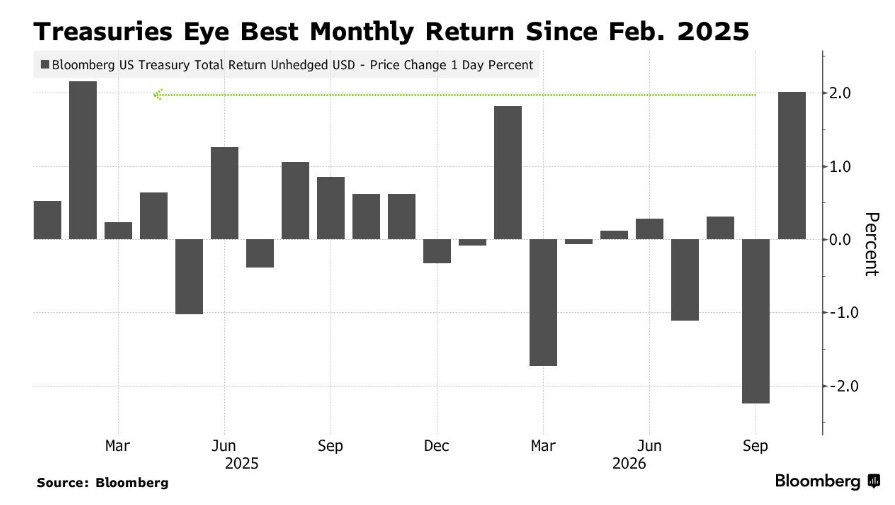
The worsening market sentiment towards AI-related stocks over the past month has been the main catalytic factor driving the rise in US government bonds. Federal Reserve Chairman Kevin Walsh said that future interest rate decisions will depend on economic data released later rather than setting any hawkish path. This statement also provides firm bullish support for short-term US bond price increases.
Traders are keeping a close eye on the policy outlook. Although high energy costs have increased price pressure, the Federal Reserve and the New Zealand Federal Reserve have yet to raise interest rates this week, and traders are unanimously betting that the Bank of Japan will follow the Federal Reserve and choose to stay on hold.
As the US midterm elections approach, the bond market faces another looming risk. Investors are increasingly skeptical that a possible renewed political impasse in Congress will ease their concerns about the direction of US finance, as in the past few decades.
The day after the election, the US Treasury will announce the quarterly refinancing plan. The market believes this will lay the foundation for any major debt management policy adjustments.
However, the current focus of the market is still on the sell-off of technology stocks: investors are increasingly skeptical that huge AI spending will bring sufficient profit growth to support current valuations.
Andrew Tyshurst, senior interest rate strategist at Nomura Holdings in Sydney, said: “The market continues to worry about the valuations of hyperscale cloud service providers, and the extremely disappointing results recently announced by Alphabet, Amazon, and Intel are driving some safe-haven funds into the bond market.”
He said the bond rally is likely to continue because “we don't think Walsh was particularly hawkish at the post-conference press conference, and it seems like these AI-related concerns will continue.”
AI transactions are under pressure, and the US bond market quickly takes over: global capital flows are beginning to definitively reprice cash flow
At a time when AI computing power and semiconductor stocks were being sold off, US Treasury bonds once again showed the safe-haven value of the combination. Technology investors are re-evaluating the payback cycle of huge capital expenses, while some of the capital is shifting to government bonds with high liquidity and relatively determined cash flow. During the Asian trading session on October 30, US bonds continued to rise, and the 10-year yield fell to about 4.90%; Australian, Japanese, and New Zealand treasury bonds strengthened simultaneously, reflecting that this round of safe-haven demand has surpassed the US market.
Bloomberg bond market statistics show that in early Asian trading, the yield on each term of US bonds fell by at least 2 basis points, while the yield on 10-year treasury bonds of Australia, Japan, and the three new countries each fell by about 5 basis points. The yield on US benchmark treasury bonds fell by a cumulative total of nearly 40 basis points in October, and is expected to record the first monthly decline since February this year; at the same time, the Bloomberg US Treasury yield index rose by about 2% in the same month, which is expected to be the best monthly performance since February 2025. The former measures changes in yield, and the latter measures return on bond investment. Both sets of data indicate that US bonds are absorbing strong safe-haven demand brought about by declining risk appetite in technology stocks.
The key to this round of asset rotation is that the market is beginning to differentiate between “growth in AI demand” and “cash returns that investors can obtain.” Looking at industrial mechanisms, cloud revenue growth requires server delivery, data center power supply, network interconnection, actual utilization rate improvement, and customer repayment before it can be converted into cash flow covering construction expenses and financing costs. Orders for GPUs, HBM, and liquid cooling equipment are strong, which can prove that construction demand exists, but it cannot be proven that the return on capital for each project alone is sufficient to cover capital costs. As investors increase their requirements for cash flow fulfillment, stock valuations and corporate credit risk compensation may be under pressure at the same time, while treasury bonds receive safe-haven funding support.
This also explains why the decline in technology stocks can occur at the same time as the rise in US debt: the market reduces the level of trust in companies' forward profits and financing capabilities, while part of the increase in capital is allocated to government bonds. US bonds have resumed their role in hedging stock pullbacks in this round of adjustments, but this ability to protect still depends on the source of the shock — profit and credit concerns are generally conducive to safe-haven purchases, and once again uncontrolled energy inflation may depress the prices of stocks and long-term bonds at the same time.
US Treasury Secretary Bezent appeased financing, and the market is still picking risks: Can rising US debt reduce AI costs?
There is no inevitable contradiction between Bezent's latest views and market transactions. He emphasized that new cloud enterprises are only part of the AI ecosystem, that financing transactions are still being implemented, and he used Meta's use of equity financing as an example to show that the capital market can still fund construction. The answer here is “whether financing channels are still in operation”; when investors reduce their holdings of technology stocks and buy US bonds, the assessment is “whether the current price is sufficient to cover profits, cash flow, and credit risk.” Being able to complete financing does not automatically mean that financing is cheap, nor does it mean that all projects will receive sufficient returns.
In terms of financing mechanisms, the pricing of new corporate bonds usually includes a benchmark interest rate for the same period, as well as compensation for risks such as credit and liquidity. Therefore, falling US bond yields can reduce the benchmark portion of financing costs, but if the credit spreads of companies such as CoreWeave widen faster, their comprehensive financing costs may still rise. For cloud giants that operate with abundant cash flow, the pressure is more reflected in return thresholds for new investments and discounted equity valuations; for new cloud companies that rely on continuous external financing, the pressure will also directly affect construction progress, equipment procurement, and refinancing capabilities. As a result, the strengthening of US debt may first reflect capital risk aversion rather than an overall improvement in the AI financing environment.
The Federal Reserve's suspension provided room for bond buying without announcing the end of austerity. On October 28, the Federal Reserve maintained the federal funds rate target range of 3.75% to 4% at 10-2. Two opponents advocated a 25 basis point increase in interest rates. Walsh acknowledged that financial and credit conditions faced by some businesses and households have been tightened, while stressing that overall financial conditions cannot still be called tight, and that follow-up policies require more information. This supports the judgment that “no additional aggressive hawkish signals have been released that the market is concerned,” but it is not enough to deduce that interest rate cuts are imminent.
Bezent's judgment on energy corresponds to another favorable path that is likely to last longer: if the geographical conflict eases and oil supply is restored to sufficient, inflation and borrowing costs are expected to fall. At the same time, he said that raising interest rates again in the future will not necessarily constitute a policy mistake. Taken together, the two statements mean that the Ministry of Finance's optimistic expectations are mainly based on economic resilience and energy pressure relief, and do not rely on immediate relaxation of monetary policy to support asset prices.
As far as investment allocation is concerned, the long-term term of treasury bonds and corporate credit need to be judged separately: holding treasury bonds can participate in price increases caused by falling yields, and buying AI corporate bonds also requires taking the risk that credit spreads will continue to widen. In the next phase, long-term US bonds will also face financial expectations after the midterm elections and the issuance schedule revealed in the November 4 quarterly refinancing announcement. Safe-haven demand can support current debt prices, but long-term supply, the record pace of expansion of long-term fiscal deficits, and the risk of inflation will still affect the term premiums required by investors.