


The Zhitong Finance App learned that during the Asian midday trading session on Friday, the Bank of Japan followed the pace of monetary policy of the Federal Reserve and the European Central Bank and kept the benchmark interest rate unchanged. At the same time, the Bank of Japan stated for the first time in an official monetary policy statement that basic inflation had reached the 2% target. This milestone can be described as opening the door for a return to the interest rate hike process as soon as December and the normalization of future policy interest rate paths.
According to a statement from the Bank of Japan, the central bank kept the policy interest rate at 1.25% during the two-day meeting that ended on Friday. All economists covered by the major financial institutions' surveys had previously predicted this result of keeping interest rates unchanged.
Achieving the inflation target means that the Bank of Japan now needs to shift from driving inflation up to ensuring that inflation does not exceed the target level. The Bank of Japan said it was “essential” to keep inflation close to current levels in the future, while warning that underlying inflation risks deviating from the target upward. Considering the risk of rising inflation, more than 80% of the economists surveyed expect the Bank of Japan to raise interest rates again in December.
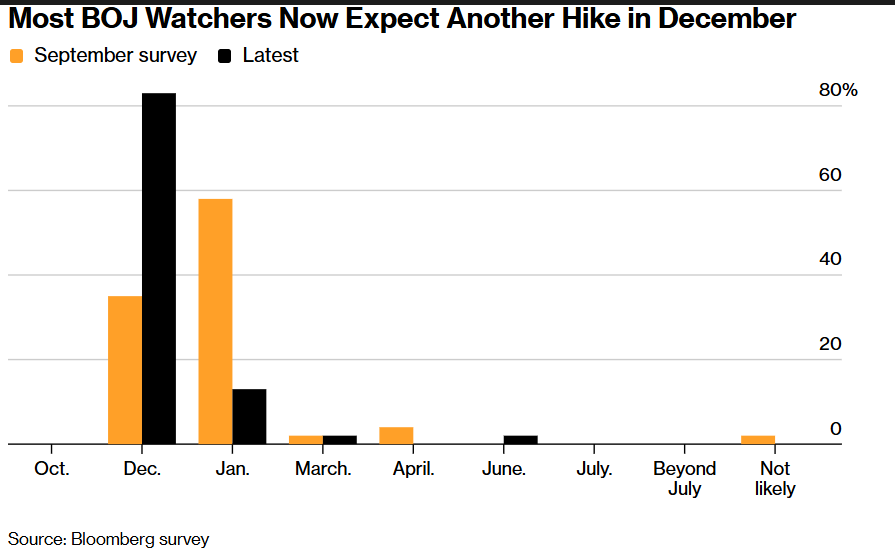
As shown in the chart above, most senior Bank of Japan observers currently expect the Bank of Japan to raise interest rates again in December.
Junya Takemoto, senior economist at Sumitomo Mitsui Banking Corporation, said, “At Ueda's press conference this afternoon, given that the market's expectations for December interest rate hikes are already so strong, I wanted to see if the Bank of Japan will reinforce these expectations or maintain a neutral position. In the past, Ueda said at a press conference that the Bank of Japan will closely evaluate the development of the situation before the next meeting.
The Bank of Japan also said that starting in January, it will increase the sales rate of its exchange-traded funds to nearly three times the original rate. It is expected to sell about 860 billion yen, or about 5.5 billion US dollars, every year. The bank said it would take about 43 years to complete this process, and at the previous pace of sales, it would take more than 110 years.
The yen appreciated from 157.52 yen to 1 US dollar before the resolution was announced to about 157.12 yen to 1 US dollar.
Market focus is now turning to a press conference scheduled for around 3:30 p.m. local time by the governor, Kazuo Ueda. Investors will carefully look for guidance on the next rate hike, as well as any clues as to how high interest rates will eventually rise during this austerity cycle.
The Bank of Japan was the last of the three major central banks that met this week to announce a resolution, and both the Federal Reserve and the European Central Bank kept interest rates unchanged. Last month, the three central banks raised interest rates simultaneously for the first time.
As far as the Bank of Japan is concerned, raising interest rates for two consecutive sessions will be an unprecedented move in this century, and may frighten the market. Japan's benchmark interest rate is at its highest level in 31 years, although it is still low compared to other G7 members.
According to the Bank of Japan's monetary policy statement, the current interest rate decision was passed 8-1, and Takada Venture voted against it and advocated raising interest rates. After raising interest rates for three months in June, the Bank of Japan raised borrowing costs again on September 18, marking the shortest interval of interest rate hikes since 1990.
After the Bank of Japan kept interest rates unchanged, the yen can be described as rapidly expanding its gains against the US dollar. The Bank of Japan kept interest rates unchanged as scheduled, and the yen increased against the US dollar after indicating for the first time that underlying inflation had reached 2%.
After members of the Bank of Japan's monetary policy committee voted 8-1 to pass the decision to keep interest rates unchanged, the yen rose 0.4% to 157.12 yen against the US dollar. All 53 Japanese economists covered by the Bloomberg survey had previously expected the Bank of Japan to make this decision.
This trend occurred when the global market turned to safe-haven assets on Friday. Technology stocks fell on the same day, and oil prices rose. The yen has shown signs of returning to its traditional safe-haven role. Many years before, during periods of market pressure, large interest rate gaps and Japan's large-scale overseas investment flows had an impact on the yen exceeding safe-haven demand.
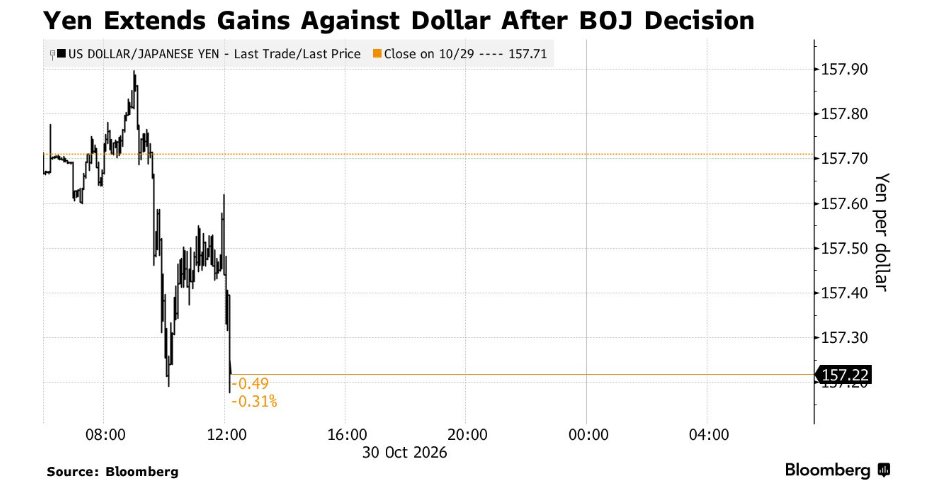
As shown in the chart above, after the announcement of the Bank of Japan's decision, the exchange rate of yen against the US dollar rapidly expanded its gains, highlighting the pace of yen appreciation.
Moh Siong Sim, foreign exchange strategist at OCBC Bank, said that the central bank confirmed that the official inflation target had been achieved, “sending a signal that the policy will be further tightened in the future,” and “should support the yen.” However, “the risk that the situation between the US and Iran will escalate again after the US midterm elections has already pushed up oil prices, which may prevent the yen from fully benefiting from the weakening dollar environment brought about by AI concerns.”
Goldman Sachs Group strategists said earlier that with changes in Japan's policy environment, the risk of a sharp weakening of the yen when global yields rise has been reduced, and the yen is becoming a more effective tool to hedge against market shocks caused by AI.
Last week, the sell-off in global technology stocks boosted demand for safe-haven assets. The yen once rose to its strongest level in more than a month, reaching 156.08 yen to 1 US dollar.
Meanwhile, the recent strong performance of long-term Japanese treasury bonds, signs of a recovery in domestic demand, and a more favorable policy environment have further enhanced the appeal of higher yields. The yield on 30-year Japanese bonds has dropped about 40 basis points from its peak of 4.25% earlier this month.
The Bank of Japan said that starting in January, it will increase the annual sales rate of ETFs from about 330 billion yen to about 860 billion yen, and Nikkei index futures in the Osaka market will expand their decline thereafter. Japanese stocks are also under pressure along with other global markets as market concerns about AI-related spending and valuations triggered a sell-off in technology stocks.
Bank of Hong Kong strategist Shogo Karitani said, “The ETF sale arrangement was unexpected. This is seen as a strong hawkish move by the Bank of Japan because it represents a further advance in the normalization of monetary policy, thereby driving some moderate yen purchases.”
As the scale of AI infrastructure-related development of global technology companies continues to soar, and the overall development scale of technology companies has reached a record high since this year, the yield index situation in the global credit bond market can be described as continuing to deteriorate, driving the AI-related financing costs and even overall financing costs of Japanese companies to rise significantly, and various types of credit spreads have generally widened.
Traders will be watching Bank of Japan Governor Kazuo Ueda's press conference after the resolution, which usually starts at 3:30 p.m. Tokyo time.
The real change from the “hawkish suspension”: official inflation judgments have crossed a major threshold, and ETF withdrawals unexpectedly accelerated
The central change in the Bank of Japan's decision is to maintain interest rates and promote policy normalization at the same time. On October 30, the central bank maintained the policy interest rate at 1.25% at 8-1, in line with the expectations of all 53 economists in the Bloomberg survey; Takada proposed a 25 basis point increase to 1.5%. The interest rate decision itself did not create an accident. The incremental information that actually affected market pricing was the first time that the central bank confirmed that basic inflation was generally in line with the 2% target, and announced that it would speed up the sale of stock ETFs. After the announcement of the resolution, the yen rose to about 0.4% against the US dollar, reaching 157.12, while Nikkei Index futures extended their decline.
“Meeting basic inflation standards” means that the Bank of Japan's judgment on continuing price trends has changed. The mutual impetus between wages and prices and the stabilization of medium- to long-term inflation expectations have further shifted the focus of policy to prevent inflation from being overadjusted. The official website forecast raised the CPI increase forecast for the 2027 fiscal year excluding fresh food from 2.4% to 2.6%, while the actual GDP growth forecast for the same period was lowered from 0.8% to 0.7%, showing a combination of moderate growth and still strong price pressure. The central bank clearly reserves the direction of continuing to raise interest rates based on economic, price, and financial conditions, so December is the next window of market attention; more than 80% of the economists surveyed expect to raise interest rates at that time, but this is not the central bank's commitment to a specific meeting.
Reducing ETF holdings and speeding up has strengthened the signal for withdrawing from unconventional easing. According to official documents, starting from January 2027, the annual sales volume has increased from about 330 billion yen to 860 billion yen, about 2.61 times the original; the corresponding estimated market value is about 2.46 trillion yen. Based on the static calculation of existing holdings and the rate of reduction, the time required to complete disposal was shortened from about 112 years to 43 years. This difference can be said to have a direct impact on the judgment of supply pressure in the market — that is, 860 billion yen is a book value, not the expected cash from sales.
This arrangement will increase the supply of stock assets that private investors need to undertake, and strengthen the central bank's policy signal to withdraw from risky asset holdings, so it can also put pressure on Japanese stocks and support the yen. However, the official estimate is that the sales volume accounts for about 0.1% of the stock market turnover, and that there is room to adjust or suspend sales according to market conditions, indicating that normalization is still taking a gradual approach. The weakening of Nikkei futures is also in the context of global AI technology stocks being pressured, and investors did not attribute all of them to ETF holdings reduction measures.
Why can the yen and long-term bonds rise at the same time? The “safe-haven trading theme” triggered by the collapse of AI trading is reshaping interest spreads and capital flows
The yen received support in this round in terms of both domestic policy and global safe-haven. The Bank of Japan maintains the direction of further interest rate hikes, which will help improve the relative interest rate prospects for Japanese yen assets; concerns about AI investment returns driving up US bonds and falling yields may weaken the interest rate spread advantage of US dollar assets. If the risk asset adjustment is accompanied by the liquidation of the Japanese yen finance carry trade (carry trade), investors can buy back yen to repay the financing, which may further increase the pressure on appreciation.
According to this, Goldman Sachs believes that compared to the past few years, the yen is becoming a more effective hedging tool for AI market shocks: the normalization of Japanese policies has reduced the extent to which the yen continues to withstand unilateral depreciation pressure when overseas yields rise, and the environment where US stocks and US bond yields decline together is generally more favorable to yen performance.
However, the performance of the yen in hedging AI growth shocks and hedging energy supply shocks may be different. The former is often accompanied by a decline in US bond yields and a contraction in risk positions; the latter may raise Japan's energy import bills, worsen trade terms, and prolong the time that US interest rates remain high. OCBC Bank strategists stressed in an updated report that the potential escalation of the US-Iran situation will push up oil prices and may limit the yen's gains from the weakening US dollar. Therefore, the key to the current strengthening of the yen is the combination of policy normalization and safe-haven demand. The incremental safe-haven funds brought about by the large-scale collapse of oil prices and AI transactions constitute an important variable affecting the magnitude of appreciation.
A rise in long-term Japanese bonds can also coexist with a “hawkish suspension.” The yield on 30-year Japanese bonds has fallen about 40 basis points from this month's high of 4.25%, to about 3.85%. Long-term yields reflect future short-term interest rate paths and term premiums (Term Premium): Expectations of further interest rate hikes may push up the former, but more credible inflation controls, the need to allocate long-term capital such as insurance institutions, and global safe-haven purchases can reduce the risk compensation required for long-term bonds. As a result, the short end is still bound by expectations of interest rate hikes, but the long term may rise, and the yield curve may flatten. This dynamic pattern reflects differences in pricing over time periods.
The Bank of Japan's latest outlook itself also reveals this set of market tension: the expansion of AI applications and related fixed investments can continue to support the global economy, but if profit growth fails to keep up with investment expansion, asset prices may face adjustments — that is, AI trading completely collapses and the AI bubble completely bursts; at the same time, rising prices of semiconductors, copper, and machinery may also be transmitted to consumer prices. In other words, AI can simultaneously be a supporting factor for physical investment and inflation, as well as a trigger for financial markets to re-examine valuation and financing risks. This is the common background of central banks continuing to focus on interest rate hikes while investors buy long-term treasury bonds to take refuge.
As far as the global bond market is concerned, the short-term dominant force is still safe-haven demand. The pressure on technology stocks can simultaneously strengthen US bonds, long-term Japanese bonds, and the yen; previously reported by Bloomberg, the return on US bonds in October was about 2%, and the benchmark yield fell by a cumulative total of nearly 40 basis points, reflecting this round of capital flow. In the medium term, improving yields in Japan may increase the attractiveness of domestic bonds, but rising short-term interest rates in Japan may also reduce the Japan-US dollar spread and reduce the exchange rate hedging costs of Japanese dollar bonds, so it cannot be mechanically deduced that “Japan's normalization will inevitably trigger a sell-off of US bonds.” Actual allocation depends on hedged earnings, exchange rate expectations, and debt matching requirements.
With regard to the financing environment of the AI industry chain, this distinction is particularly important: falling treasury bond yields help reduce the benchmark cost of financing, but widening corporate credit spreads (Credit Spread) may still offset this benefit. The safe-haven purchase of yen and government bonds first indicates that investors are reallocating risk. This does not mean that the financing conditions for new cloud companies, tech giants, or Japanese companies have been loosened at the same time.