


- Cincinnati Financial reported third quarter 2026 results, with revenue of US$3,047 million and net income of US$459 million, compared with US$3,726 million and US$1,122 million a year earlier.
- Across the first nine months of 2026, Cincinnati Financial posted revenue of US$10,184 million and net income of US$1,988 million, both higher than the prior year, highlighting a softer quarter set against a stronger year-to-date picture.
- Attention now turns to how Cincinnati Financial's investment narrative reflects a softer third quarter profit result while nine-month earnings remain higher.
Compare Cincinnati Financial's softer quarter with peers facing similar conditions by scanning our hand picked group of 30 resilient stocks with low risk scores that prioritize resilience and disciplined underwriting over headline earnings swings.
Cincinnati Financial Investment Narrative Recap
To own Cincinnati Financial, you need to be comfortable with a profit-first insurer that leans heavily on underwriting discipline and investment income, while living with earnings that can swing from quarter to quarter. The latest result shows a softer third quarter, but nine-month revenue and net income remain higher than a year earlier, so the immediate hit to the broader thesis looks contained.
The key short-term catalyst is whether management can keep the combined ratio in check while personal lines growth stays modest and catastrophe activity remains unpredictable. The biggest risk right now is that persistent catastrophe losses and higher expenses push underwriting out of its recent comfort zone and compress margins more decisively.
The third-quarter earnings release is the announcement that matters most today. Revenue of US$3,047 million and net income of US$459 million were both lower than the prior-year quarter, while basic EPS from continuing operations moved from US$7.19 to US$2.99. That is a sharp reset in quarterly profitability, even if the business is still profitable.
Across the first nine months, Cincinnati Financial reported revenue of US$10,184 million and net income of US$1,988 million, which both sit above the prior period. That contrast keeps the existing catalysts in focus, including disciplined underwriting, a shift toward higher-value personal lines and diversified specialty and reinsurance books, while also underlining the risk that more frequent catastrophe-heavy quarters could drag earnings away from the longer-term trend analysts have been watching.
Cincinnati Financial Analyst Expectations In Context
Cincinnati Financial's current analyst narrative leans on relatively cautious assumptions. Forecasts point to revenue of about US$12.7b and earnings of US$1.0b by 2029, based on a view that top line performance will shrink modestly each year and profit margins will compress meaningfully from where they sit today.
Consensus models build in a 1.5% annual revenue decline over the next three years. Alongside that, analysts expect margins to move from 20.1% today to 8.2% in three years, which represents a sharp reset in profitability if it plays out that way. This framework matters for you because it describes a scenario where the franchise still earns solid profits but does so on slimmer economics per dollar of premium and investment income.
On earnings, the spread between today and the out year is wide. Analysts see earnings at about US$2.7b now and project US$1.0b in 2029, with the more optimistic end of the range at US$1.2b. That is a drop of roughly US$1.7b from current earnings to the central forecast, so anyone relying on these numbers is effectively underwriting a much lower profit base later in the decade.
Cincinnati Financial's narrative projects revenue of about US$12.7b and earnings of roughly US$1.0b by 2029. This setup assumes revenue falls at about 1.5% per year and that earnings decrease by about US$1.7b from the current US$2.7b level.
Analysts then layer valuation on top of those targets. Their central case price target of US$186.50 assumes the stock trades on a P/E of 32.4x 2029 earnings, compared with about 10.5x today and a current US insurance sector P/E of 11.4x. To line up with that view, you would need to accept not just lower earnings and margins, but also a much richer multiple being applied to that smaller profit pool several years from now.
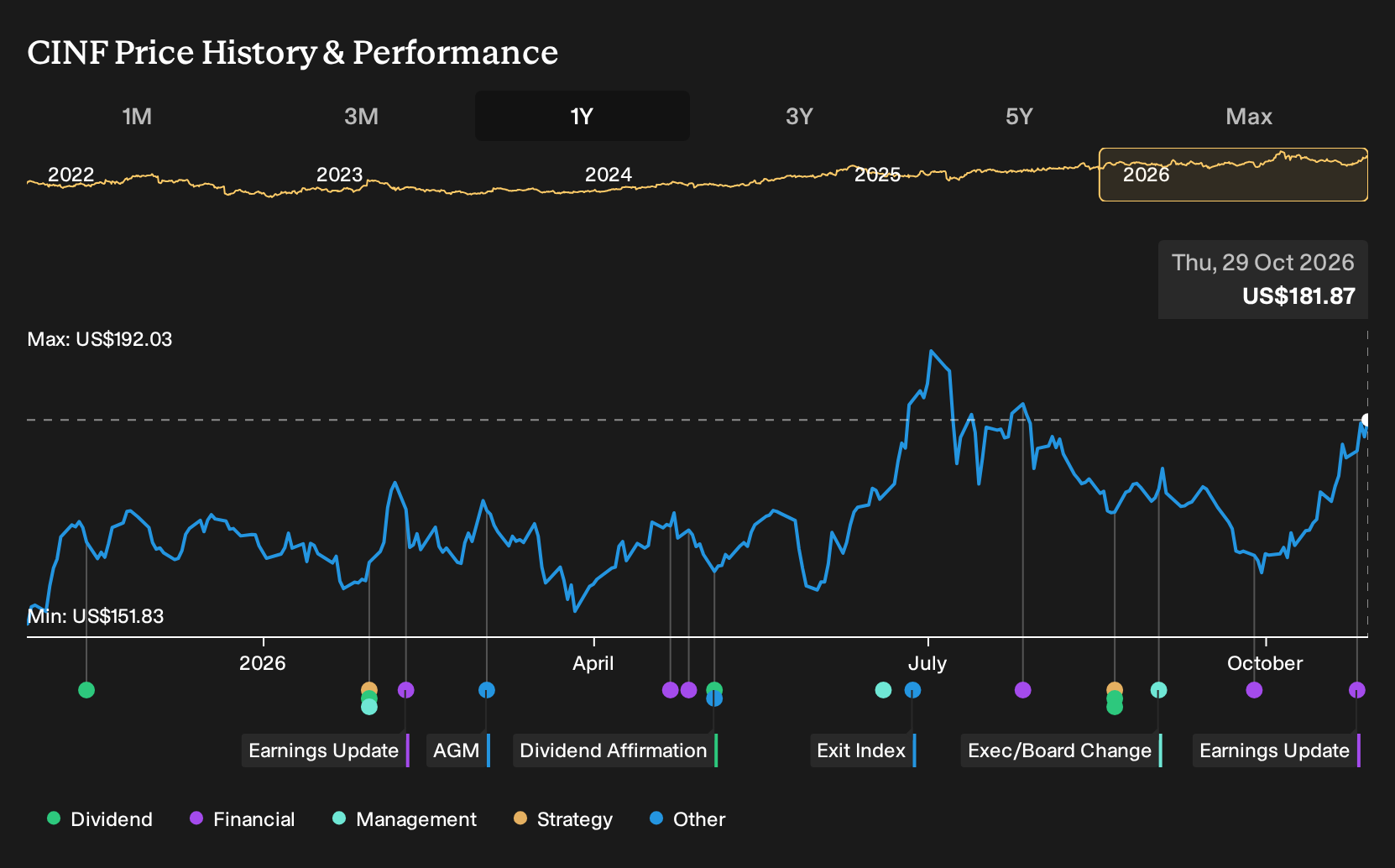
The current share price of US$181.52 sits only about 2.7% below that consensus target, which implies the analyst group on average views Cincinnati Financial as roughly in line with their fair value estimate today. For you as an investor, the small gap between price and target makes the underlying assumptions about declining revenue, shrinking profitability and a higher future P/E especially important to stress test against your own outlook for underwriting discipline, catastrophe volatility and capital allocation.
Uncover why Cincinnati Financial's fair value indicates a 3% potential upside to its current price, as the discount to the consensus view may not last long.
Exploring Other Perspectives
Three fair value views from the Simply Wall St Community cluster between about US$152 and US$186, with one member effectively aligned to the US$186.50 sell side target. That spread sits between rising catastrophe and expense risks on one side and Cincinnati Financial’s long underwriting profit run and capital strength on the other. You should expect opinions to differ sharply and use these contrasting angles as a prompt to explore several alternative viewpoints before deciding how this stock fits your own portfolio.
Explore 2 other Cincinnati Financial fair value estimates, including one that suggests it could be worth as much as $186.50.
The Verdict Is Yours
Disagree with existing narratives? Extraordinary investment returns rarely come from following the herd, so trust your own analysis and approach.
- A great starting point for your Cincinnati Financial research is our analysis highlighting 3 key rewards and 1 important warning sign that could impact your investment decision.
- See our latest analysis for Cincinnati Financial. The report includes a comprehensive fundamental analysis summarized in a single visual, the Snowflake, making it easy to evaluate Cincinnati Financial's overall financial health at a glance.
Looking For More Cincinnati Financial Style Ideas?
If the Cincinnati Financial story has you thinking about portfolio balance, it can help to line it up against other businesses with different risk and return profiles. The Simply Wall St Screener lets you quickly scan for stocks that share the traits you care about, from resilient balance sheets to sizable income streams.
- For investors who want staying power at the core of their holdings, start with a curated list of solid balance sheet and fundamentals (23 results) that can help anchor risk in choppy markets.
- If income is your priority, check out a set of 7 dividend fortresses that focus on meaningful yield as a key part of total return.
- Those hunting for overlooked opportunities can sift through a focused pool of 18 high quality undiscovered gems that may not yet be widely followed.
Have feedback on this article? Concerned about the content? Get in touch with us directly. Alternatively, email editorial-team@simplywallst.com