


The Zhitong Finance App learned that Binance, the world's largest cryptocurrency exchange, said that the estimated impact of a security breach reached 6.3 billion US dollars. Analysts say this could constitute the largest crypto asset theft in history. Binance says it has frozen affected assets together with partners and is currently positioned at around $3 billion; the company has not updated the status of the remaining $3.33 billion.
Binance becomes the latest example of a hacking incident
Binance said in its announcement that preliminary investigations suggest that the security incident may be linked to an engineer's laptop being hacked. According to blockchain analysis company TRM Labs, North Korea is behind this hacking attack. The company said North Korea began preparations at least 36 hours before the data was stolen.
TRM said, “On the night of October 29th, billions of dollars of cryptocurrency began flowing out of Binance's wallet,” involving 10 blockchains — including Bitcoin, Ethereum, Solana, and XRP — and into addresses controlled by a single attacker.
For exchanges that hold billions of dollars in customer assets, the challenge is no longer just protecting private keys or storing most of the funds offline. Wallet systems increasingly involve multi-party signatures, automated transaction processes, smart contract permissions, and external service providers.
Binance announced on the X platform on Friday that up to now, the total losses caused by this incident are about US$6.3 billion, and said it will make up for all losses. Binance has temporarily suspended the exchange's withdrawal function.
The incident raised new questions about the industry's ability to protect digital assets while seeking to attract traditional finance. This incident at the world's largest cryptocurrency exchange highlights that even the biggest players may face security breaches.
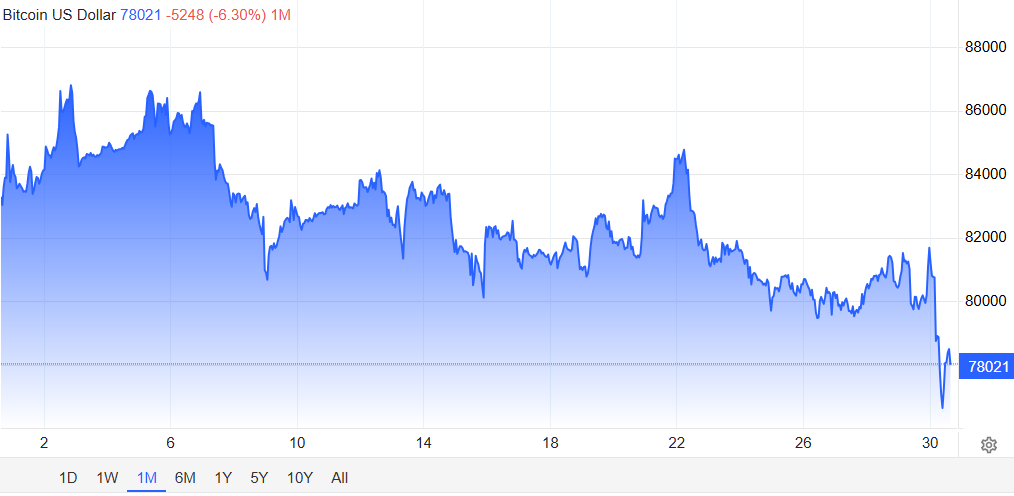
The hacking incident weighed down on the price of crypto assets. Bitcoin once hit a six-week low. The latest report was $7,8021, down 3%; Ether fell more than 3% to $2,185.83. Crypto exchange Coinbase Global (COIN.US) shares fell 4.8% at night, while Bitcoin reserve company Strategy (MSTR.US) fell nearly 6% at night.
“This is the biggest cyber theft ever, not just the biggest theft in the cryptocurrency sector,” said Aneirin Flynn, CEO of cybersecurity technology company FailSafe. “It's going to hurt people's confidence in cryptocurrencies. The industry is seeking institutional capital, but institutions won't turn a blind eye to repeated failures in custody and security.”
Hacker attacks are frequent
This hacking incident is yet another example of a series of costly security breaches in the cryptocurrency industry. In February 2025, Dubai-based Bybit suffered a $1.5 billion theft, which was the largest single cryptocurrency theft recorded at the time. The US Federal Bureau of Investigation (FBI) has targeted North Korean hackers who spread stolen assets across thousands of addresses on multiple blockchains.
In August, hackers stole more than $100 million worth of bitcoin from thousands of wallets protected by hardware devices made by the Canadian company Coinkite. The attack exploited a software flaw to make protecting the private keys of cryptocurrencies predictable.
In September, cryptocurrency exchange Bitget said attackers had stolen around $388 million. In October, criminals tampered with Ledger hardware wallets distributed through Southeast Asian dealers, and blockchain researchers estimated losses of more than $90 million. Ledger says its own systems have not been compromised.
The forecast market Polymarket temporarily suspended trading this week due to the invasion of a third-party vendor, losing more than $2.5 million.
These incidents have highlighted the wide range of security breaches faced by cryptocurrency companies, from their own wallets and technology systems to supply chains and external vendors. The risk isn't limited to crypto-native companies. In South Korea, a series of cyber attacks have hit multiple financial institutions in recent weeks, including cryptocurrency exchange Bithumb Co. , Mirae Asset Global Investments Co. and Daishin Securities Co. These companies all reported unauthorized access, leading to user data breaches.
There have been several major thefts in recent months. These security breaches raise questions about the security of outsourced systems and third-party technology providers as financial companies increasingly rely on connected digital infrastructure.
Here's what analysts and professional investors have to say
Eric Jardine, Chainalysis Research Director
“Investigations are ongoing and we are unable to confirm the cause of this attack. As of 8:30 p.m. EST (8:30 Beijing time), we have confirmed that at least US$5.912 billion has been stolen and that funds have been transferred across multiple blockchains, including Bitcoin, Ethereum, Wave, Ripple, and several second-tier networks.”
“Binance has also confirmed that around $3 billion has been frozen. Blockchain transparency and industry collaboration are disrupting the transfer of stolen funds. Our investigators are identifying additional freeze opportunities to support recovery efforts.”
Amanda He, Chief Investment Officer of ChainUP Investment Singapore
“The initial drop was probably due to hackers selling these coins. However, after 8 a.m. EST (8 p.m. Beijing time), as morning trading in Asia began, panic spread further... Binance is still the largest exchange in the market in terms of turnover, so it is really at the center of this storm — and the center of market activity.”
“We have a small position on Binance, accounting for less than 20% of our total holdings. But for the positions we actually placed there, we have sold all of them. If you can transfer it out, you can transfer it out first; if you can't, sell it; switch to safe-haven assets such as stablecoins. Withdrawals are currently suspended.”
Tim Sun, Senior Research Fellow, Hong Kong HashKey Group
“We think the impact of the Binance incident is likely to go beyond direct asset losses. This incident is probably one of the biggest security breaches in the history of the crypto industry.”
“We are more concerned about potential liquidity shocks. As the world's largest digital asset trading platform, once the Binance deposit and withdrawal business is interrupted, it may affect the ability of market makers to transfer funds between trading venues.”
Geoffrey Kendrick, head of digital asset research at Standard Chartered Bank of London
“I doubt this round of decline has some way to go. Only when assets are unfrozen and more details about this attack come to light will we be able to find a new bottom.”
Damon Xu, founder of Singapore 1Token
“We expect cross-exchange strategies to shrink and leverage to drop. Even if affected users eventually receive full compensation and funds are locked up during the transition period, traders may find themselves in a situation where they are profitable on one platform but unable to use their funds, while facing margin gaps and forced liquidation on another platform.”
“Decentralized exchanges could benefit. Hyperliquid's strong performance during this period is noteworthy, and some capital and trading activity may migrate to the chain.”
Aravind Srinivasan, head of systemic OTC business at crypto market maker GSR
“This is the biggest hack in history... Binance Spot also has wider spreads and less liquidity. The average trading spread of Bitcoin spot this morning was once five times the normal level, and Ether was 2.5 times. The spread has narrowed slightly since then.”
Kenneth Goh, Director of Private Wealth Management at Dahua Jixian Singapore
“The crypto industry has a long history of exchange theft. Mt. Gox went out of business after losing nearly $500 million in Bitcoin in 2014, and Bybit also lost around $1.5 billion last year.”
“What's special about this time is where it happened. The world's largest exchange was supposed to have the strongest controls in the industry, but it's still being breached. Investors will then take a closer look at where their assets are held and who is responsible in case of problems.”
Karpeles Lab CEO, Mt. Mark Karpeles, former head of Gox
“Binance seems to have scattered assets across multiple systems (to ensure that a single attack only affects a portion of the assets), but even so, a single attack caused huge losses. The attackers seem to have managed to obtain valid authorizations from both Binance 14 and Binance 16 addresses, which means they are likely to have found the private keys used by these two addresses.”
Tokyo Bitbank Market Analyst Yuya Hasegawa
“The scale of the reported incident is truly alarming. However, the full extent of the losses is still unclear, especially since stablecoin issuers have frozen a significant portion of the affected assets.”
“The biggest concern is not necessarily the amount of money stolen itself, but whether the incident caused a loss of broader confidence in centralized exchanges, which in turn led to more withdrawals, disrupted liquidity, and forced sell-offs.”
“However, if Binance can prove that customer assets are safe, cover all losses, and quickly resume normal operations, the market shock could be relatively brief. Bitcoin's fundamentals were not directly damaged by this incident.”
Jeff Ko, Chief Analyst at ViaBTC Hong Kong
“I don't think stolen bitcoins will bring much selling pressure. Bitcoin addresses cannot be frozen, but every coin is traceable on the chain, and Bitcoin doesn't have the same deep and liquid mixing tools as Tornado Cash. In fact, most of these bitcoins are likely to be locked down and will probably take years before entering the market. Ether is another story. It's much easier to launder coins through Tornado Cash, so I expect continued sell-off pressure, and Ether is relatively weak. As a reference, it only took a few weeks for the market to recover after Bybit was hacked.”
“In addition to sentiment, this incident once again highlights the security risks of centralized exchanges and the broader crypto market in the context of AI development. However, the part that was breached this time appears to be the way the transaction was signed and authorized, rather than a smart contract bug.”
Joshua Chu, Co-Chairman of Hong Kong Web3 Association
“This incident puts four fronts on the table at once: regulators protect the public, law enforcement agencies hunt down suspects, civil lawsuits recover assets, and ecological participants ensure they don't become an escape route for stolen money. For crypto participants who are still resisting cooperation with the government, this contradiction is very embarrassing: regulation crosses borders when making money, and the government doesn't have enough money.”