


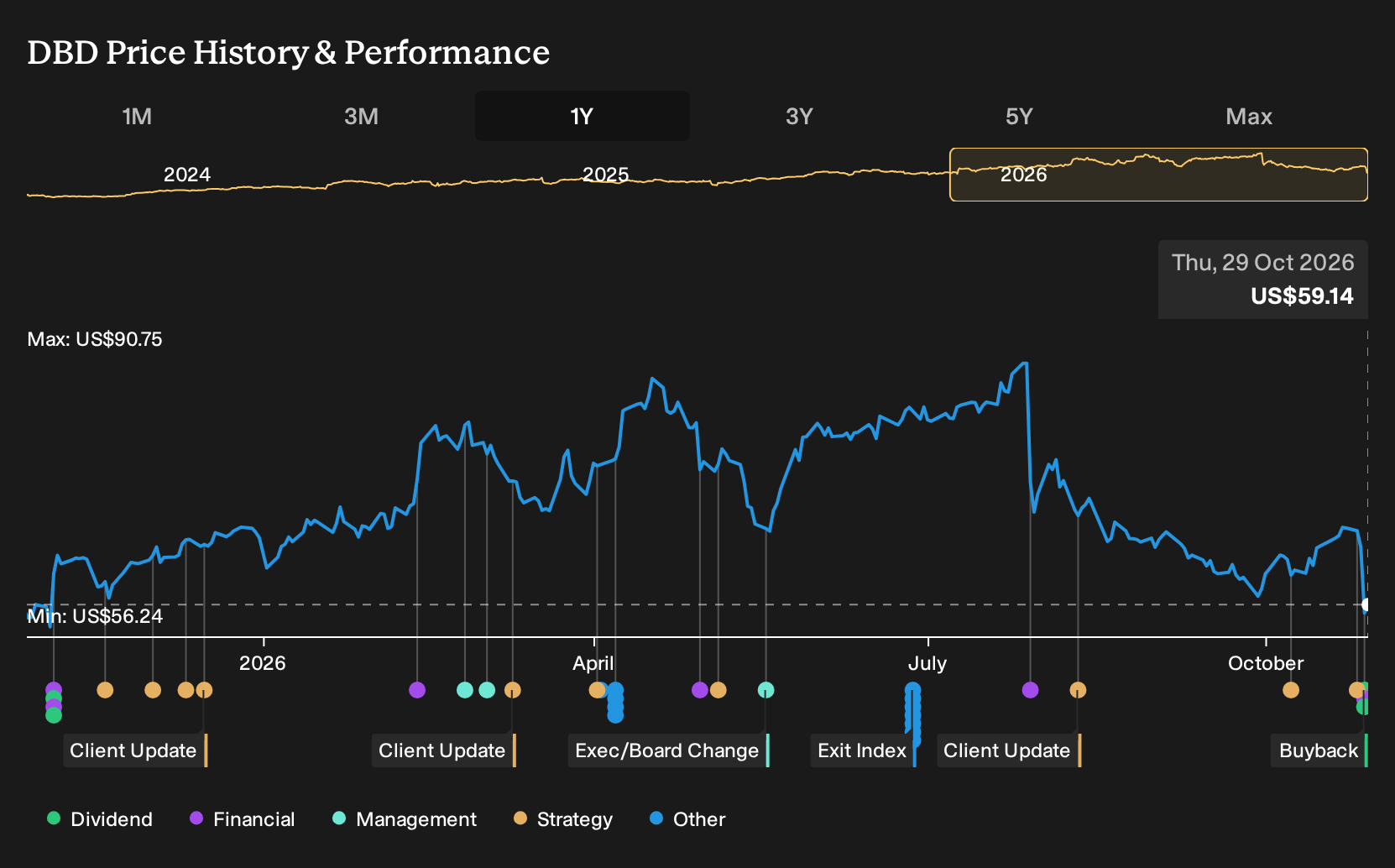
- Diebold Nixdorf reported Q3 2026 revenue of US$994.3 million and net income of US$6.6 million, then cut full year guidance while also approving a new US$250 million share repurchase authorization.
- The earnings update highlighted pressure from higher memory and raw material costs and a less favorable product mix, even as management paired the guidance reset with a planned ATM outsourcing collaboration with Euronet Worldwide.
- This article examines how Diebold Nixdorf's lowered full year outlook, despite the new buyback plan, reframes the broader investment narrative.
Scan how Diebold Nixdorf's reset guidance and new buyback stack up against other potential opportunities by comparing it with our hand-picked 30 high quality undervalued stocks.
Diebold Nixdorf Investment Narrative Recap
To own Diebold Nixdorf, you need to believe the pivot toward higher margin software, services and more efficient hardware can outgrow the current cost headwinds. In the short term, the key swing factor is execution on service productivity and backlog conversion into cash, especially with management absorbing higher memory and raw material costs while still resetting guidance.
The biggest risk right now is that elevated component prices and an unfavorable mix keep squeezing margins just as the firm is investing in technicians and North America fleet renewal. If these pressures persist or customer deployments slip, the case for stronger free cash flow and higher service profitability weakens.
The new US$250 million buyback authorization is the announcement that matters most in this context. It sits alongside Q3 2026 revenue of US$994.3 million and net income of US$6.6 million, as well as reduced full year guidance that reflects cost and mix pressure. For investors, that pairing raises questions about timing and balance sheet priorities.
On the positive side, Diebold Nixdorf now has flexibility to reduce share count while progressing ATM and retail contracts, including the planned ATM outsourcing collaboration with Euronet Worldwide. Execution risk remains tied to converting its order book into cash, holding service margins, and managing debt when operating cash flow coverage is described as weak.
What The Current Analyst Narrative Implies For Diebold Nixdorf
Analysts are sketching a fairly specific destination for Diebold Nixdorf. Their work ties the current execution story on ATMs, retail tech and services to a 2029 picture that includes higher profitability, a different capital structure and a meaningfully altered share count. Rather than treat each data point in isolation, it helps to read those estimates together and ask what sort of journey they describe for both the income statement and the balance sheet.
On the top line, the analyst set assumes revenue expands by 2.6% a year over the next three years, which is a modest clip for a hardware and services mix that still depends on large rollout programs and contract timing. That kind of pace suggests expectations for steady contract conversion from the US$814 million order book and continued uptake of DN Series ATMs and self checkout lanes rather than a sharp step change. For you, the key question is whether a business tied to long sales cycles and public sector tenders can reliably thread that 2.6% line without big swings up or down.
Profitability does more of the heavy lifting in this narrative. Analysts see net margin moving from 2.9% today to 8.6% in three years, which effectively assumes that the lean program, technician tools and manufacturing changes all end up sticking. That view leans on service productivity improving fast enough to offset higher memory costs, North America fleet renewal investment and any lingering drag from lower installation and project work. If those cost actions slip or tax outflows stay elevated, the margin bridge to 8.6% looks much harder to cross.
Diebold Nixdorf's narrative projects US$4.2b revenue and US$358.7 million earnings by 2029. This rests on 2.6% yearly revenue growth and an earnings increase of about US$247.5 million from US$111.2 million today.
The earnings step up that analysts outline is substantial in dollar terms. Moving from US$111.2 million today to US$358.7 million by 2029 means profit would need to add roughly US$247.5 million over that period, with a lot of that lift expected to come from mix and efficiency rather than sheer volume. That hinges on software, services and managed operations taking a bigger share of the business while hardware production runs more smoothly through those localized plants in Germany, Brazil and North America. If the richer margin lines underperform or hardware pricing has to absorb more component inflation, the math behind that US$358.7 million outcome starts to fray.
Valuation assumptions in the consensus are just as explicit. To line up with the US$98.33 price target, you would need to accept US$4.2b of revenue and US$358.7 million of earnings in 2029, and then apply a 10.5x P/E to that profit stream, all discounted at roughly 9.9%. That 10.5x multiple sits below both the current 19.5x that analysts cite for Diebold Nixdorf today and the 26.7x quoted for the GB tech peer group. The implied story is that a higher earnings base comes paired with a more modest P/E, so value creation relies more on delivery of those margin and cash flow goals than on multiple expansion.
There is also a capital allocation twist in these projections. Consensus expects the share count to shrink by 5.35% a year for the next three years, which lines up directionally with the new US$250 million buyback authorization alongside existing repurchases. Shrinking equity while raising earnings per share can support valuation if operating cash flow improves in line with the free cash flow targets that management references for 2025 to 2027. If cash generation falls short or working capital remains sticky, the same repurchase pace can start to stretch the balance sheet just as the business is absorbing higher tax payments and input costs.
Uncover why Diebold Nixdorf's fair value indicates a 66% potential upside to its current price that could narrow quickly.
Exploring Other Perspectives
One bullish twist you might explore is how some analysts treated Diebold Nixdorf’s buyback and automation push as a clear accelerator. Before this earnings reset, the most optimistic forecasts were built on US$4.3b of 2029 revenue and US$436.7 million of earnings. Those projections did not factor in today’s weaker quarterly profit or the lower full year guidance, so the gap between those expectations and reality may now widen. That is exactly why it helps to compare several viewpoints and decide which story appears more realistic to you.
Explore 7 other Diebold Nixdorf fair value estimates, including one that suggests as much as 297820% upside from the current price!
Form Your Own Verdict
Disagree with existing narratives? Extraordinary investment returns rarely come from following the herd, so consider forming your own view.
- A great starting point for your Diebold Nixdorf research is our analysis highlighting 4 key rewards and 2 important warning signs that could impact your investment decision.
- See our latest analysis for Diebold Nixdorf. The report includes a comprehensive fundamental analysis summarized in a single visual, the Snowflake, making it simple to review Diebold Nixdorf's overall financial health at a glance.
Looking For More Investment Ideas Beyond Diebold Nixdorf?
If the Diebold Nixdorf story has sharpened your thinking about risk, reward and balance sheet strength, it can help to line it up against a wider watchlist. The Simply Wall St Screener lets you filter the market by the traits you care about most, so you can stress test your thesis instead of relying on a single stock.
- If you care most about financial resilience, start with a list of solid balance sheet and fundamentals (23 results) that can handle tougher conditions without leaning heavily on lenders.
- If you want potential mispricing, compare Diebold Nixdorf against a 30 high quality undervalued stocks that combines balance sheet strength with healthy cash flows.
- If you are hunting for fresh ideas, widen the search to a 18 high quality undiscovered gems that may not be widely followed but still show strong fundamentals.
Have feedback on this article? Concerned about the content? Get in touch with us directly. Alternatively, email editorial-team@simplywallst.com