


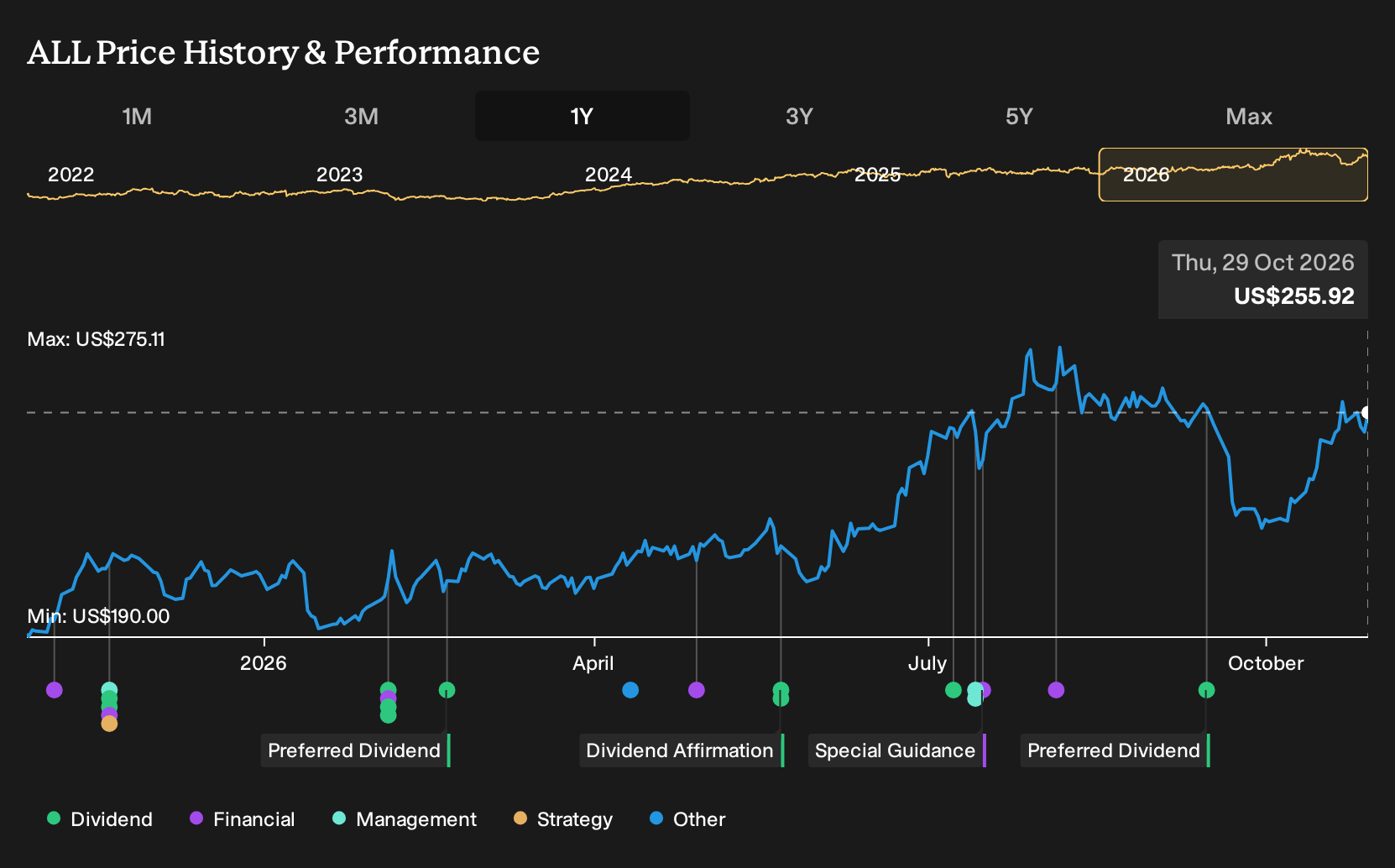
- Allstate released its 2026 America's Best Drivers Report, using internal auto claims data to rank cities by collision frequency, with Brownsville, Texas again recording a collision likelihood well below the national average.
- The insurer is set to report quarterly results, and analysts expect lower earnings alongside higher revenue as Allstate rolls out digitally enabled auto and homeowner products and leans further into analytics and AI for pricing and claims.
- The focus now turns to how Allstate's evolving AI driven product strategy and upcoming earnings report could influence the broader investment narrative.
Scan how Allstate's AI driven shift compares with other insurers by reviewing the 30 resilient stocks with low risk scores, which pairs resilient balance sheets with more controlled risk profiles.
Allstate Investment Narrative Recap
To own Allstate, you need to be comfortable with a property and casualty insurer that leans hard on underwriting discipline and heavy use of analytics and AI to keep claims and expenses in check. The big swing factor near term is whether catastrophe losses stay within the range its reinsurance and pricing are designed to handle. The fresh Best Drivers data is helpful branding, but it is not a material catalyst on its own.
The more immediate swing point is the upcoming earnings print, where expectations center on lower EPS with higher revenue along with a history of beating expectations. The main operating risk stays the same. Severe weather and regulatory pushback on pricing, especially after events like the Oklahoma lawsuit, can pressure combined ratios, earnings stability and how quickly Allstate can lean into AI driven underwriting changes.
The earnings release for the September 2026 quarter is the announcement that matters most for this setup. Expectations call for lower earnings alongside higher revenue, with recent upward EPS revisions and a track record of beating estimates in the past four quarters. That mix indicates the market is watching profitability even more closely than top line momentum.
For you as a shareholder, the link back to catalysts is direct. Allstate is rolling out Affordable, Simple, Connected products and scaling more than 250 analytical models and its ALLIE AI ecosystem, all aimed at loss and expense ratios. The print will show how much of that work is visible in margins despite catastrophe losses of US$2.88b in Q2 2026 and about US$1.43b across July and August, and how much regulatory or retention pressure is showing up in the numbers.
Allstate Earnings Assumptions and Valuation Check
Analysts outline a scenario for Allstate in which revenue increases steadily while profits compress sharply. The forecasts available indicate revenue increasing by 2.7% a year over the next three years, while profit margins decline from 18.8% today to 5.1% by 2029. Under these assumptions, consensus points to earnings of US$3.9b by 2029 compared with US$13.2b today, implying an earnings decline of about US$9.3b over that period rather than an increase. The same projections assume revenues of US$76.0b and a P/E of 19.8x in 2029, above the current US Insurance sector multiple of 10.6x, with a discount rate of around 7.2% used to bring those figures back to today’s values.
Allstate’s projections indicate US$76.0b in revenue and US$3.9b in earnings by 2029, based on 2.7% annual revenue growth and an earnings decrease of about US$9.3b from US$13.2b today.
Uncover why Allstate's fair value indicates a 7% potential upside to its current price, which could narrow quickly.
Exploring Other Perspectives
Some of the most optimistic analysts are focused on Allstate’s AI heavy model rather than catastrophe risk. They were already penciling in about US$81.6b of revenue and US$4.8b of earnings by 2029, which is well above consensus. The new Best Drivers data and upcoming earnings could influence those views, so consider both narratives before making any decision.
Explore 5 other Allstate fair value estimates, including one that suggests as much as 203% upside from the current price!
The Verdict Is Yours
Disagree with existing narratives? Extraordinary investment returns rarely come from following the herd, so go with your instincts.
- A great starting point for your Allstate research is our analysis highlighting 4 key rewards and 2 important warning signs that could impact your investment decision.
- See our latest analysis for Allstate. The report includes a comprehensive fundamental analysis summarized in a single visual, the Snowflake, making it easy to evaluate Allstate's overall financial health at a glance.
Looking for more Allstate sized investment ideas?
Once you have a view on Allstate, it can help to line it up against other opportunities that match your preferred risk, income, or balance sheet profile. The Simply Wall St Screener lets you do that quickly by filtering for the traits you care about most.
- If capital preservation is high on your list, start with a focus on sturdier businesses by reviewing the list of solid balance sheet and fundamentals (23 results) that combine financial resilience with consistent fundamentals.
- Income focused investors who want yield with some defensive characteristics can zero in on the 7 dividend fortresses and compare those payouts to Allstate’s profile.
- For readers hunting for potential mispriced opportunities, the 30 high quality undervalued stocks can help surface candidates that pair quality metrics with valuations that may not fully reflect them yet.
Have feedback on this article? Concerned about the content? Get in touch with us directly. Alternatively, email editorial-team@simplywallst.com