


The Zhitong Finance App learned that the conflict between the Persian Gulf and Russia stirred up the energy market and pushed oil refining performance to record highs. As a result, oil giants made unexpected profits of more than 50 billion US dollars. ExxonMobil (XOM.US), Chevron (CVX.US), British Petroleum (BP.US), Shell (SHEL.US), and Total Energy (TTE.US) all surpassed expectations in the third quarter, with a total adjusted net profit of $56.3 billion. What is behind this is an unprecedented fuel supply crisis that pushed retail oil prices to historic highs.
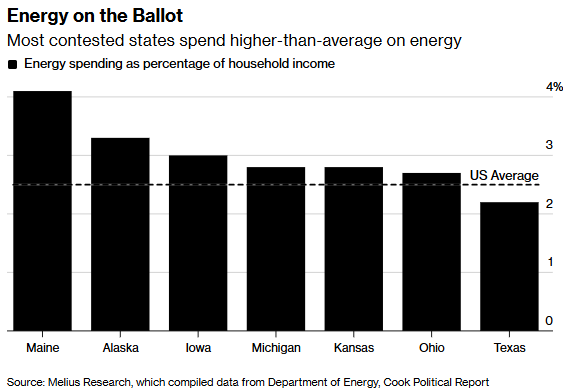
The drivers' pain at the gas station is bringing excessive profits to the oil supergiants, and is also inciting discontent as US President Trump and his Republican Party prepare for the midterm elections. This election will determine control of the National Assembly. American voters continue to place the cost of living as their primary concern, and high oil prices are turning traditional Republican polls such as Texas, Kansas, and Alaska into swing states.
Since the US and Israel attacked Iran at the end of February, international oil prices have risen by nearly 60%, and refining has become another bottleneck in the global energy supply chain. The war in the Middle East and the Russian-Ukrainian conflict have shut down about 10% of the world's fuel manufacturing capacity, bringing huge profits to refineries that are still in operation.
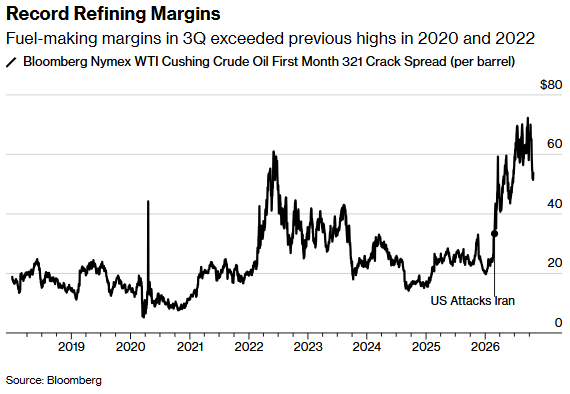
ExxonMobil's statement on Friday showed that its refining division's third-quarter profit reached a record 9.05 billion US dollars, an increase of nearly five times over the same period last year. Chevron refinery's profit for the same period reached US$4.93 billion, the highest in history, four times that of a year ago.
More than half of BP's $8.46 billion adjusted net profit came from sectors including refining and trading. Earlier this week, Shell and Total also announced impressive results.
ExxonMobil shares rose 1.6% in the New York premarket, Chevron rose 1.3%, British Petroleum once rose 1.8% in London, and Shell and Total also rose.
Trump downplayed concerns about gasoline and diesel prices at a rally in Texas this week, saying prices would fall “soon.” The average oil price during his second term was higher than during his predecessor Biden. A few days ago, he also praised American oil companies for making “a huge amount of money” for the country, which is clearly a shift compared to criticizing them for “making too much money” this summer.
However, as the Iran conflict enters its ninth month, the disruptions in global energy markets show little sign of abating, despite the increase in ships passing through the Strait of Hormuz. Until now, the market has relied heavily on strategic and commercial inventory supply. However, as these buffers gradually run out, price fluctuations are expected to intensify.
ExxonMobil operates the largest refining system outside of China and announced the fourth highest overall profit in the company's 156-year history. The company's third-quarter adjusted earnings per share were $4.23, 10 cents higher than analysts' average expectations.
ExxonMobil raised its dividend for the 44th year in a row and promised to maintain an annual repurchase of $20 billion.
Chief Financial Officer Neil Hanson said that the surge in profits was not so much a windfall as a reward for increasing production when needed most. Since 2019, ExxonMobil has increased Gulf Coast distillate production by 40%, thanks to significant investments since 2020 — when competitors sold refineries or converted them into biofuel plants.
“As a company, our most meaningful response to rising global commodity prices is to use all available means to increase supply,” Hanson said in an interview. ExxonMobil is “putting more diesel on the market in today's very tense environment.”
Chevron also recorded the fourth-highest quarterly profit in the company's history. Its third-quarter net earnings per share of $5.28 were 35 cents higher than analysts' average expectations. The company maintained $2.5 billion share repurchases during the quarter and is at the lower end of the annual guidance range. For the second consecutive quarter, Chevron executives used windfall profits mainly to reduce debt.
Chief Financial Officer Aymel Bonner said in an interview: “We are not reacting to an upward or downward trend, and we are not adjusting our layout. Currently, we are sticking to our long-term financial priorities and are not making any changes.”
Bilaj Bolhattaria of the Royal Bank of Canada Capital Market said in the report that Chevron has not raised the annual repurchase range, “probably reflecting the outside perception of huge repurchases rather than increasing investment in the midst of the energy crisis.”
Thanks to the acquisition of Hess last year, Chevron's production increased year on year, making it possible to take advantage of the increase in international crude oil prices of about 34% year over year. The Hess deal gave Chevron a 30% interest in Guyana's prolific Stabroek block, which is operated by ExxonMobil.
Chevron is expected to produce 300,000 barrels per day from Venezuela by the end of the year, up 20% from a year ago. The company costs less than $20 per barrel in Venezuela, making it one of the most profitable oil producing regions in the world.
Bonner said that Venezuela “immediately increased earnings and positive free cash flow, and we are not worried about the capacity to increase production.”