


- RLI Corp. reported third quarter 2026 revenue of US$476.96 million and net income of US$81.01 million, with diluted EPS from continuing operations of US$0.88, all lower than the prior year period. For the first nine months, the company reported revenue of US$1,476.4 million and net income of US$303.92 million.
- The contrast between softer third quarter results and higher year to date revenue provides a clearer view of how recent underwriting and pricing conditions may be pressuring profitability, even as overall business volume remains resilient.
- This raises the question of how RLI Corp.'s softer third quarter earnings, particularly the lower net income, may influence the broader investment narrative.
Contrast RLI's softer quarter with peers facing similar underwriting pressure, and scan a hand picked shortlist of insurers with stronger balance sheets and fundamentals via the list of solid balance sheet and fundamentals (23 results).
RLI Investment Narrative Recap
To own RLI, you need to be comfortable with an insurer that leans hard into underwriting discipline while absorbing higher costs and more retained catastrophe risk. The latest quarter, with revenue of US$476.96 million and net income of US$81.01 million, underlines how softer pricing and a higher expense base can squeeze near term earnings.
In the short run, the key swing factor is whether RLI can keep accident year loss ratios and expenses in check while property markets stay competitive. The biggest risk is that the rising expense ratio and extra catastrophe exposure combine with softer pricing, which would pressure margins more than this quarter already suggests.
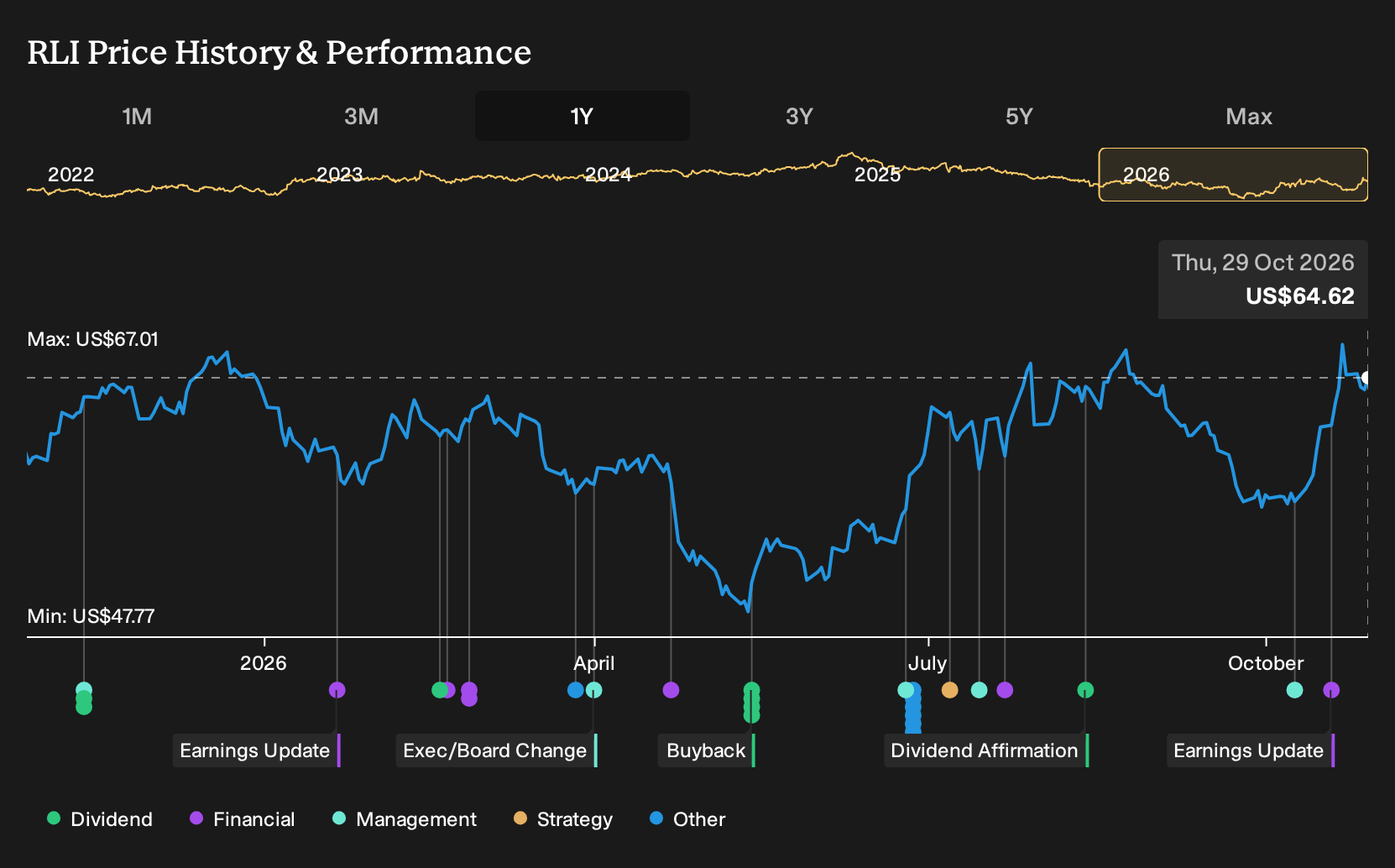
The third quarter 2026 earnings report is the clear reference point here. Revenue for the period was US$476.96 million compared with US$509.26 million a year earlier, while net income moved from US$124.61 million to US$81.01 million. Diluted EPS from continuing operations shifted from US$1.35 to US$0.88.
Across the first nine months, revenue was US$1,476.4 million versus US$1,416.76 million in the prior year period, and net income was US$303.92 million versus US$312.16 million. For you as a shareholder, that mix of steadier year to date revenue and softer quarterly profitability feeds directly into the existing catalyst and risk narrative around expenses, underwriting discipline and catastrophe exposure.
RLI's analyst narrative points to forecast revenue of US$2.0b and earnings of US$209.0 million by 2029, with revenue expected to remain broadly flat and earnings projected to decline by roughly US$229.7 million from US$438.7 million today.
Uncover why RLI's fair value indicates a 13% potential downside to its current price that leaves little room for error.
Exploring Other Perspectives
The bearish narrative around RLI Corp. leans hard on margin risk. The lowest analysts were already modeling revenue of about US$2.1b and earnings near US$196.7 million by 2029, well below the consensus path. After this softer quarter, you might see those cautious voices grow louder, so it is worth exploring how far opinions can stretch before you decide where you sit.
Explore 3 other RLI fair value estimates, including one that suggests as much as 13% downside from the current price.
Form Your Own Verdict
Disagree with existing narratives? Extraordinary investment outcomes rarely result from strictly following the herd, so consider trusting your own analysis.
- A great starting point for your RLI research is our analysis highlighting 2 key rewards and 2 important warning signs that could impact your investment decision.
- See our latest analysis for RLI. The report includes a comprehensive fundamental analysis summarized in a single visual, the Snowflake, making it easier to evaluate RLI's overall financial health at a glance.
Looking for more RLI investment ideas?
If RLI's latest update has you rethinking your insurance exposure or simply wanting a broader watchlist, it can help to line it up against other businesses with different strengths and risk profiles using the Simply Wall St Screener.
- If you are hunting for quality at a reasonable entry point, scan a focused set of 30 high quality undervalued stocks that blend solid fundamentals with more appealing valuations.
- If income reliability matters most to you, weigh RLI against a curated pool of 7 dividend fortresses that offer higher yields with an emphasis on resilience.
- If capital preservation ranks higher than aggressive upside, broaden your shortlist with a carefully filtered group of 30 resilient stocks with low risk scores that score well on balance sheet strength and risk metrics.
Have feedback on this article? Concerned about the content? Get in touch with us directly. Alternatively, email editorial-team@simplywallst.com