


- Safran confirmed its full year 2026 guidance in October 2026, reiterating a mid teens revenue growth outlook following its July revision.
- The group’s expanded actuation capabilities from the Collins Aerospace acquisition position Safran at the center of Airbus’s folding wing fuel efficiency initiatives.
- We will now look at how Safran's confirmed mid teens 2026 revenue outlook might influence the broader investment narrative that investors follow.
Scan beyond Safran and compare its guidance story with hand picked peers by running the 605 high quality undiscovered gems that share strong fundamentals but still fly under most investors’ radar.
Safran Investment Narrative Recap
To own Safran, you need to be comfortable with a capital intensive aerospace group that is leaning hard into fuel efficient propulsion and higher value equipment and defense activities. The confirmed 2026 mid teens revenue growth outlook supports that investment case at the top line, but it does not change the need for sustained execution on LEAP engine output, CFM56 aftermarket and defense programs.
The near term swing factor remains Safran’s ability to deliver engines and complex equipment without fresh supply chain snags that could hold back revenue recognition and put pressure on propulsion margins. The biggest risk still sits in heavy capex and R&D staying above 6% of sales while the French corporate surtax weighs on free cash flow.
The Airbus folding wing work, supported by Safran’s expanded actuation capabilities from the Collins Aerospace acquisition, looks most relevant to this guidance confirmation. The new wing concepts require roughly double the number of actuators, which gives the equipment and controls activity a clearer role in next generation aircraft programs that target lower fuel burn.
For you, the link to catalysts is straightforward. If Safran executes on these higher content airframe opportunities while keeping engine programs and defense projects on track, the mix shift away from interiors toward propulsion and defense equipment could support the mid teens revenue ambition. Any stumble in program execution or supply chain stability would quickly test that guidance and the margin narrative that sits behind it.
Safran's narrative projects €45.9b revenue and €6.2b earnings by 2029. This is based on an assumed 11.0% yearly revenue growth and an earnings increase of about €2.3b from €3.9b today.
Uncover why Safran's fair value indicates a 36% potential upside to its current price that could narrow quickly.
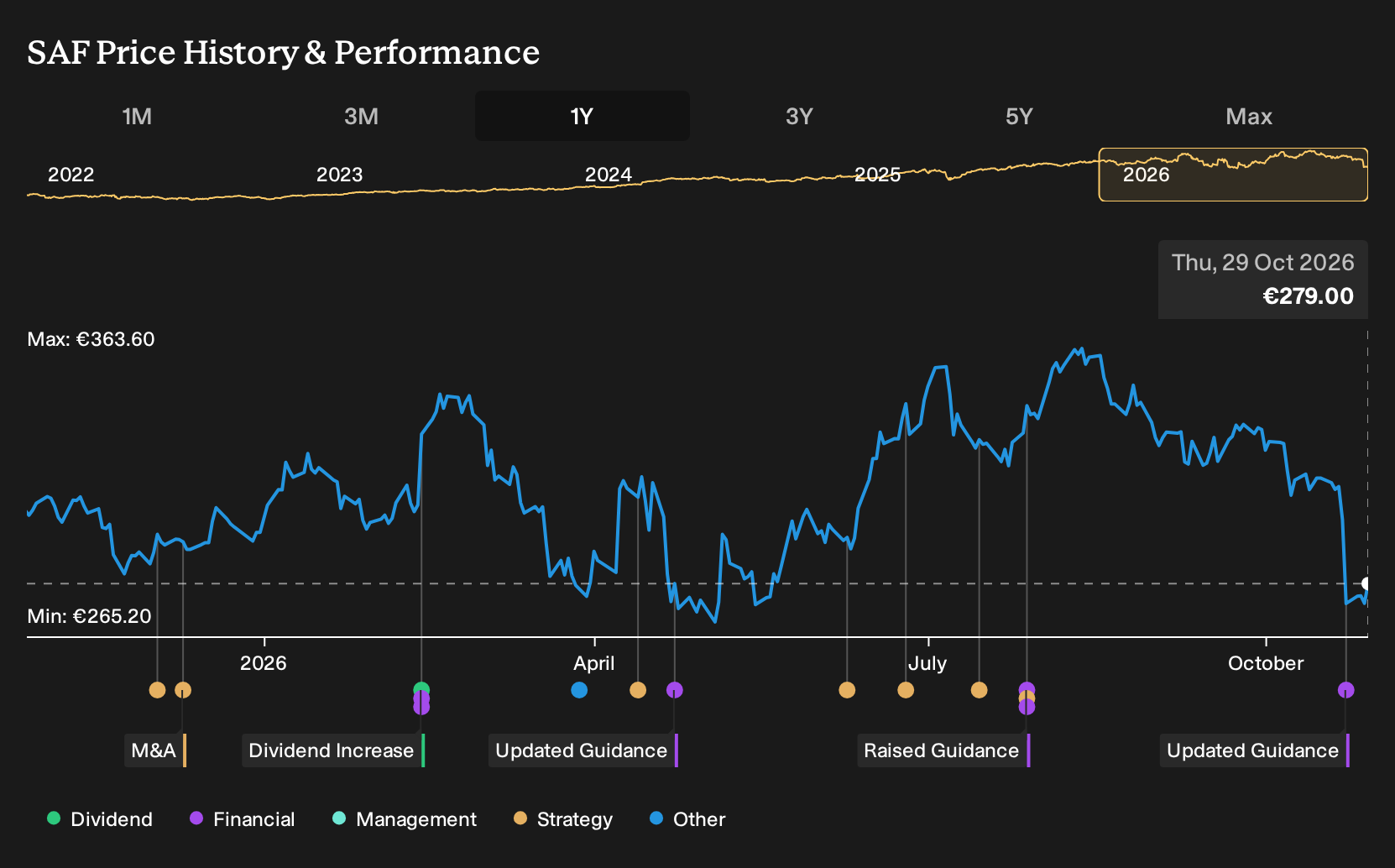
Exploring Other Perspectives
One alternate view focuses on input cost pressure rather than Safran’s folding wing opportunity. The most cautious analysts worry about raw materials and in house forging costs squeezing profitability, which helps explain why they were only pencilling in about €44.7b revenue and €5.6b earnings for 2029 before this 2026 guidance confirmation. Those lower figures show how widely opinions can differ, so it can be useful for you to compare several narratives and decide which assumptions feel more realistic if guidance or program execution shifts from here.
Explore 4 other Safran fair value estimates, including one that suggests it could be worth just €325.00.
Decide For Yourself
Disagree with existing narratives? Extraordinary investment outcomes rarely come from following the herd, so consider your own analysis and judgment.
- A great starting point for your Safran research is our analysis highlighting 3 key rewards that could impact your investment decision.
- See our latest analysis for Safran. The report includes a comprehensive fundamental analysis summarized in a single visual, the Snowflake, making it easy to evaluate Safran's overall financial profile at a glance.
Looking For More Ideas Beyond Safran?
If you want to put Safran’s story in context, it often helps to line it up against other opportunities that share solid fundamentals or different risk profiles. The Simply Wall St Screener can help you quickly filter for companies that better match your return goals and risk tolerance.
- If you want quality at a reasonable price, start with companies that combine strong fundamentals with attractive valuations by checking out this 200 high quality undervalued stocks.
- If capital preservation sits high on your list, compare Safran with businesses that score well on financial resilience and lower risk using this 220 resilient stocks with low risk scores.
- If balance sheet strength matters most to you, focus on companies with robust assets and funding profiles through this list of solid balance sheet and fundamentals (203 results).
Have feedback on this article? Concerned about the content? Get in touch with us directly. Alternatively, email editorial-team@simplywallst.com