


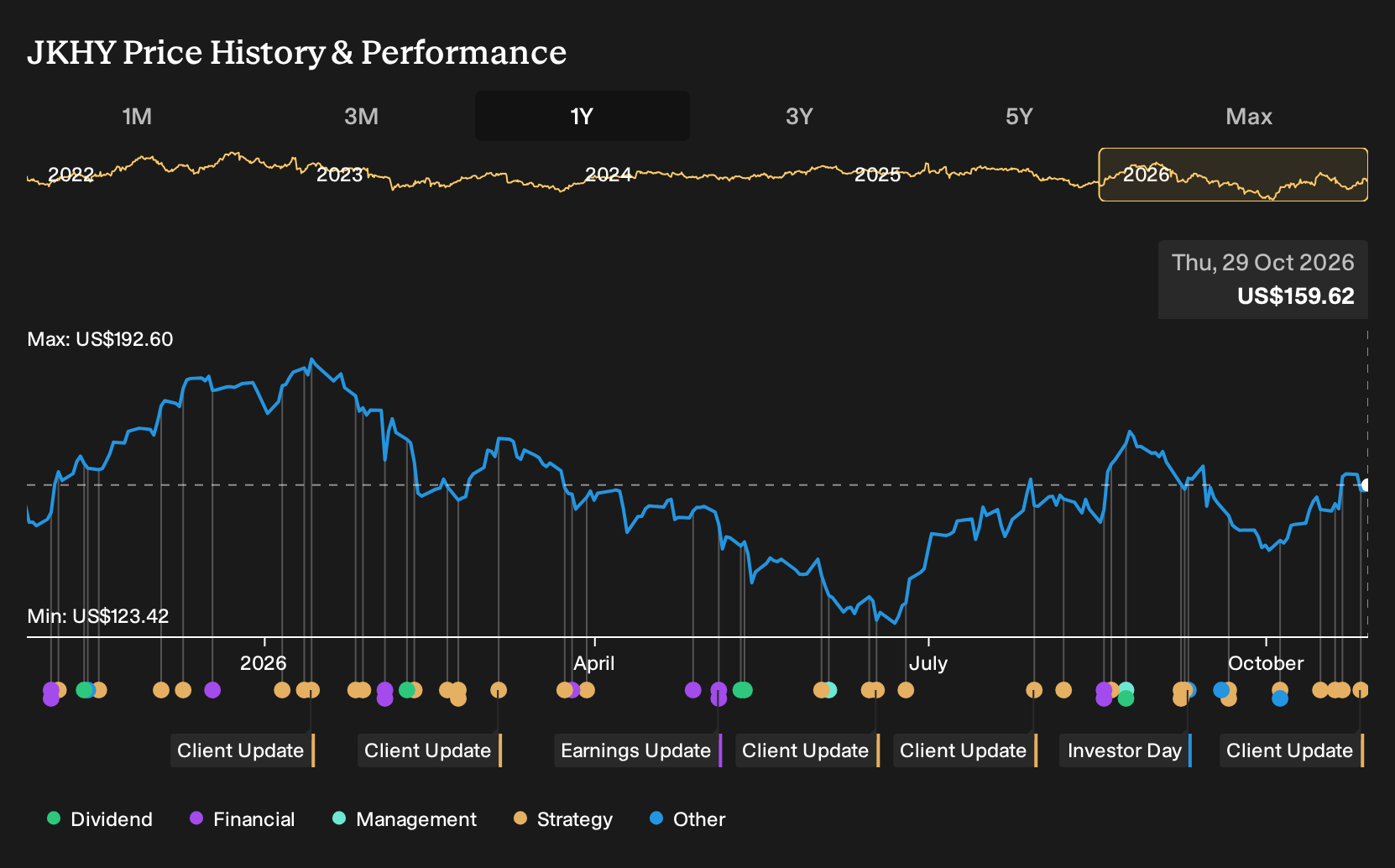
- In October 2026, Jack Henry & Associates expanded its collaboration with Google Cloud, becoming the first core technology provider to integrate with Google Cloud Universal Ledger to support tokenized deposits and real time programmable settlement for bank and credit union clients.
- The move gives Jack Henry a new way to embed 24/7 programmable payments and tokenized deposit infrastructure into its core and Banno platforms. This can matter for how community and regional institutions keep deposits and digital engagement inside their own ecosystem.
- Next, the focus shifts to how Jack Henry & Associates' investment narrative could be influenced by this tokenized deposit integration with Google Cloud.
Jack Henry & Associates Investment Narrative Recap
To own Jack Henry & Associates, you need to believe community and regional institutions will keep leaning on its platforms for cloud, digital, real time payments, and now tokenized deposits. The short term swing factor is execution on this modernization pipeline while keeping recurring software and services work flowing, even as deconversion revenue is expected to be lower in fiscal 2027.
The biggest risk remains industry consolidation. Fewer banks and credit unions means Jack Henry & Associates must win a larger share of a shrinking client base while managing cost inflation in areas like cyber security. The recent tokenized deposit work and youth banking integrations are helpful signals, but not a clear near term game changer on their own.
The Greenlight family banking integration looks closest to the core of this story. It plugs directly into Banno through Jack Henry & Associates APIs, keeps kids and parents inside a bank or credit union’s own app, and adds financial literacy, allowance automation, and spend controls as daily use cases around the existing core system.
For catalysts, this sits alongside the Nuuvia youth and family banking collaboration and the tokenized deposit work with Google Cloud. Together, they show the ecosystem filling out around real time payments, household engagement, and embedded tools. Execution risk is real. Jack Henry & Associates still needs to prove these fintech connections turn into durable contracts that offset bank consolidation and support margins.
Jack Henry & Associates Analyst Expectations In Context
Analyst models around Jack Henry & Associates now put hard numbers behind the tokenized deposit and youth banking story. Forecasts point to revenue of about US$3.1b and earnings of US$610.5m by 2029, based on an assumed 6.6% yearly revenue growth rate and profit margins that remain around 19.8%.
On the earnings side, consensus implies an increase from about US$502.8m today to US$610.5m by 2029. This is roughly a 21% step up over that period. That trajectory sits alongside an expected 3.13% annual reduction in the share count, which could make earnings per share grow faster than total profit if that buyback pace holds.
Valuation assumptions are just as important for investors tracking Jack Henry & Associates. To line up with the current analyst price target, the shares would need to trade on a P/E of 24.5x those projected 2029 earnings, compared with 21.1x today and around 17.2x for the broader U.S. diversified financials peer group cited in the report.
Jack Henry & Associates' narrative projects about US$3.1b in revenue and US$610.5m in earnings by 2029. This would require 6.6% yearly revenue growth and an earnings increase of roughly US$107.7m from about US$502.8m today.
Uncover why Jack Henry & Associates' fair value indicates a 19% potential upside to its current price that may not last much longer.
Exploring Other Perspectives
Four fair value estimates from the Simply Wall St Community span roughly US$163.69 to about US$205.11, so retail views on Jack Henry & Associates stretch from cautious to optimistic. When you set those against bank consolidation risk and new youth banking and tokenized deposit catalysts, you get a reminder that opinions can diverge sharply. Explore the full spread of community viewpoints before forming your own stance.
Explore 3 other Jack Henry & Associates fair value estimates, including one that suggests it could be worth just $163.69.
Decide For Yourself
Don't just follow the ticker; dig into the data and build a conviction that's truly your own.
- A great starting point for your Jack Henry & Associates research is our analysis highlighting 4 key rewards that could impact your investment decision.
- See our latest analysis for Jack Henry & Associates. The report includes a comprehensive fundamental analysis summarized in a single visual, the Snowflake, making it easy to evaluate Jack Henry & Associates' overall financial health at a glance.
Looking for more investment ideas beyond Jack Henry & Associates?
If the Jack Henry & Associates story has you thinking about where else recurring software revenue, resilient balance sheets, or dependable income streams might show up, the Simply Wall St Screener can help you filter the wider market down to a focused shortlist that fits your own playbook.
- For investors who want staying power and cleaner balance sheets, start with a list of solid balance sheet and fundamentals (23 results) that can handle shocks better than highly leveraged peers.
- If your priority is resilience with fewer red flags, look across 30 resilient stocks with low risk scores that rank well on stability and business quality factors.
- Income focused readers can zero in on stocks that aim to pay you while you wait by scanning 7 dividend fortresses offering yields above 5%.
Have feedback on this article? Concerned about the content? Get in touch with us directly. Alternatively, email editorial-team@simplywallst.com