


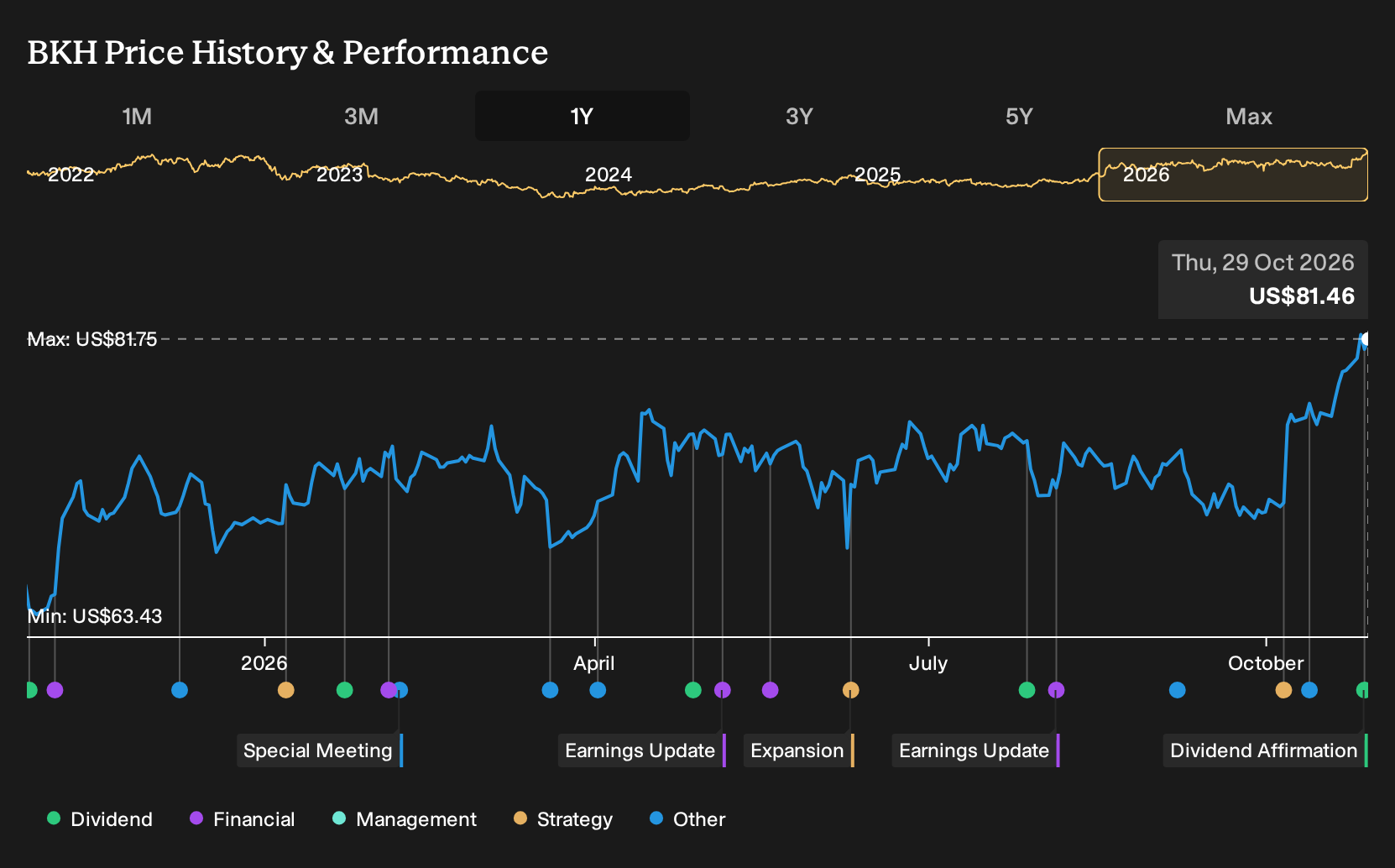
- Black Hills Corporation confirmed a quarterly dividend of US$0.703 per share for common shareholders of record on 17 November 2026, payable on 1 December 2026.
- The long term agreement to supply 590 megawatts of power to a Google backed data center supports Black Hills Corporation's planned US$1.8b investment in additional natural gas generation capacity and related future cash flow.
- We will look at how Black Hills' investment narrative is reshaped by the long term Google power contract and capacity expansion plan.
Scan a curated set of utilities that focus on long term contracts and steady payouts by reviewing the 7 dividend fortresses alongside Black Hills' latest dividend and Google data center deal.
Black Hills Investment Narrative Recap
To own Black Hills, you need to believe the regulated utility model around electric and gas networks remains intact and that regulators keep supporting its large capital plan. The Google backed data center contract and related US$1.8b build out rely on that same premise. The biggest near term swing factor still sits with rate case outcomes rather than headlines about new customers.
Weather and balance sheet pressure remain the key operational risks. Warm winters already pulled on earnings earlier in 2026, and interest costs are not comfortably covered by current profits. The Google contract adds long duration visibility on load, but it does not remove exposure to rate decisions, financing terms, or construction execution.
The long term power agreement with Google is the announcement that most directly ties into Black Hills’ current catalysts. Management now has a specific 590 megawatt commitment to point to, alongside a disclosed US$1.8b natural gas generation build that fits into the existing US$4.7b capital plan. That helps frame the Cheyenne data center pipeline in operational terms.
For you as a shareholder, this deal connects several moving parts. It reinforces the focus on large load data center customers, links expected future cash generation to concrete assets in rate base, and interacts with the planned NorthWestern Energy merger by adding scale. The core execution test now lies in delivering projects on time and securing timely cost recovery while managing dividend commitments and interest coverage.
Black Hills' current analyst narrative links a forecast for revenues to reach US$4.9b and earnings of US$821.4m by 2029, based on an assumed 28.6% yearly revenue growth rate and an earnings increase of about US$522m from US$299.1m today.
Uncover how Black Hills' fair value indicates a 6% potential upside to its current price before the market closes.
Exploring Other Perspectives
Two fair value estimates from the Simply Wall St Community sit between about US$66.9 and US$86.6 per share, which already shows how far private investors can disagree on Black Hills. You now have the Google contract, the pending NorthWestern merger, ongoing rate reviews, and weather sensitivity all pulling those views in different directions. Explore them.
Explore another Black Hills fair value estimate, including one that suggests up to 18% downside from the current price.
Decide For Yourself
Disagree with existing narratives? Extraordinary investment returns rarely come from following the herd, so go with your instincts.
- A great starting point for your Black Hills research is our analysis highlighting 3 key rewards and 2 important warning signs that could impact your investment decision.
- See our latest analysis for Black Hills. The report includes a comprehensive fundamental analysis summarized in a single visual, the Snowflake, making it easy to evaluate Black Hills' overall financial health at a glance.
Looking for more investment ideas beyond Black Hills?
Once you have a view on Black Hills, it can help to line it up against other opportunities that fit different risk levels and income profiles. The Simply Wall St Screener lets you scan for companies with the kind of balance between quality, yield, and resilience that suits your own approach.
- If capital preservation comes first, you could focus on businesses that score well on stability and financial strength by reviewing 30 resilient stocks with low risk scores.
- For investors who want income supported by fundamentals, compare Black Hills' profile with a curated 7 dividend fortresses that prioritise resilient payouts.
- If you are hunting for future leaders that are not widely followed yet, broaden your watchlist with a 18 high quality undiscovered gems that already show strong underlying metrics.
Have feedback on this article? Concerned about the content? Get in touch with us directly. Alternatively, email editorial-team@simplywallst.com