


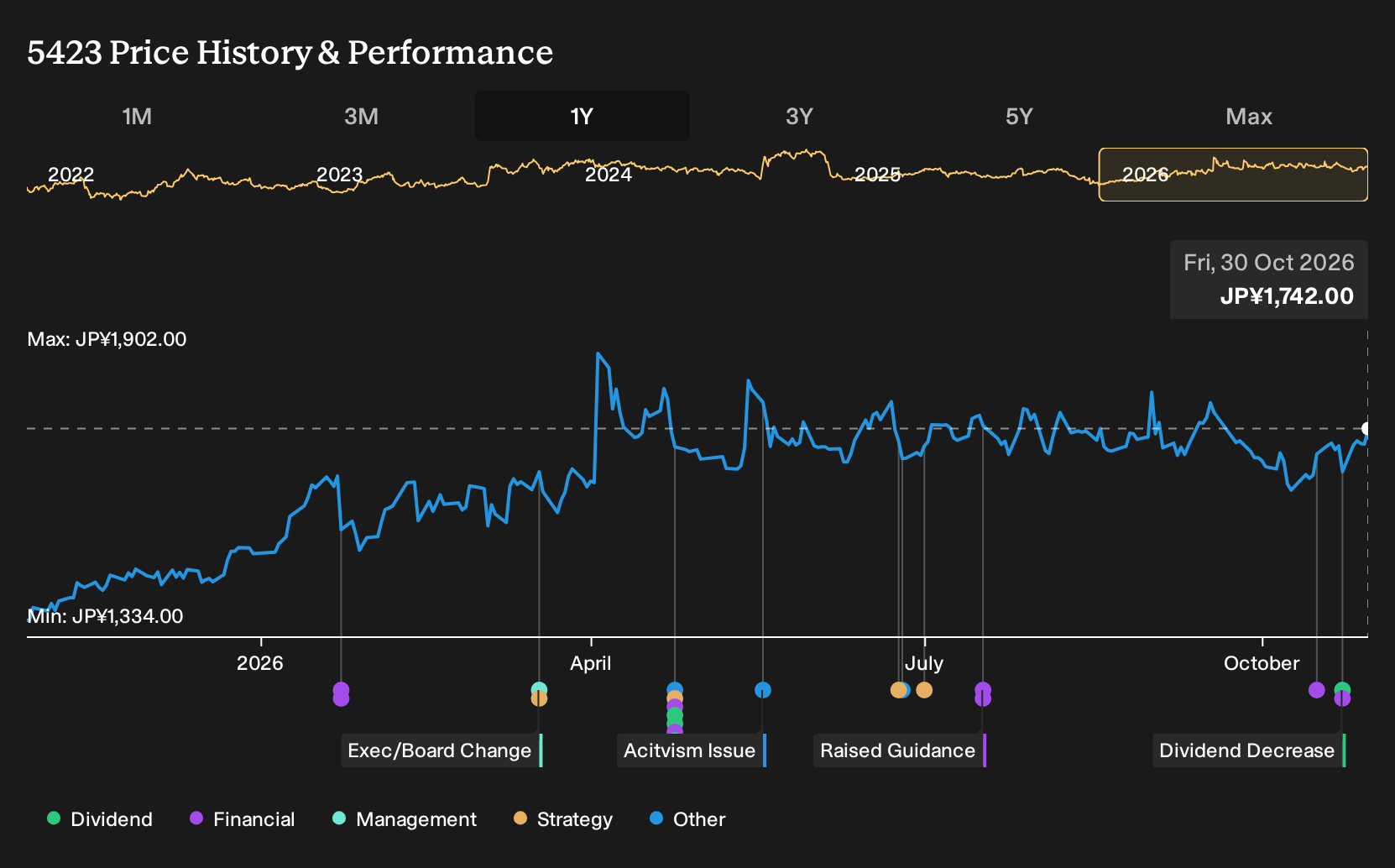
- Tokyo Steel Manufacturing reported half year results to September 30, 2026, with sales of ¥150,422 million, net income of ¥2,389 million, basic EPS of ¥23.46, and a second quarter dividend cut to ¥20 per share from ¥25 a year earlier.
- The business paired a reduced interim payout with guidance that lifts profit and EPS expectations through asset sales and pricing, while trimming full year operating profit targets as operating conditions and cost controls remain key swing factors.
- We will now look at how Tokyo Steel Manufacturing’s weaker net income but higher profit guidance could reshape the broader investment narrative.
What Is Tokyo Steel Manufacturing's Investment Narrative?
To own Tokyo Steel Manufacturing, you need to be comfortable with a simple idea. This is a cyclical, capital intensive producer where pricing power, scrap costs and plant efficiency matter more than smooth quarterly charts. The latest half year shows that reality clearly. Sales rose to ¥150,422 million while net income fell to ¥2,389 million, and the firm cut the interim dividend to ¥20, yet raised profit guidance helped by higher shipment prices, lower scrap costs and asset sales.
In the short term, the key swing factors are still steel prices, scrap input costs and how much of recent price revisions stick in contracts. The revised guidance suggests management is leaning hard into profitability and cost control, but the lower operating profit targets and use of asset disposals highlight execution risk if demand softens or pricing momentum cools. That mix, combined with a P/E of 18.8x versus a lower sector average and earnings forecasts that point to declines over the next few years, makes this very much a belief test in how Tokyo Steel runs its furnaces rather than a clean growth story.
Yet there is one operational pressure point around Tokyo Steel Manufacturing that could unsettle that belief if it shifts even slightly.
There's only one way to know the right time to buy, sell or hold Tokyo Steel Manufacturing. Head to Simply Wall St's company report for the latest analysis of Tokyo Steel Manufacturing's Fair Value.
Form Your Own Verdict
Don't just follow the ticker. Dig into the data and build a conviction that's truly your own.
- A great starting point for your Tokyo Steel Manufacturing research is our analysis highlighting 4 important warning signs that could impact your investment decision.
- See our latest analysis for Tokyo Steel Manufacturing. The report includes a comprehensive fundamental analysis summarized in a single visual, the Snowflake, making it easy to evaluate Tokyo Steel Manufacturing's overall financial health at a glance.
Looking For More Ideas Beyond Tokyo Steel Manufacturing?
If Tokyo Steel Manufacturing has sharpened your focus on pricing power, balance sheets and payout resilience, it makes sense to scan for other listed businesses with similar traits. The Simply Wall St Screener lets you filter by quality, valuation, income profile and risk, so you can build a watchlist that reflects how you actually like to invest.
- For investors who care about valuation and business quality working together, review 14 high quality undervalued stocks that combine solid fundamentals with room for the market to reassess their pricing.
- If reliable payouts matter to your plan, check out 28 dividend fortresses that focus on higher yielding companies where income is a core part of the thesis.
- When capital preservation comes first, filter for 24 resilient stocks with low risk scores that score well on resilience so you can prioritize stability alongside potential upside.
Have feedback on this article? Concerned about the content? Get in touch with us directly. Alternatively, email editorial-team@simplywallst.com