


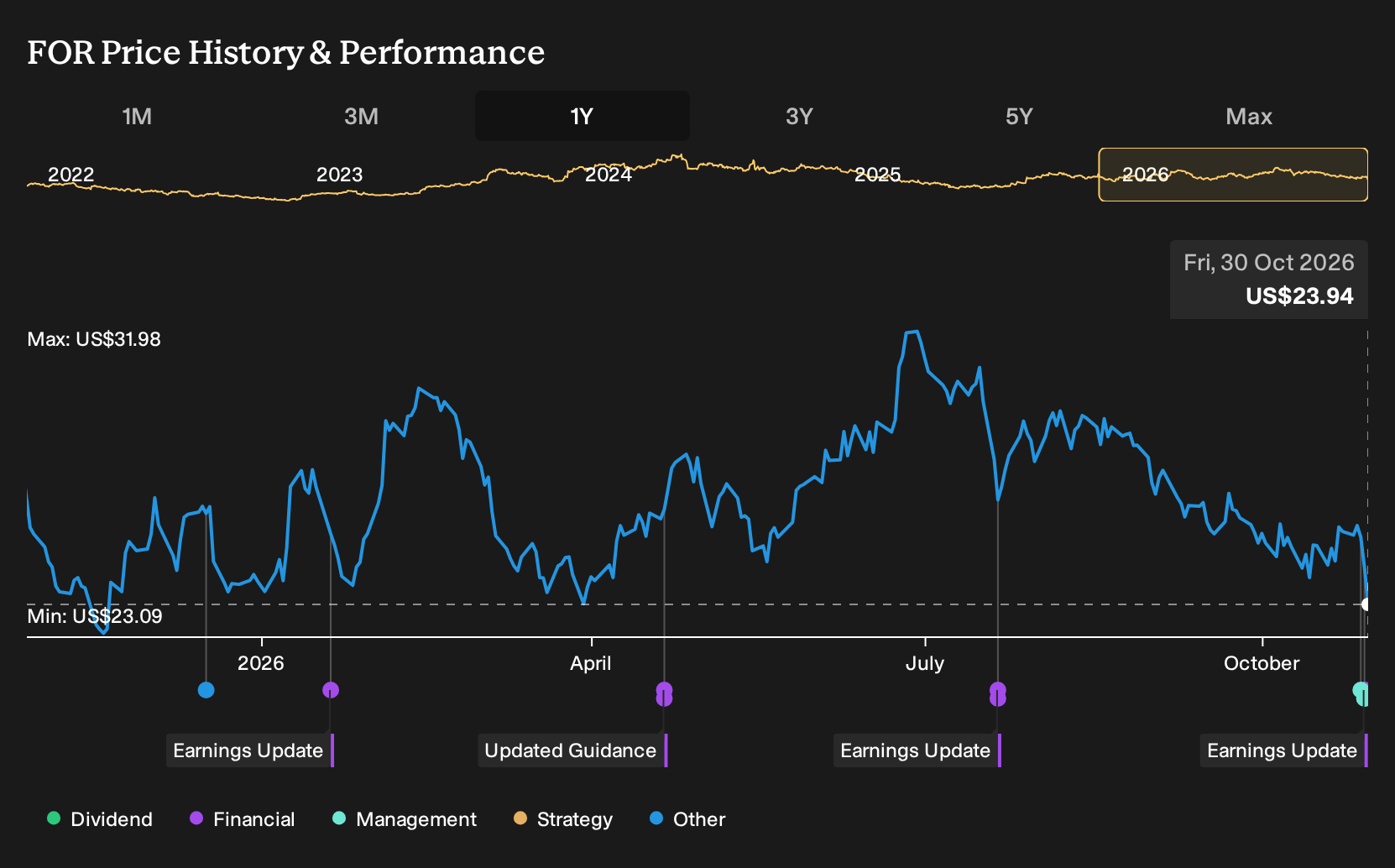
- Forestar Group reported lower fourth quarter and full year 2026 results, with sales of US$580.8 million and US$1,635.1 million, and net income of US$59.2 million and US$142.6 million respectively, alongside reduced basic and diluted earnings per share versus the prior year.
- Alongside softer earnings, Forestar Group's boardroom is shifting as long serving Executive Chairman Don Tomnitz retires, CEO Andy Oxley steps into the Executive Chairman role, and experienced real estate executive Stacey Dwyer joins multiple key board committees.
- This article will explore how Forestar Group's softer earnings and leadership reshuffle relate to its existing investment narrative and risk profile.
Compare Forestar Group's softer results and boardroom changes with other real estate developers by scanning our curated list of list of solid balance sheet and fundamentals (23 results) for potential alternatives in the same space.
Forestar Group Investment Narrative Recap
To own Forestar Group, you need to believe the land development engine still converts its contracted lot base and planned US$1.4b of 2026 land spend into consistent, profitable closings. Softer fourth quarter and full year earnings point to pressure on volumes and margins, yet they do not fundamentally alter that core thesis on their own.
The more immediate swing factor remains how quickly those contracted lots close against a backdrop of home affordability challenges. The biggest risk is that recent volume declines, margin compression, and negative free cash flow persist, which would keep returns on capital under strain even with a solid backlog and liquidity.
The boardroom reshuffle that moves CEO Andy Oxley into the Executive Chairman role and brings in Stacey Dwyer matters for how Forestar Group executes on its backlog and capital plan. Dwyer’s background in homebuilding, land development, financing, and accounting gives the audit, compensation, and governance committees deeper real estate and capital markets experience.
This governance shift lands right as Forestar Group is balancing a record contracted lot pipeline with earnings pressure and expectations for declining profit over the next few years. Execution on cycle times, lot mix, and returns on new projects now sits more squarely on a leadership team that combines operating familiarity with fresh board oversight.
Forestar Group's current analyst narrative points to revenues of about US$1.7b and earnings of roughly US$133.1 million by 2029, based on an assumed 1.1% yearly decline in revenue and a move from earnings of US$170.4 million today to that lower profit level. This implies an earnings decrease of about US$37.3 million over the forecast period.
Uncover why Forestar Group's fair value indicates a 42% potential upside to its current price, which could narrow quickly.
Exploring Other Perspectives
For Forestar Group, the most bearish twist is the concern that heavy reliance on D.R. Horton becomes a ceiling rather than a springboard. Those most pessimistic analysts were already estimating revenue of about US$1.7b and earnings of around US$132.1 million by 2029, before this weaker 2026 result, so their already cautious narrative could become even more conservative. You, as an investor, now decide which version of the future seems more realistic and whether it is worth examining several competing forecasts before acting.
Explore another Forestar Group fair value estimate, including one that suggests as much as 12% downside from the current price.
Reach Your Own Conclusion
Disagree with existing narratives? Extraordinary investment returns rarely come from following the herd, so consider trusting your own analysis and instincts.
- A great starting point for your Forestar Group research is our analysis highlighting 3 key rewards and 1 important warning sign that could impact your investment decision.
- See our latest analysis for Forestar Group. The report includes a comprehensive fundamental analysis summarized in a single visual, the Snowflake, making it easy to evaluate Forestar Group's overall financial health at a glance.
Looking for more investment ideas beyond Forestar Group?
Once you have a view on Forestar Group, it often helps to compare it with a few very different opportunities so you can see what really earns a place in your portfolio.
- If you want potential growth with a small starting price tag, scan our 10 elite penny stocks with strong financials that pair low share prices with financial profiles that are stronger than many peers.
- For investors who care most about quality at a reasonable entry point, compare Forestar Group against our 30 high quality undervalued stocks that combine healthier balance sheets with solid cash generation.
- If capital preservation comes first for you, stress test your ideas against our 30 resilient stocks with low risk scores that focus on businesses with more resilient risk scores.
Have feedback on this article? Concerned about the content? Get in touch with us directly. Alternatively, email editorial-team@simplywallst.com