


Canadian investors are rethinking income after a record pullback from United States stocks, as Canada forges closer commercial ties with Europe and other partners. Reliable cash flow suddenly matters more than story stocks. That is where high yielding Canadian dividend companies with well covered, growing payouts come in. This article highlights three such dividend payers from our screen that merit a closer look for long term income.
The three stocks highlighted here offer a compelling starting point if you want exposure to higher yielding Canadian dividend payers with well covered, stable payouts. However, if you want the names that matter most, these 3 dividend aristocrats stocks are the strongest companies we've found.
Sun Life Financial (TSX:SLF)
Sun Life Financial anchors this Dividend Powerhouses screen because its more than 3% yield is tied directly to recurring life insurance premiums and fee income from asset management, creating a fairly straightforward link between the day to day business and the cash paid out to shareholders.
Sun Life Financial is a global insurer and asset manager providing life and health coverage, retirement products, and investment solutions, with revenue concentrated in Canada at about CA$15.7b and the U.S. at roughly CA$13.0b, plus CA$7.7b from Sun Life Asset Management, and a market value near CA$63.8b.
"Strong growth in Asia individual insurance sales, with $875 million of quarterly sales and over $7 billion of contractual service margin in the region, supports the view that Sun Life Financial can keep expanding its addressable market and add new premium and fee income streams that feed into earnings growth."
The real swing factor is whether one less visible pressure is quietly reshaping the balance between that income engine and future payout capacity.
If that pressure is what you care about, read the full narrative for Sun Life Financial to see whether it is quietly masking risk or accelerating Sun Life Financial's payout potential.

Magna International (TSX:MG)
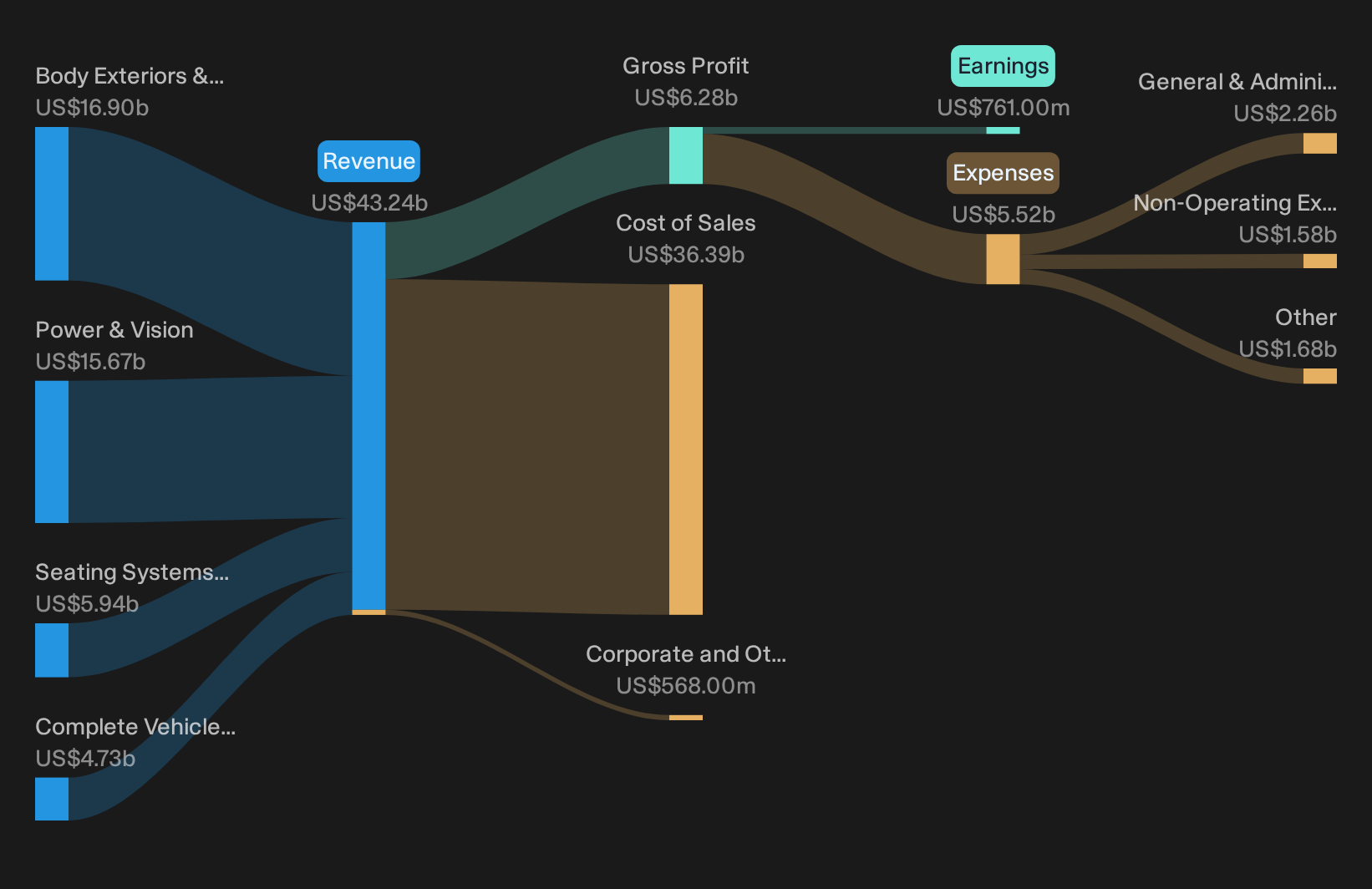
Magna International is the second pillar in this Dividend Powerhouses screen, using its cash rich auto parts and contract manufacturing work to support a 3%+ payout. The Power & Vision and Complete Vehicles operations do much of the heavy lifting for dividend coverage.
Magna International designs and builds everything from vehicle bodies and seating to cameras, radar and full vehicle assemblies. It earns about $16.9b from Body Exteriors & Structures, $15.7b from Power & Vision, $5.9b from Seating Systems and $4.7b from Complete Vehicles, with a market value near $24.0b.
"Magna International is continuing its operational excellence and factory of the future programs, with management pointing to roughly 200 bps of EBIT margin improvement from 2023 through the 2026 outlook and a target of 35 to 40 bps of annual margin expansion, which supports expectations for further progress in net margins and earnings."
What income focused holders will really care about is how one less visible shift in this margin story filters through to long term dividend comfort.
That hidden shift in dividend comfort is exactly what the full narrative for Magna International unpacks, showing where Magna International's margin work could be accelerating or quietly stalling future payouts.
Bank of Nova Scotia (TSX:BNS)
Bank of Nova Scotia is a classic Dividend Powerhouse, using the cash it earns from everyday banking and wealth clients to fund a 3%+ yield that is designed to be regular, covered and dependable for income focused investors.
Bank of Nova Scotia runs a full service banking and wealth platform, with Canadian Banking generating about CA$11.9b of revenue, International Banking contributing roughly CA$9.6b, Global Wealth Management around CA$7.1b and Global Banking and Markets near CA$6.8b, and the group valued at about CA$162.4b.
Scotiabank’s appeal on this list comes from how that dividend is tied to broad based earnings across Canada and a range of international markets, setting up an income stream that is meant to keep pace with a changing global customer base.
"Expansion of banking and wealth management services in Pacific Alliance markets such as Mexico, Peru, Chile and Colombia remains a live driver, with International Banking revenue and loan growth in these regions and ROE above 16% pointing to further potential for fee income and earnings growth as Bank of Nova Scotia continues to deepen client relationships."
What could influence the long term dividend story is how one quiet shift in capital use and credit costs shapes those future cash flows.
That shift is exactly what the full narrative for Bank of Nova Scotia breaks down, showing whether capital is quietly accelerating Bank of Nova Scotia's dividend engine or masking new risks.

Seeking Alternatives Before The Crowd?
Fresh ideas move first. Breakout themes gain momentum while they are still under the radar for now, and laggards get caught dropping before headlines hit. Act now.
- Hunt for resilient cash generators by scanning the list of solid balance sheet and fundamentals (6 results) to keep financial footing front and center when markets start flying in either direction.
- Spot potential income workhorses early by reviewing the 3 dividend fortresses before yields get compressed and the best opportunities are picked over by the crowd.
- Track the next wave of infrastructure demand by checking the 39 power grid technology and infrastructure stocks while capital still chases yesterday’s trends instead of tomorrow’s cash flows.
Have feedback on this article? Concerned about the content? Get in touch with us directly. Alternatively, email editorial-team@simplywallst.com