


AT&T Inc. has delivered a 56.7% gain over the past three years, a run that now meets a fresh stream of earnings headlines and guidance updates. With the stock recently closing at US$21.41, the core question is whether that price can be squared with what the business is currently earning and expected to earn.
- That 56.7% three year return puts real weight on the idea that AT&T’s earnings power and payout profile need to support a meaningfully higher equity value than a few years ago.
- Management’s higher earnings outlook, coupled with strong fiber and wireless customer additions and lower planned capital spending, can reshape expectations for profit sustainability and cash available to equity holders in the years ahead.
- Your read on AT&T is one view; the desks covering it have another. See what analysts think AT&T's shares could be worth.
The issue now is whether AT&T’s current share price is adequately backed by its earnings when lined up against the Fair Ratio benchmark.
If you want to test the same earnings question you are asking of AT&T across a broader watchlist, start by scanning 29 high quality undervalued stocks.
Is AT&T a Bargain on Earnings?
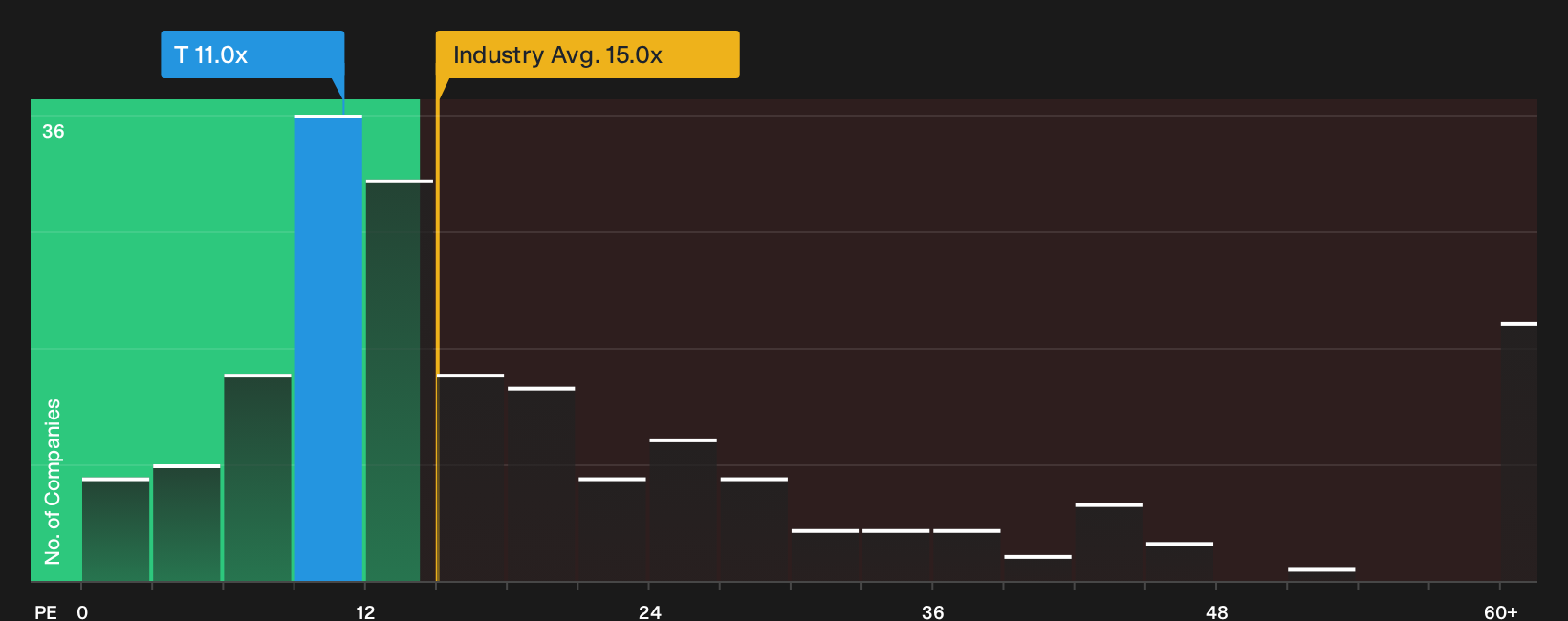
The P/E ratio is a useful lens for AT&T because earnings remain a central yardstick for how investors weigh a mature telecom business. At AT&T’s current share price, the stock trades on roughly 11.0x earnings. That is slightly below the broader Telecom sector on about 15.0x and modestly under the peer group average near 11.8x, which points to a discounted earnings tag relative to similar operators.
Because the Fair Ratio blends AT&T’s growth profile, profit structure, size and risk into a single earnings benchmark, the current 11.0x multiple comes in under what that model would imply. Despite the higher 2026 earnings outlook and customer momentum in fiber and wireless, the market is still pricing AT&T below this tailored yardstick on P/E. For investors, that gap highlights a situation where the share price does not fully reflect the earnings capacity that the Fair Ratio framework would suggest. Explore the numbers behind AT&T's P/E valuation.
The AT&T Narrative: What Would Justify Today's Price?
Simply Wall St Narratives pick up where the AT&T valuation puzzle leaves off. They spell out which earnings, growth and margin paths would need to play out for the stock to look meaningfully cheaper or more expensive than it does today. Each idea links its number to a specific view of how AT&T's growth, profitability and risks could evolve, giving you something concrete to revisit on the Community page as fresh information comes through.
Community views on AT&T are split between those who see fiber, cost cuts and capital returns leaving more upside on the table, and those who think the current price already bakes most of that in.
Bull case: 25% undervalued
"The current valuation suggests the market is cautious that AT&T’s fiber led convergence, expected cost savings of roughly $6b from legacy networks, and planned approximately $45b in shareholder returns over three years will fully translate into a higher share price..."
Discover why this Narrative puts AT&T at 25% undervalued.
Bear case: 6% overvalued
"The current valuation implies that AT&T's share price already reflects guided double-digit EPS growth through 2028, disciplined capital returns of $45 billion over three years, and sustained operating leverage from Advanced Connectivity, leaving limited room for disappointment..."
Explore why this Narrative puts AT&T at 6% overvalued.
AT&T's valuation still leaves one powerful question hanging
Before you lean too hard on the numbers, you also need to know who is steering AT&T and how their rewards line up with the outcomes you care about. See who runs AT&T and how they are paid.
Have feedback on this article? Concerned about the content? Get in touch with us directly. Alternatively, email editorial-team@simplywallst.com