


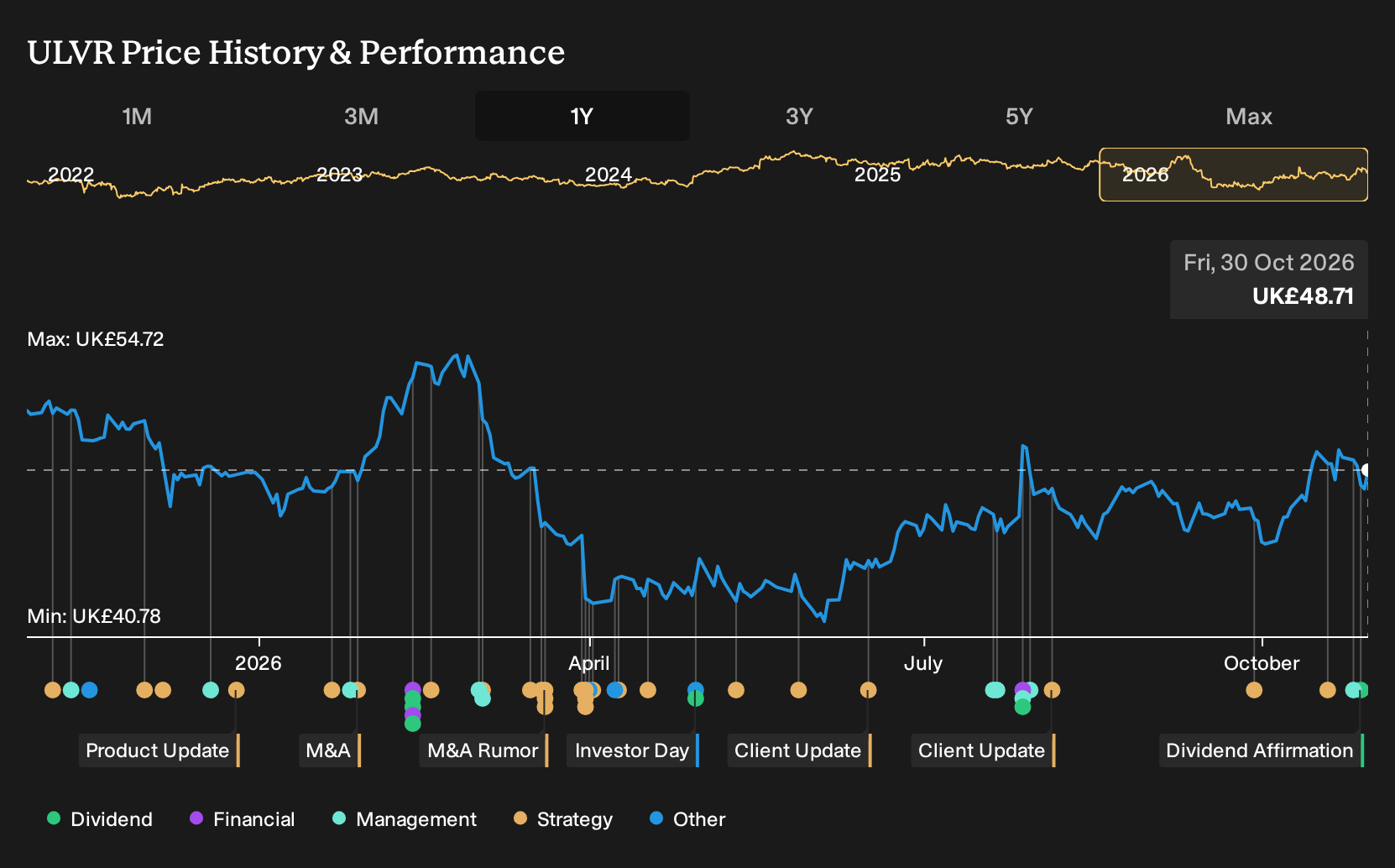
- Unilever reported its Q3 2026 sales and trading update and declared a €0.4664 interim dividend for the third quarter, while also recording the resignation of non executive director Ruby Lu.
- The group raised its 2026 growth outlook after Q3 performance, signaling management confidence even as higher input costs drive further price increases in cleaning products.
- We will now look at how Unilever's upgraded 2026 growth outlook could influence the broader investment narrative for the business.
Compare Unilever's upgraded outlook with other consumer staples under pressure from higher input costs by scanning our hand picked 12 high quality undervalued stocks that may merit a closer look.
Unilever Investment Narrative Recap
To own Unilever, you need to believe the business can keep turning its huge emerging markets footprint and its focused Home & Personal Care portfolio into steady, volume-led growth, even when costs are unhelpful. The upgraded 2026 outlook points to management confidence that current pricing, mix and productivity actions are holding up against input cost pressure.
The biggest short-term swing factor remains how shoppers react to further price increases in cleaning products at a time of higher raw material costs linked to the war in Iran. If volumes prove sensitive, the risk is pressure on margins, not a fundamental break in the long-term story.
The most relevant announcement for that debate is the Q3 2026 sales and trading update, where Unilever raised its 2026 growth outlook while flagging more pricing in Home Care. That combination puts execution in the spotlight. Investors are effectively being asked to trust that brand strength and product superiority can carry extra pricing without eroding demand.
Higher input costs of around $850 million expected in 2026 were already a key risk, especially in emerging markets, and the latest comments on pricing link straight back to that concern. The update, together with the confirmed €0.4664 interim dividend, keeps attention on whether cash generation and margins can absorb cost inflation while supporting reinvestment in Power Brands.
Unilever's current analyst narrative points to revenues of €57.3b and earnings of €7.6b by 2029. These projections are based on 4.2% yearly revenue growth and an earnings increase of €2.0b from the current €5.6b base.
Uncover how Unilever's fair value indicates a 7% potential upside to its current price before the discount to fair value closes.
Exploring Other Perspectives
One alternate view says the bigger risk for Unilever is not input costs but execution on automation and AI. The lowest analysts were pencilling in revenue of about €55.9b and earnings of €6.5b by 2029 before this Q3 update. That is a far more cautious story. Use this gap in expectations as a prompt to explore multiple scenarios for how today’s dividend decision, pricing comments and board change might reshape those forecasts.
Explore 7 other Unilever fair value estimates, including one that suggests up to 16% downside from the current price.
Reach Your Own Conclusion
Disagree with existing narratives? Extraordinary investment returns rarely come from following the herd, so trust your own analysis.
- A great starting point for your Unilever research is our analysis highlighting 4 key rewards and 1 important warning sign that could impact your investment decision.
- See our latest analysis for Unilever. The report includes a comprehensive fundamental analysis summarized in a single visual, the Snowflake, making it easy to evaluate Unilever's overall financial health at a glance.
Looking For More Ideas Beyond Unilever?
Once you have a view on Unilever, it can help to widen the lens and compare it with other listed businesses facing different risks and cash flow profiles. The Simply Wall St Screener lets you quickly sort through global stocks by fundamentals so you can build a watchlist that truly matches your own investment style.
- Prefer value with quality in mind, rather than just a low share price, by reviewing our hand picked 12 high quality undervalued stocks and see which companies warrant a place on your radar.
- If balance sheet resilience is a priority, filter for companies with stronger financial footing through our focused list of solid balance sheet and fundamentals (10 results) to find candidates that may better handle tough conditions.
- For investors seeking potential opportunities that are less crowded, scan our curated 5 high quality undiscovered gems to identify lesser known businesses with solid underlying fundamentals.
Have feedback on this article? Concerned about the content? Get in touch with us directly. Alternatively, email editorial-team@simplywallst.com