


Control of the Senate is suddenly in play again, and that shifts the spotlight onto sectors where policy shapes profits. A possible blue wave raises questions about Medicare, Medicaid and the ACA that could reshape how money flows through hospital operators and health insurers. This article walks through three U.S. Hospital Operators and Health Insurers screener stocks that appear closely tied to this political turn, and explains why their exposure to the debate matters for your portfolio.
The three tickers in this piece are only a sample of what this policy theme touches, and the full screen flags 12 more hospital operators and health insurers with equally compelling stories that are not covered here. To move straight from headlines to hands-on analysis, head into the U.S. Hospital Operators and Health Insurers screener to identify, filter and analyze the U.S. Hospital Operators and Health Insurers that best match your risk and return preferences.
Oscar Health (OSCR)
Overview: Oscar Health is a U.S. health insurer that uses technology-driven plans on ACA exchanges and other regulated markets to serve individuals, families and small employers.
Operations: Oscar Health generates all of its approximately US$15.3b in revenue from life and health insurance activities in the United States.
Market Cap: US$9.49b
Oscar Health matters in this screener because its ACA-focused insurance plans and tech platforms are closely tied to any federal shift in coverage rules, subsidies or exchange design.
"The top-line growth is just as aggressive, with revenue surging +42.8% over the trailing twelve months."
One key question is what happens if a single policy decision changes how much pricing power Oscar Health has in those exchange-linked contracts.
When pricing power hinges on Washington, the real question is how Oscar Health plans to respond, and that is where the full narrative for Oscar Health shows what the market might be missing.

Clover Health Investments (CLOV)
Overview: Clover Health Investments offers Medicare Advantage PPO and HMO plans to U.S. seniors, with care decisions supported by its Clover Assistant software.
Operations: Clover Health Investments generates about US$2.48b in revenue from insurance activities in the United States, fully tied to domestic healthcare policy.
Market Cap: US$2.43b
Clover Health Investments plugs directly into the screener theme, because almost every dollar it earns flows from Medicare Advantage rules written in Washington. As a result, any Democratic tilt in the Senate that reshapes funding formulas or risk adjustment mechanics can quickly feed into its top line and economics.
"The company's differentiated technology-driven care model, particularly the Clover Assistant platform, positions it to benefit from the healthcare industry's accelerated shift toward technology adoption and data-driven, value-based care, supporting lower medical costs and higher medical margins."
The real swing factor for investors is how one future policy recalibration could filter through to Medicare Advantage reimbursement levels and profitability.
That policy swing factor is exactly why the full narrative for Clover Health Investments pulls apart where Clover Health Investments’ technology, regulation and margins could be quietly decoupling from the headline story.

Centene (CNC)
Overview: Centene is a large U.S. managed care provider focused on Medicaid, Medicare, ACA marketplace and commercial health coverage for under-insured Americans.
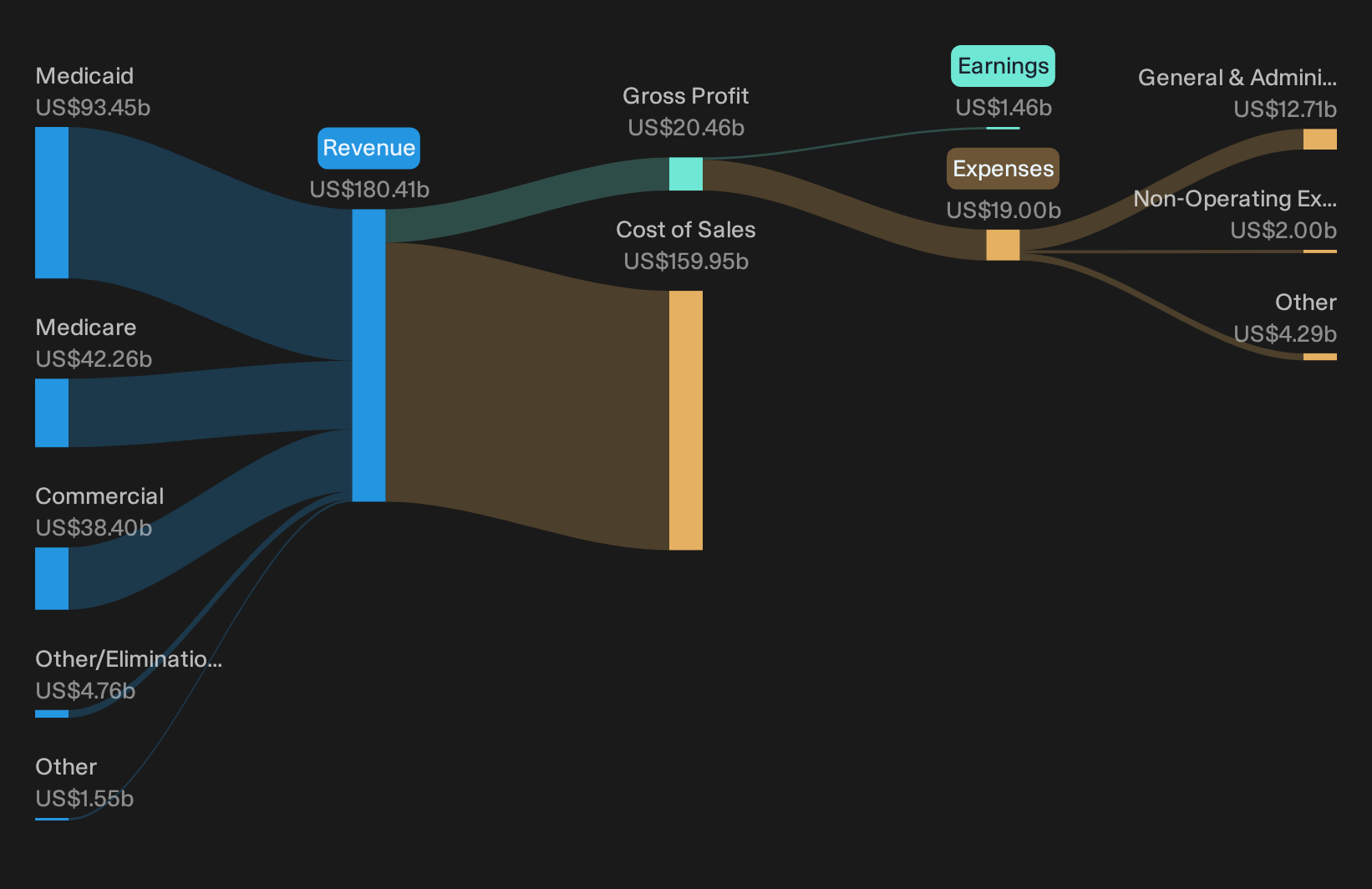
Operations: Centene generates about US$93.4b from Medicaid, US$42.3b from Medicare, US$38.4b from Commercial plans and US$4.8b from Other activities, all in the United States.
Market Cap: US$33.97b
Centene matters for this screen because it is deeply tied into Medicaid, Medicare and ACA marketplace programs. Any policy shift after a blue wave can ripple straight through to how it prices coverage and earns its profits.
"Centene's effort to restore Medicaid margins, supported by a 2026 composite rate yield outlook of roughly 5% and a targeted full year Medicaid HBR of about 93.5%, continues to point to earnings power that some investors may not yet fully reflect in valuation, with potential impact on segment net margins."
The real test comes if a single assumption about future policy support for these government programs stops lining up with Centene's internal playbook.
If that assumption proves off track, the full narrative for Centene shows where Centene's earnings power, policy risk and valuation might be quietly decoupling from headline expectations.
Curious About Alternative Opportunities?
Fresh ideas move first. Some sectors build quiet breakout momentum while most eyes stay fixed elsewhere. Scan these under the radar for now shortlists before the crowd pays closer attention.
- Identify resilient cash generators before momentum shifts by using the curated list of solid balance sheet and fundamentals (25 results) that filters for financial strength while it still goes largely unnoticed.
- Track cash flowing AI businesses with real earnings, not hype, through the hand picked 39 profitable AI stocks that aren't just burning cash assembled to spotlight companies where enthusiasm meets discipline.
- Explore potential metal supply stories with the focused 33 best rare earth metal stocks built to surface producers that could gain attention if demand pressure changes.
Have feedback on this article? Concerned about the content? Get in touch with us directly. Alternatively, email editorial-team@simplywallst.com