


Parsons (PSN) just packed several developments into a single week, pairing a CFO transition with fresh third quarter results, updated 2026 revenue guidance, and a new federal approval for its PFAS remediation technology.
Parsons shares have swung sharply this year, with a 23.7% 1 month share price return and a 14.7% 3 month share price return contrasting with a year to date share price decline of 18.5% and a 1 year total shareholder return decline of 39%. This hints that recent earnings, PFAS progress, and the CFO transition are reshaping how investors view both growth potential and execution risk.
Scan how Parsons compares with a carefully filtered group of contractors and infrastructure specialists using the list of solid balance sheet and fundamentals (25 results) as a starting universe for your next idea.
Parsons now trades at a clear gap to both analyst targets and intrinsic value estimates, after a sharp rebound from this year’s drawdown. Given that spread, where does fair value really land for this stock?
Most Popular Narrative: 15% Undervalued
Parsons closed at $50.69 compared with a widely followed fair value estimate of $59.64. The narrative frames the recent rebound as still leaving a valuation gap that depends heavily on contract mix and execution quality.
The main thing that has to go right is Parsons successfully executing its portfolio mix shift toward higher margin, product and AI driven federal work while continuing to wind down and exit lower return or higher risk construction and advisory contracts without further large charges.
The current valuation implies the share price reflects concern about guidance cuts and recent one off losses more than the size and duration of Parsons’ backlog, product programs and identified long runway in infrastructure and environmental remediation.
See why 13 investors see Parsons as 15% undervalued.
Result: Fair Value of $59.64 (UNDERVALUED)
Still, the recent US$118 million in nonrecurring charges and the US$77 million loss tied to contract exits show how quickly the Parsons narrative can be shaken.
Find out about the key risks to this Parsons narrative.
Another View: Parsons On Earnings Multiples
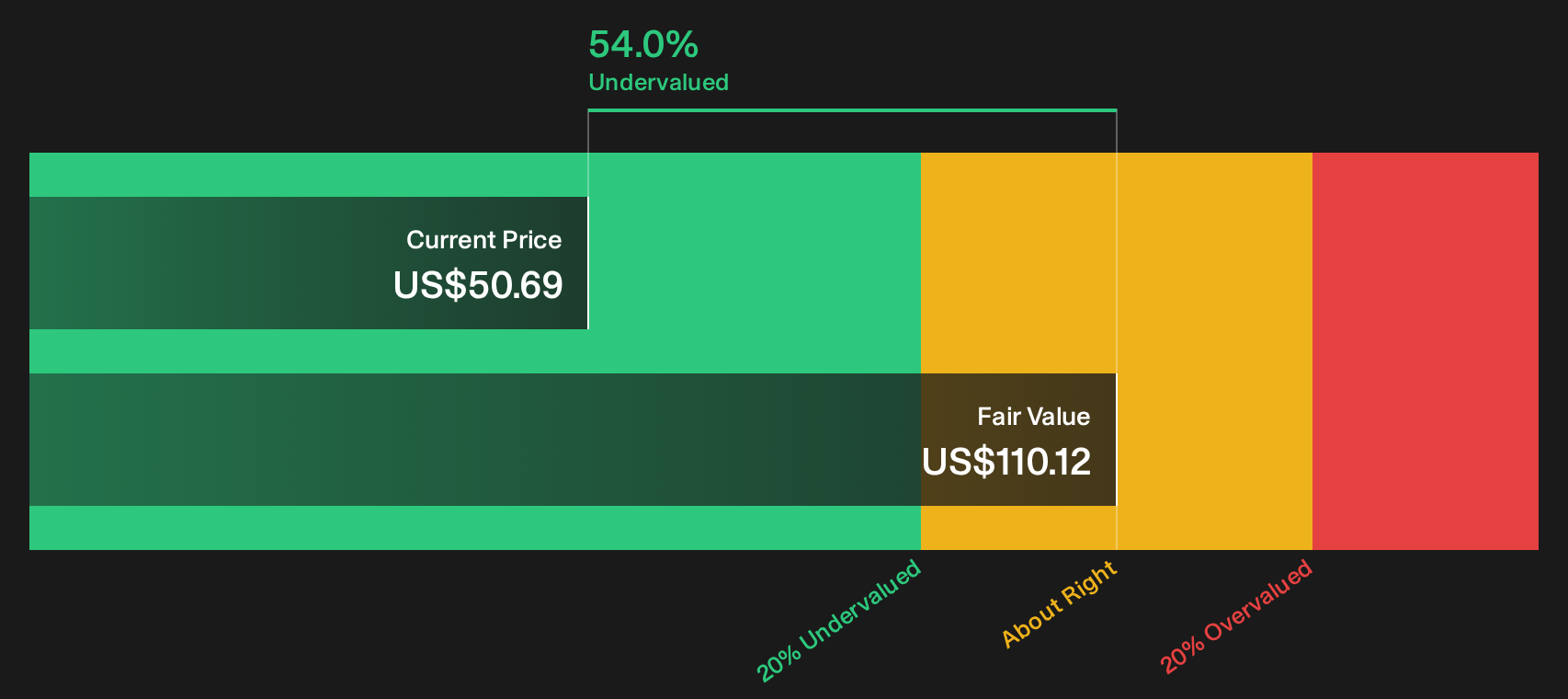
The discounted cash flow fair value of $110.12 suggests Parsons could be trading well below the level implied by its future cash flows, even after the recent rebound to $50.69. That sits alongside a 36.3x P/E, above both the US Professional Services average of 22.3x and a fair ratio of 34.6x, which points to richer pricing on reported earnings. So is the gap between cash flow value and earnings multiples a margin of safety or a signal that expectations are already demanding?
Our DCF work tries to translate those expectations into a single number that you can compare directly with today’s share price, without relying only on headline multiples, Look into how the SWS DCF model arrives at its fair value.
Next Steps
Mixed messages run through the Parsons story, so move quickly, test the assumptions against the underlying data, and weigh both sides of the thesis for yourself with the 2 key rewards and 1 important warning sign.
Looking for more investment ideas beyond Parsons?
If Parsons has you thinking differently about valuation and risk, do not stop here. Fresh opportunities emerge constantly, and a broader watchlist keeps you ahead.
- Target potential bargains with strong fundamentals by scanning companies that screen as 29 high quality undervalued stocks before the crowd pays attention.
- Prioritise resilience by focusing on businesses that appear in the 30 resilient stocks with low risk scores and build a portfolio that can better handle surprises.
- Hunt for strong balance sheets by starting with the list of solid balance sheet and fundamentals (25 results) and narrow in on businesses backed by healthier financial foundations.
Have feedback on this article? Concerned about the content? Get in touch with us directly. Alternatively, email editorial-team@simplywallst.com