


- Tennant Company recently introduced the P1 VAC, its first autonomous robotic vacuum for soft-floor cleaning, expanding the robotics portfolio into everyday commercial environments with a compact, app-managed platform.
- The move into autonomous soft-floor equipment broadens Tennant's addressable cleaning tasks and could change how facilities deploy labor across routine and higher value work.
- We will now look at how Tennant's investment narrative could be influenced by the P1 VAC launch into soft-floor robotics.
Scan beyond Tennant to see how other robotics and automation plays could be positioning for similar shifts in labor and cleaning technology through our hand picked 96 robotics and automation stocks.
Tennant Investment Narrative Recap
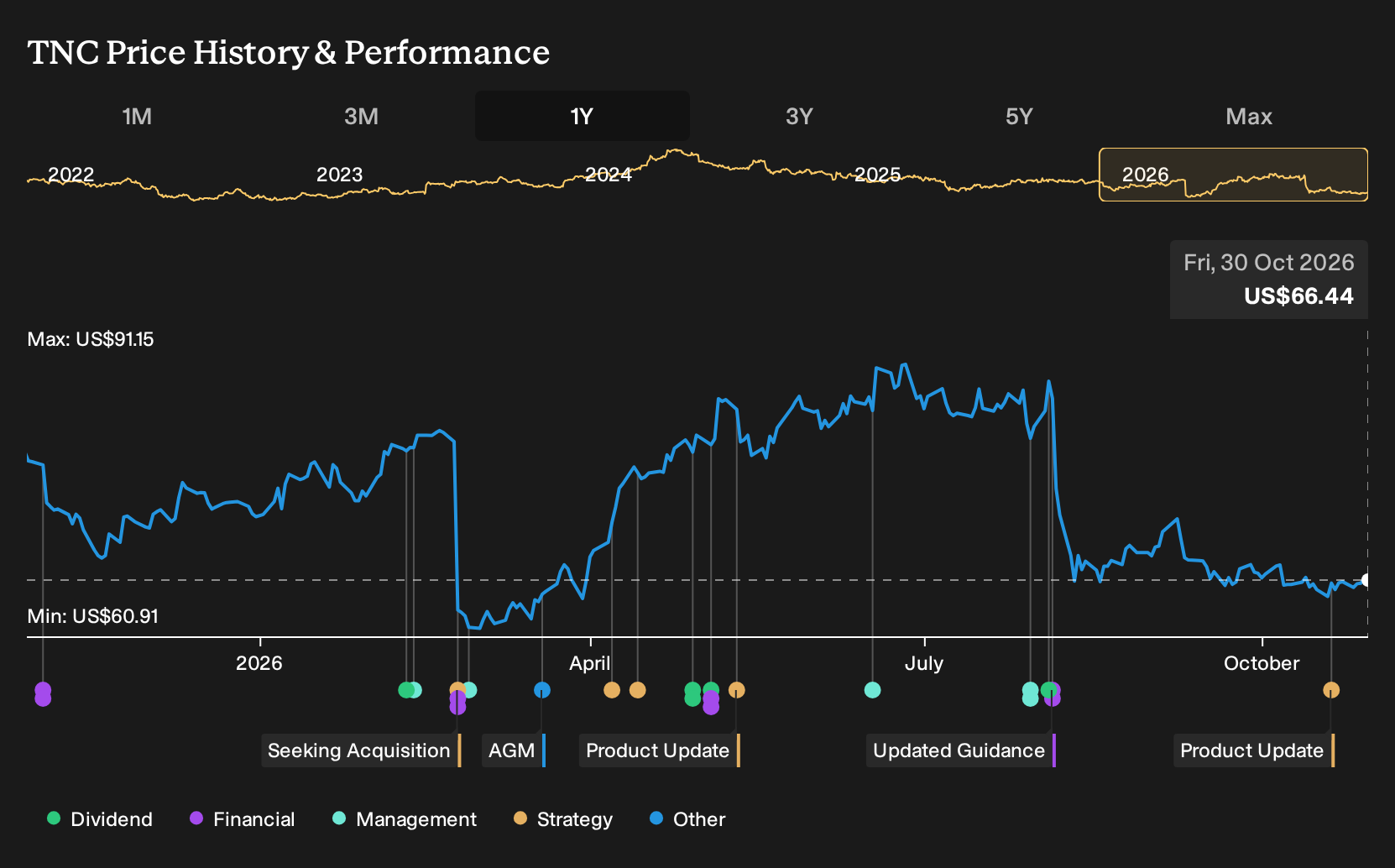
To own Tennant, you need to believe that robotics can gradually shift the business mix toward higher quality cleaning solutions while ERP issues and weaker margins get brought under control. The P1 VAC fits that story by adding soft floor automation. However, the immediate operating picture is still defined by thin 1.5% net margins and recent share price weakness.
The near term swing factor remains execution on the ERP rollout and margin recovery, not this single product. The biggest risk is that ERP disruption, cost inflation, or aggressive low priced competitors in EMEA keep pressure on pricing and volumes. This could hold back earnings even if robotics revenue keeps building.
The most relevant recent development for this story is Tennant’s expanded robotics roadmap, including the P1 VAC as the first soft floor machine in the new P Series. Management has flagged a plan for 10 autonomous launches and a targeted US$250 million robotics equipment business by 2028. This frames how meaningful P1 VAC adoption could become.
For catalysts, that robotics ambition ties back to earlier signals such as 56% year over year robotics sales growth in the first half of 2026 and the extended Brain Corp partnership to 2029 with BrainOS Clean 2.0 and SelfPath AI. Your call is whether Tennant can convert this broader product lineup and tech stack into steadier cash generation while still managing debt coverage, dividend strain, and ERP remediation costs.
Tennant's narrative projects US$1.5b revenue and US$131.1 million earnings by 2029, based on analyst assumptions. That path implies 6.5% yearly revenue growth and a very large earnings increase from US$18.3 million today to the US$131.1 million consensus figure.
Uncover why Tennant's fair value indicates a 32% potential upside to its current price before this discount begins to narrow.
Exploring Other Perspectives
One alternate view focuses on profitability risk rather than robotics upside. Bearish analysts already viewed Tennant as stretched, with 6.7% yearly revenue growth anticipated and earnings reaching about US$121.8 million by 2029. That more cautious outlook has not factored in the P1 VAC yet, so those forecasts may change as opinions update.
Explore 3 other Tennant fair value estimates, including one that suggests it could be worth just $77.00.
The Verdict Is Yours
Disagree with existing narratives? Extraordinary investment returns rarely come from following the herd, so consider forming your own view.
- A great starting point for your Tennant research is our analysis highlighting 3 key rewards and 4 important warning signs that could impact your investment decision.
- See our latest analysis for Tennant. The report includes a comprehensive fundamental analysis summarized in a single visual, the Snowflake, making it easy to evaluate Tennant's overall financial health at a glance.
Looking For More Ideas Beyond Tennant?
Once you understand where Tennant might fit in your portfolio, it helps to line it up against a wider set of opportunities using the Simply Wall St Screener.
- If capital preservation sits high on your list, scan a curated group of 30 resilient stocks with low risk scores that score well on resilience and downside control.
- For investors hunting for quality at a reasonable entry point, sift through a 29 high quality undervalued stocks that combine solid fundamentals with discounted prices.
- Income focused readers can zero in on reliable cash distributions by reviewing a 5 dividend fortresses that pair higher yields with robust payout support.
Have feedback on this article? Concerned about the content? Get in touch with us directly. Alternatively, email editorial-team@simplywallst.com