


- Tractor Supply reaffirmed its full year 2026 guidance after third quarter sales reached US$3,910.46 million, while quarterly net income and diluted EPS from continuing operations declined compared with the same period in 2025.
- Management paired this guidance confirmation with a new Chief Technology and Digital Officer hire and fresh product listings from LetPot on TractorSupply.com. This points to continued focus on technology and assortment even as profitability remains under pressure.
- We will now look at how Tractor Supply's reaffirmed 2026 earnings guidance could reshape the investment narrative around margins and growth.
Tractor Supply Investment Narrative Recap
To own Tractor Supply, you need to believe the rural lifestyle model can support steady traffic even when discretionary categories soften. The reaffirmed 2026 outlook for roughly 2.5% to 3.5% net sales growth and US$930 million to US$990 million of net income suggests management still sees a path through a cautious consumer.
The near term swing factor is whether transactions and big ticket demand stabilize into the holiday quarter, since third quarter net income and EPS from continuing operations declined year on year. The main risk is that weaker comparable sales and higher freight or fuel costs squeeze margins faster than supply chain and pricing initiatives can offset.
The most relevant announcement here is the reaffirmed 2026 guidance. Tractor Supply now expects earnings per diluted share of US$1.78 to US$1.88, alongside the net sales and profit ranges already outlined. That keeps the financial goalposts clear for you as you think about how the quarter fits into the bigger operational story.
Against the backdrop of softer recent earnings, this confirmation puts more weight on execution of existing catalysts such as the Nampa automated distribution center, the pet ecosystem and Final Mile delivery. Any shortfall versus these 2026 ranges, whether from prolonged macro pressure or cost inflation, would quickly test confidence in those projects and in the stock’s risk profile.
What The Consensus Assumptions Mean For Tractor Supply
Analysts are effectively asking you to view Tractor Supply as a retailer that can grow into larger earnings power over time while keeping risk in check. The current consensus framework ties together modestly higher margins, steady revenue expansion and some help from share count reduction to reach a bigger profit pool by the end of the decade.
On the top line, the model is built around annual revenue growth of 4.6% over the next three years. That pace sits above Tractor Supply's reaffirmed 2026 net sales outlook, which shows how the Street is underwriting some improvement from current trends as freight, fuel and discretionary pressure are worked through.
Earnings today stand at about US$977.3 million. Forecast consensus points to US$1.2b of net income by 2029 on revenue of roughly US$18.2b in the same year, with profit margins moving from 6.1% to 6.6% as supply chain projects, tariff refunds and pricing decisions blend together.
The shift in profit in that framework is clear. The analyst view implies Tractor Supply would add roughly US$223 million of net income from current levels by 2029, helped by that small margin lift and a 1.47% annual decline in share count over the next three years.
The valuation overlay then asks you to decide whether that path feels reasonable. To line up with the consensus price target of US$36.30, you would need to be comfortable with Tractor Supply trading on a P/E of 19.6x those 2029 earnings, compared with 18.5x today and about 16.5x for the wider US Specialty Retail group.
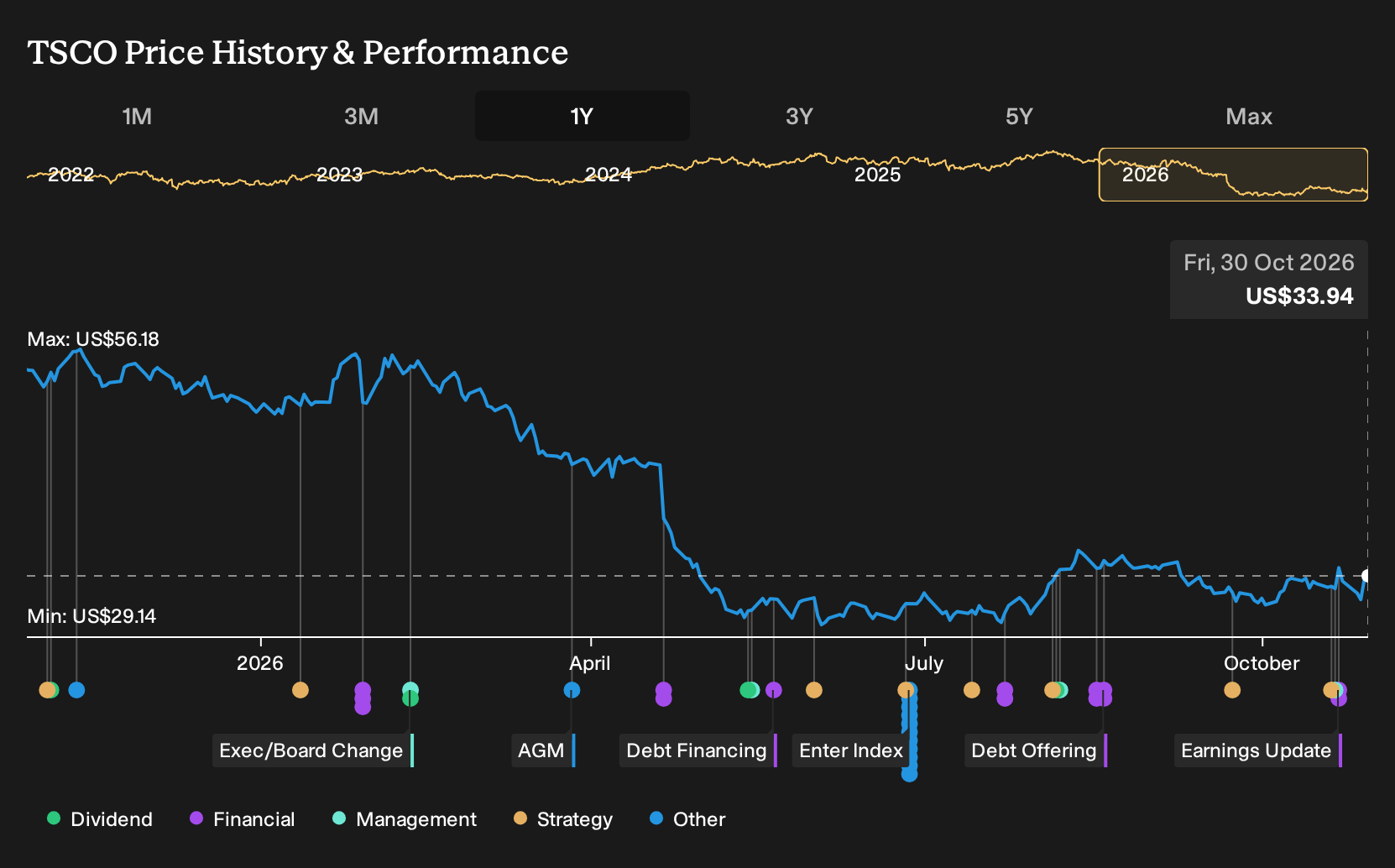
For context, the current share price of US$34.73 sits only about 4.3% below the analyst average target. That narrow gap signals that the market and the Street are not far apart on what this earnings and revenue mix is worth, even with softer recent results and a trimmed 2026 outlook still in the rear view mirror.
Tractor Supply's narrative projects US$18.2b revenue and US$1.2b earnings by 2029. That rests on 4.6% yearly revenue growth and around US$223 million earnings increase from US$977.3 million today.
Uncover why Tractor Supply's fair value indicates a 7% potential upside to its current price before that discount closes.
Exploring Other Perspectives
The more cautious analysts are less focused on Tractor Supply's new tech hire and more concerned about margin drag from delivery and remodel costs. They were penciling in only 3.5% annual revenue growth and about US$1.1b of earnings by 2029 before this guidance reaffirmation. That is a much more cautious story. Use it as a reminder that smart people can disagree, and treat today’s news as a prompt to compare several viewpoints before deciding how Tractor Supply fits your portfolio.
Explore 4 other Tractor Supply fair value estimates, including one that suggests there may be as much as 9% downside from the current price.
Decide For Yourself
Disagree with existing narratives? Extraordinary investment returns rarely come from following the herd, so go with your instincts.
- A great starting point for your Tractor Supply research is our analysis highlighting 2 key rewards and 2 important warning signs that could impact your investment decision.
- See our latest analysis for Tractor Supply. The report includes a comprehensive fundamental analysis summarized in a single visual, the Snowflake. This makes it easy to evaluate Tractor Supply's overall financial health at a glance.
Looking For More Investment Ideas Beyond Tractor Supply?
If Tractor Supply's guidance and valuation prompts you to broaden your watchlist, it can help to line it up against companies with different strengths. Use the Simply Wall St Screener to compare fundamentals, risk profiles and income potential in a structured way rather than stock by stock guesswork.
- If you want potential upside with a margin of safety, start by reviewing our 29 high quality undervalued stocks that combine quality fundamentals with pricing that still looks reasonable.
- If balance sheet strength matters most to you, focus on companies in the list of solid balance sheet and fundamentals (25 results) so you can see which businesses pair financial resilience with consistent fundamentals.
- If income is your priority, scan through our 5 dividend fortresses that aim for yields of 5% or more while still screening for durability.
Have feedback on this article? Concerned about the content? Get in touch with us directly. Alternatively, email editorial-team@simplywallst.com