


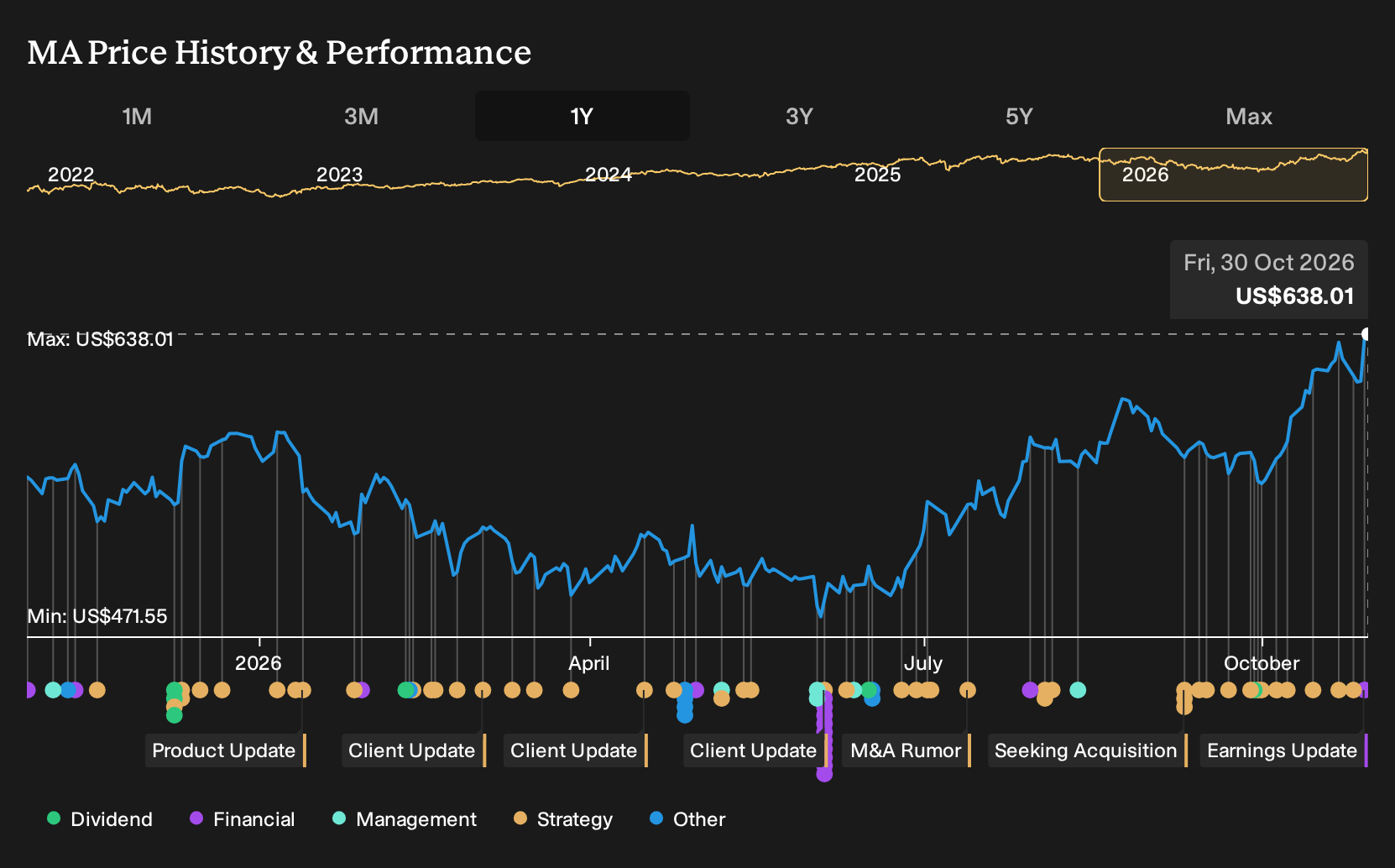
- Mastercard reported third quarter 2026 net revenue of US$9,807 million and net income of US$4,628 million, with value added services such as AI driven security and stablecoin infrastructure contributing alongside the core payments network.
- Alongside the earnings release, Mastercard completed a US$9.0b buyback program and advanced new partnerships in B2B payments, transit, and embedded finance, which speaks directly to how the business is trying to deepen payment flows and service revenue across multiple channels.
- The focus now turns to how Mastercard's stronger value added services mix and resilient earnings profile might reshape the existing investment narrative.
Scan how Mastercard's mix of payments, AI security, and embedded finance compares with other payment and fintech players by reviewing our hand picked 19 high quality undiscovered gems targeting similar themes.
Mastercard Investment Narrative Recap
To hold Mastercard, you need to believe its global payment rails and value added services can keep attracting more digital activity, even as local real time systems and alternative networks try to divert flows. The Q3 print, with US$9.8b in sales and US$4.6b in net income, reinforces that the current model is still working across both the core network and newer services.
In the near term, the key catalyst is continued adoption of AI security, cyber and data products that already make up a large share of Mastercard revenue. The biggest risk remains structural, not quarterly. Alternative domestic schemes and regulatory actions on fees could chip away at both pricing power and long run margins, but this specific quarter does not materially change that equation.
The recent Tech Mahindra partnership is one of the more operationally relevant updates for Mastercard after these results. It puts virtual cards and embedded payment tools directly inside ERP and procurement systems, which ties into management's push to expand commercial B2B flows and attach services such as fraud tools, data and controls on top of the network.
As a potential catalyst, this kind of integration can support higher transaction stickiness and a richer mix of fee based services if enterprises lean into automated payables, real time reconciliation and tighter spend governance. The trade off is execution risk. Complex ERP integrations, regulatory scrutiny on commercial fees and competition from bank led or domestic rails could limit how much of that B2B opportunity actually lands on Mastercard platforms.
Mastercard Analyst Expectations In Context
Mastercard's narrative projects US$51.9b revenue and US$24.2b earnings by 2029 based on analyst models. This implies 12.6% yearly revenue growth and an earnings increase of about US$7.2b from US$17.0b today.
Discover how Mastercard's fair value indicates an 8% potential upside to its current price that may not last much longer.
Exploring Other Perspectives
Fair value estimates for Mastercard from 22 members of the Simply Wall St Community cluster between US$520 and about US$844. Some see deep undervaluation while others price in a rich future. Set those against risks like domestic real time schemes and fee regulation, and it becomes clear you should compare several viewpoints before deciding how Mastercard fits your portfolio.
Explore 21 other Mastercard fair value estimates, including one that suggests as much as 32% upside from the current price!
The Verdict Is Yours
Don't just follow the ticker. Dig into the data and build a conviction that's truly your own.
- A great starting point for your Mastercard research is our analysis highlighting 3 key rewards and 2 important warning signs that could impact your investment decision.
- See our latest analysis for Mastercard. The report includes a comprehensive fundamental analysis summarized in a single visual, the Snowflake, making it easy to evaluate Mastercard's overall financial health at a glance.
Looking for more investment ideas beyond Mastercard?
Once you have a view on Mastercard, it helps to benchmark it against other listed businesses with different risk, return and balance sheet profiles. The Simply Wall St Screener lets you do that quickly by filtering the market down to a focused shortlist that actually fits what you are looking for.
- If you want potential mispricing and quality together, start with a curated list of 30 high quality undervalued stocks that pair stronger fundamentals with what our models flag as discounted prices.
- For investors who care first about staying power, compare Mastercard with a list of solid balance sheet and fundamentals (24 results) so you can see which companies carry less financial strain on their books.
- If your priority is smoother rides rather than big swings, narrow the universe to a 29 resilient stocks with low risk scores and see which stocks align better with your comfort level.
Have feedback on this article? Concerned about the content? Get in touch with us directly. Alternatively, email editorial-team@simplywallst.com