


- Progressive recently reported a 2.5% drop in auto claim frequency and has reduced new-business auto rates across many U.S. states, while peers such as Travelers and Hartford are also reshaping auto portfolios and dividends in response to changing risk profiles.
- Fresh commentary from Elon Musk that self-driving technology could cut serious crashes highlights how automation may reshape Progressive's underwriting assumptions, pricing decisions, and long term exposure to auto claim risk.
- We will now examine how Progressive's investment narrative could be reshaped by evolving auto claim frequency as self driving capabilities advance.
Scan how Progressive's auto reset compares to peers facing the same self driving shift by zeroing in on insurers in our 29 resilient stocks with low risk scores.
Progressive Investment Narrative Recap
For an investor to stay with Progressive, the belief has to be that its data heavy underwriting and fast pricing engine can keep combined ratios in check even as auto becomes more competitive. The short term swing factor is how quickly those recent auto rate cuts and the 2.5% drop in claim frequency settle into a stable, profitable run rate.
The biggest risk is that auto pricing turns more deflationary while claim severity stays sticky, which would pressure margins on a business where analysts already expect earnings to decline over the next three years. The self driving discussion does not materially change that near term execution test yet.
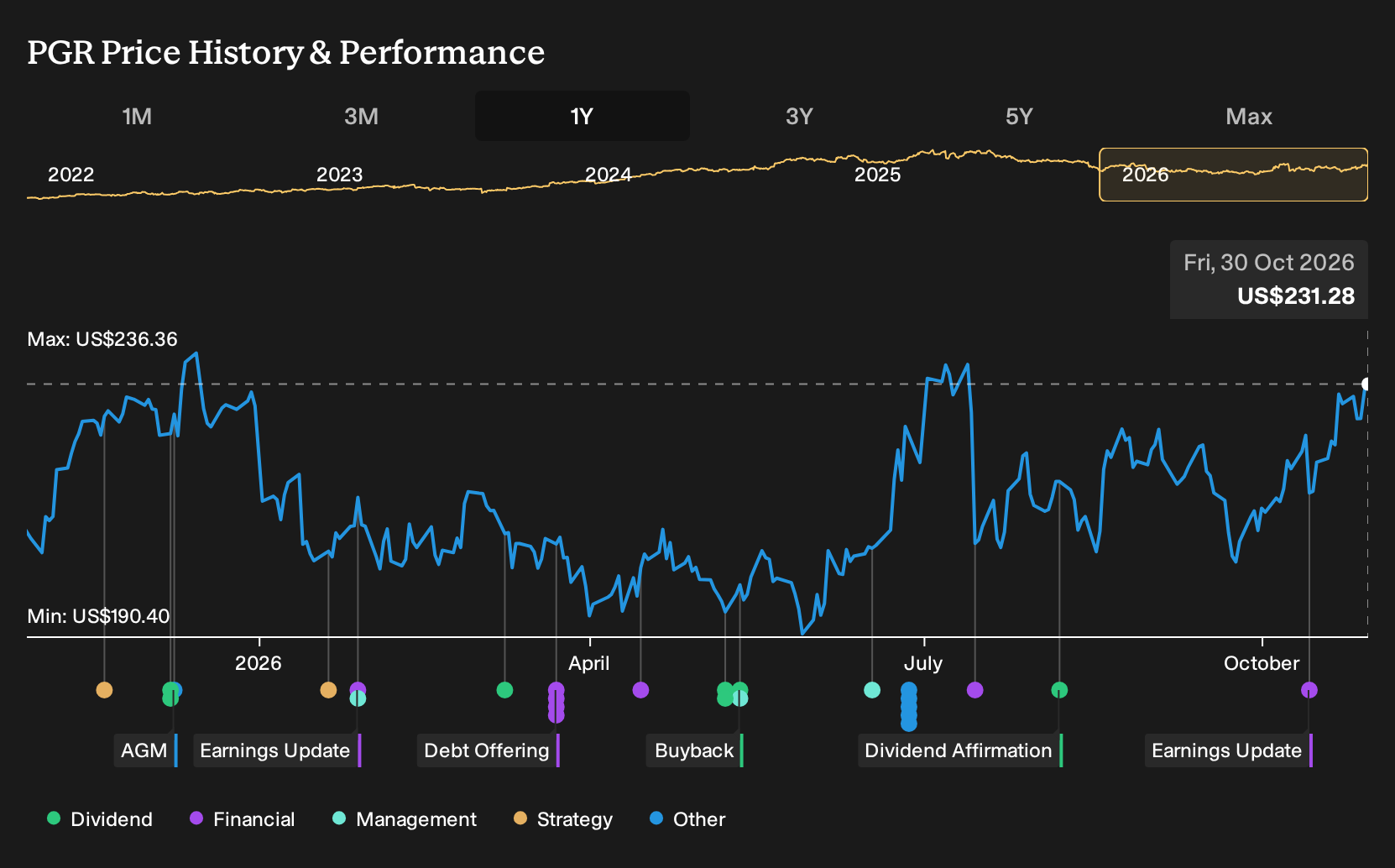
The most relevant operational move today is Progressive cutting new business auto rates across many states. That step directly ties into the reported 2.5% fall in claim frequency and shows management is already recalibrating pricing as observed risk changes, rather than waiting for a fully autonomous future to arrive.
For you as a shareholder, the question is whether Progressive can keep using its analytics and telematics to reprice quickly enough if claim patterns keep shifting with more automation. If competition leans harder into discounting to chase volume, that same rate flexibility could become a pressure point for earnings rather than a clear catalyst.
Progressive is currently tied to a consensus narrative that points to revenues of US$99.0b and earnings of US$9.5b by 2029. Analysts assume revenue expands at about 2.9% each year and earnings move down by US$2.2b from US$11.7b today to reach that 2029 level.
Uncover why Progressive's fair value indicates alignment with its current price.
Exploring Other Perspectives
One alternate view is that Progressive’s biggest swing factor is not self driving at all, but weaker bundling economics. The most bearish analysts were already working off slower revenue growth of about 1.1% a year and earnings closer to US$8.2b by 2029. That is a much harsher script. Use this news as a prompt to compare those assumptions with your own before deciding which narrative feels closer to how you see the next few years playing out.
Explore 3 other Progressive fair value estimates, including one that suggests it could be worth just $230.38.
Form Your Own Verdict
Don't just follow the ticker. Dig into the data and build a conviction that's truly your own.
- A great starting point for your Progressive research is our analysis highlighting 2 key rewards and 2 important warning signs that could impact your investment decision.
- See our latest analysis for Progressive. The report includes a comprehensive fundamental analysis summarized in a single visual, the Snowflake, making it easy to evaluate Progressive's overall financial health at a glance.
Looking For More Investment Ideas Beyond Progressive?
If the Progressive story has sharpened how you think about risk, pricing, and long term assumptions, you can apply that same lens across the wider market using the Simply Wall St Screener.
- For investors who want quality at a reasonable entry point, start with companies that screen as potential bargains through our 30 high quality undervalued stocks.
- If resilience matters most to you, filter for businesses with stronger balance sheets and sturdier fundamentals using our list of solid balance sheet and fundamentals (24 results).
- For income focused portfolios, look into companies offering higher yields that still clear quality checks via our 5 dividend fortresses.
Have feedback on this article? Concerned about the content? Get in touch with us directly. Alternatively, email editorial-team@simplywallst.com