


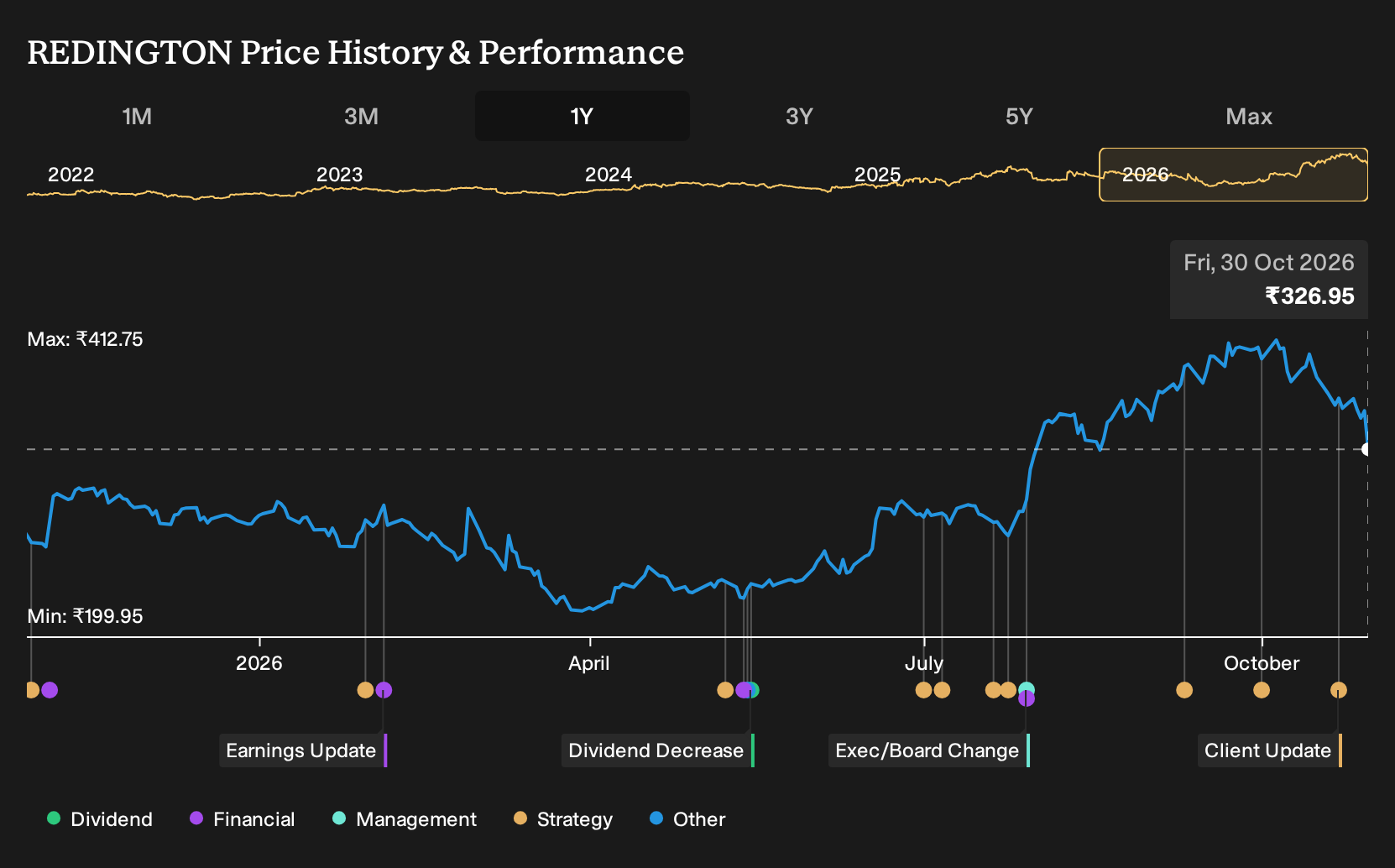
Redington Gulf’s fresh collaboration agreement with Amazon Web Services on AI adoption puts a concrete contract behind years of cloud talk. Investors who held Redington over the past year are up 31.7%, including dividends. If you had been deciding on 30 October 2025, you would have seen only earlier cloud partnerships and the debate over shrinking hardware margins, not this AWS deal. What exactly did buyers think would justify that kind of patience?
Redington is not the only name tied to this theme. Zero in on 54 AI infrastructure stocks and compare how each one is priced.
The Argument You Would Have Been Weighing Up On Redington
The shares cost ₹259 at the start of the period, and anyone looking at Redington had two very different stories to compare.
The bullish Narrative saw Redington as a future software and services marketplace. That view pointed to a Fair Value of ₹836, a price those assumptions implied, built on 20.0% revenue growth, a 2.0% profit margin and a future P/E of 30.0x over a 3 year stretch.
The bearish story anchored to a Fair Value of ₹170 and focused on pressure from direct to consumer channels. It treated margin compression, working capital strain and consolidation risk as central threats to Redington’s role in hardware distribution.
What The Results Changed For The Redington Thesis
The AWS agreement on AI adoption directly backs the bullish Redington story that hinged on cloud alliances and higher margin services. In the same window, Q1 2027 figures showed revenue at ₹349,224.7m and net income at ₹4,859.8m, with net margin moving from 1.1% to 1.4%. The evidence cut both ways but leaned toward the optimistic case.
The whole debate turned on whether services growth would show up in profitability. For any similar distributor, track net margin alongside cloud or software revenue claims to see if that shift is actually taking hold.
What Redington's Price Seems To Be Weighing Now
Redington at ₹327 reflects a year in which cloud, AI and recurring software have moved from slideware to reported segments. The selected Narrative suggests that its Fair Value sits above the current price, framed around how much of the Software Solutions Group and data center funnel is already recognised in the market's expectations.
Investors are effectively assessing whether today’s valuation fully incorporates a larger mix of recurring, renewal-driven software and higher-margin services within Redington’s business model.
"The current valuation implies that the market is still pricing Redington closer to a traditional hardware distributor rather than as a business with a $2.2b recurring and software-led segment and higher returns on capital. Redington’s operational management has resulted in working capital days moving from 37 to 32 and return on capital employed at 22%, which together can help contain finance costs and support net margin resilience as the business scales."
One Narrative has put a figure on that disagreement. → See the Narrative with its higher Fair Value, assumptions and all
Before The Next Story Makes Headlines
By the time a rally makes headlines, you are reading about returns someone else has already earned. Why not go straight to the source and look for your own contrarian opportunity? These three companies trade below our estimated value.
- Company 1 - 43% below our estimate - connects lenders, brokers and insurers on platforms that deepen engagement and efficiency.
- Company 2 - 20% below our estimate - builds a teahouse and supply network where overseas franchise GMV shifts revenue mix.
- Company 3 - 21% below our estimate - signs longer healthcare managed services contracts bundling AI tools into daily operations.
Those are three of them. See all 197 potentially undervalued companies →
Have feedback on this article? Concerned about the content? Get in touch with us directly. Alternatively, email editorial-team@simplywallst.com