


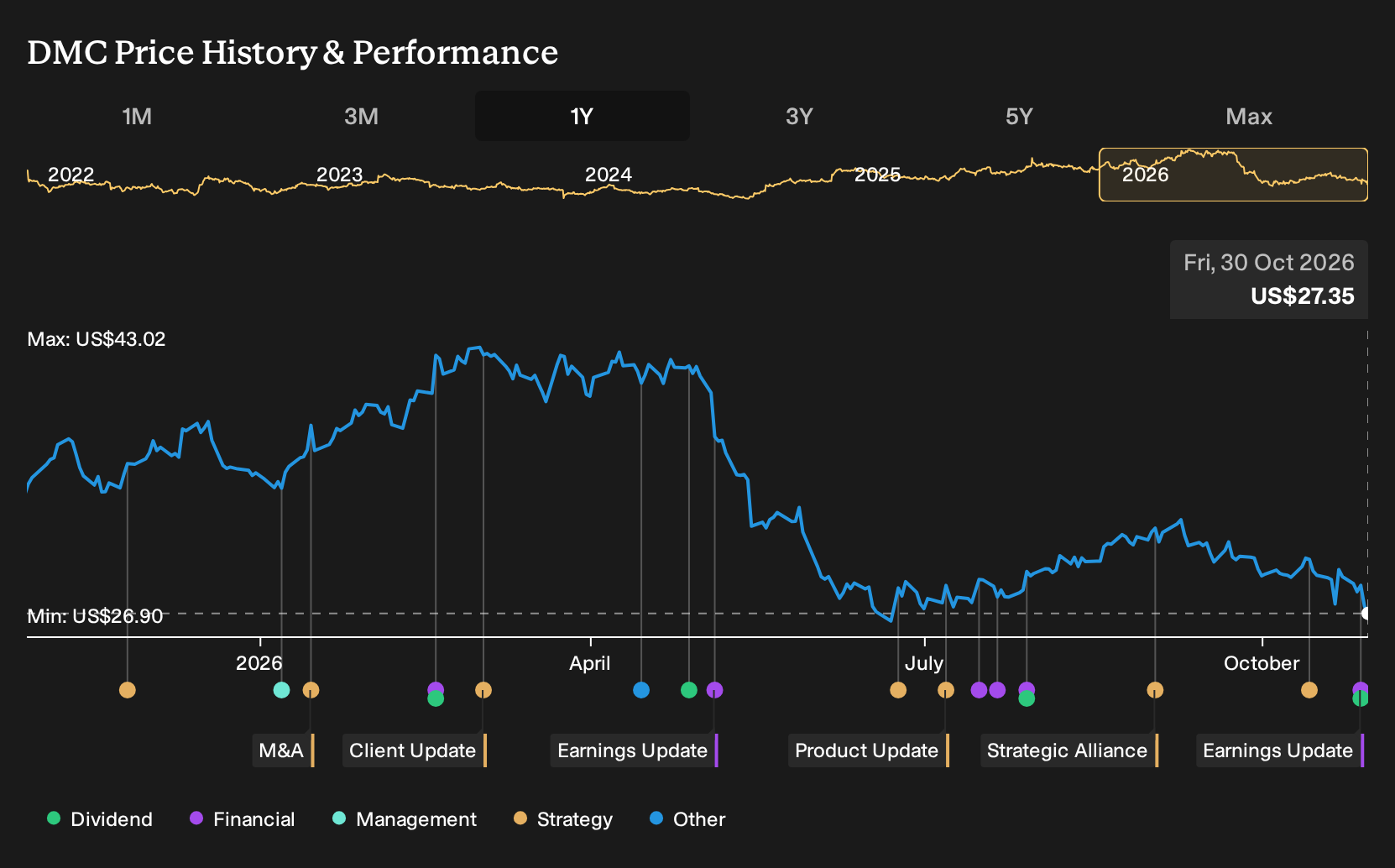
- Del Monte reported third quarter 2026 sales of US$1,095.3 million and net income of US$18.3 million, moving from a loss a year earlier, and the board approved a US$0.30 per share quarterly cash dividend payable in December 2026.
- The combination of a swing back to profit and a renewed dividend indicates that Del Monte’s operations generated enough cash to support both reinvestment and direct returns to shareholders, despite ongoing industry pressures.
- Now the focus turns to how Del Monte's investment narrative might shift as investors weigh this return to profitability and dividend resumption.
Del Monte Investment Narrative Recap
To own Del Monte, you need to believe the shift toward premium pineapples, prepared foods and value added products can steadily outweigh thin banana economics and stubborn cost pressures. The return to profit in the third quarter supports that mix story, but banana price competition and disease risks still sit close to the front of the queue.
In the near term, the key swing factor is whether fresh and prepared products can sustain higher margin contributions while input costs for freight, fertilizer and packaging stay manageable. The biggest risk remains a squeeze from low banana pricing or worsening crop disease that erodes volumes or forces higher farming spend.
The fresh quarterly cash dividend of US$0.30 per share, payable in December 2026, is the headline announcement that ties directly into this earnings update. It signals that management sees enough stability in cash generation to return capital to shareholders while still funding planned Central American production projects and prepared foods integration work.
For you, the practical question is whether that payout looks well supported alongside the ongoing capital program and known headwinds in bananas and logistics. The dividend is described as not well covered by free cash flow, so your focus probably needs to stay on execution in premium fruit, prepared products and cost control rather than the yield alone.
What The Del Monte Forecasts Assume
Analysts sketch a very different Del Monte a few years from now compared with the one that just reported a modest quarterly profit and restarted its dividend. Their consensus work assumes revenue grows by 10.3% a year over the next three years, helped by a richer mix of premium fruit and prepared products rather than just higher banana volumes. That pace of top line expansion would need to hold through to 2029 to line up with the current long range models.
Earnings expectations step up even more sharply. The group is reported to be earning US$34.0 million today, with forecasts pointing to US$398.1 million of profit by 2029 on the same timetable that margins rise from 0.8% to 6.9%. That implies earnings would have to increase by about US$364 million, a very large absolute uplift that puts real pressure on Del Monte to improve pricing power, mix and cost discipline across both fresh and prepared operations.
These consensus figures also bake in some help from the capital structure. The analyst work assumes the share count drifts lower by 1.32% per year over the next three years, which would concentrate any future earnings across fewer shares. The valuation framework behind the US$52.0 price target then leans on Del Monte trading on a 7.3x P/E multiple of those 2029 earnings, which is materially below the current US Food sector P/E of 18.6x and well under the company’s present multiple of 40.8x.
Del Monte's narrative projects US$5.8b revenue and US$398.1 million earnings by 2029. This requires 10.3% yearly revenue growth and an earnings increase of about US$364 million from US$34.0 million today.
Discover how Del Monte's fair value indicates a 90% potential upside to its current price that may not last much longer.
Exploring Other Perspectives
The three fair value estimates from the Simply Wall St Community span roughly US$27.47 to US$52. That is a wide bracket for the same Del Monte equity story. You are seeing private investors weigh the fresh profit and dividend reset against risks such as freight and fertilizer costs. Use that dispersion as a prompt to explore multiple viewpoints before forming your own stance.
Explore 2 other Del Monte fair value estimates, including one that suggests up to 90% upside from the current price.
Reach Your Own Conclusion
Don't just follow the ticker. Dig into the data and build a conviction that's truly your own.
- A great starting point for your Del Monte research is our analysis highlighting 4 key rewards and 2 important warning signs that could impact your investment decision.
- See our latest analysis for Del Monte. The report includes a comprehensive fundamental analysis summarized in a single visual, the Snowflake, making it easy to evaluate Del Monte's overall financial health at a glance.
Looking for more investment ideas beyond Del Monte?
If the Del Monte story has sharpened your thinking about income, quality and risk, use that same lens to hunt for other opportunities with the Simply Wall St Screener.
- For investors who want income and resilience working together, start with companies screened for strong yields and balance sheet support via the 5 dividend fortresses.
- If value is your priority, target businesses that combine solid fundamentals with prices that look conservative through the 33 high quality undervalued stocks.
- When you prefer resilience first, focus on companies with lower risk profiles and healthier finances by running a search through the 29 resilient stocks with low risk scores.
Have feedback on this article? Concerned about the content? Get in touch with us directly. Alternatively, email editorial-team@simplywallst.com