


- Manchester United has faced a poor start to the current season, with reports of pressure on manager Michael Carrick, strained relationships with senior players, and speculation over a January squad shake up, including possible high profile exits and a search for a Luke Shaw replacement.
- These football decisions point to deeper operational questions for Manchester United, including wage commitments, transfer spend discipline, and whether a potential managerial change can align on pitch performance with the ongoing rebuild of a high cost squad.
- Now the focus shifts to how Manchester United's investment narrative could be reshaped by speculation over Michael Carrick's position and a potential squad overhaul.
Manchester United Investment Narrative Recap
To own Manchester United, you largely need to believe the club can convert its global following into steadier cash generation despite a high cost squad and current on pitch issues. Manager uncertainty and talk of multiple exits add noise, but the near term driver still looks like execution on the wider squad rebuild and cost discipline.
The biggest risk right now sits in wage commitments and player trading. If contract burdens, injuries and inconsistent transfer income persist, earnings may stay weak and the business could remain unprofitable. If the current upheaval does not materially change that wage and transfer equation, the long term story is not transformed by this news.
The most relevant development here is the reported plan to sack Michael Carrick, alongside the possibility of five first team departures. For shareholders, that goes straight to execution risk on the midfield overhaul, youth integration and tighter transfer spending that analysts have been watching as key operational levers.
Manager change and a January clear out could affect how quickly Manchester United reshapes its wage bill, leans into player trading and manages injuries in crucial positions such as left back. Your lens as an investor is whether any new coaching setup and squad mix make it easier or harder to stabilise performance and reduce reliance on sporadic transfer profits.
Manchester United Analyst Expectations In Context
Analysts are effectively asking investors to judge whether Manchester United can turn a loss-making operation into a profitable one while managing a volatile on-pitch rebuild. Revenue is projected to rise at 7.8% a year over the next few seasons, profit margins are expected to move from a loss position of 2.6% today to a positive 11.1% in three years, and earnings would need to change by £113.4 million from a loss of £18.1 million to £95.3 million by 2029 for that scenario to hold.
Manchester United's narrative, based on those projections, points to £858.3 million of revenue and £95.3 million of earnings by 2029, with analysts assuming 7.8% yearly revenue growth and an earnings shift of £113.4 million from current earnings of a £18.1 million loss.
Uncover why Manchester United's fair value indicates a 12% potential upside to its current price, which could narrow quickly.
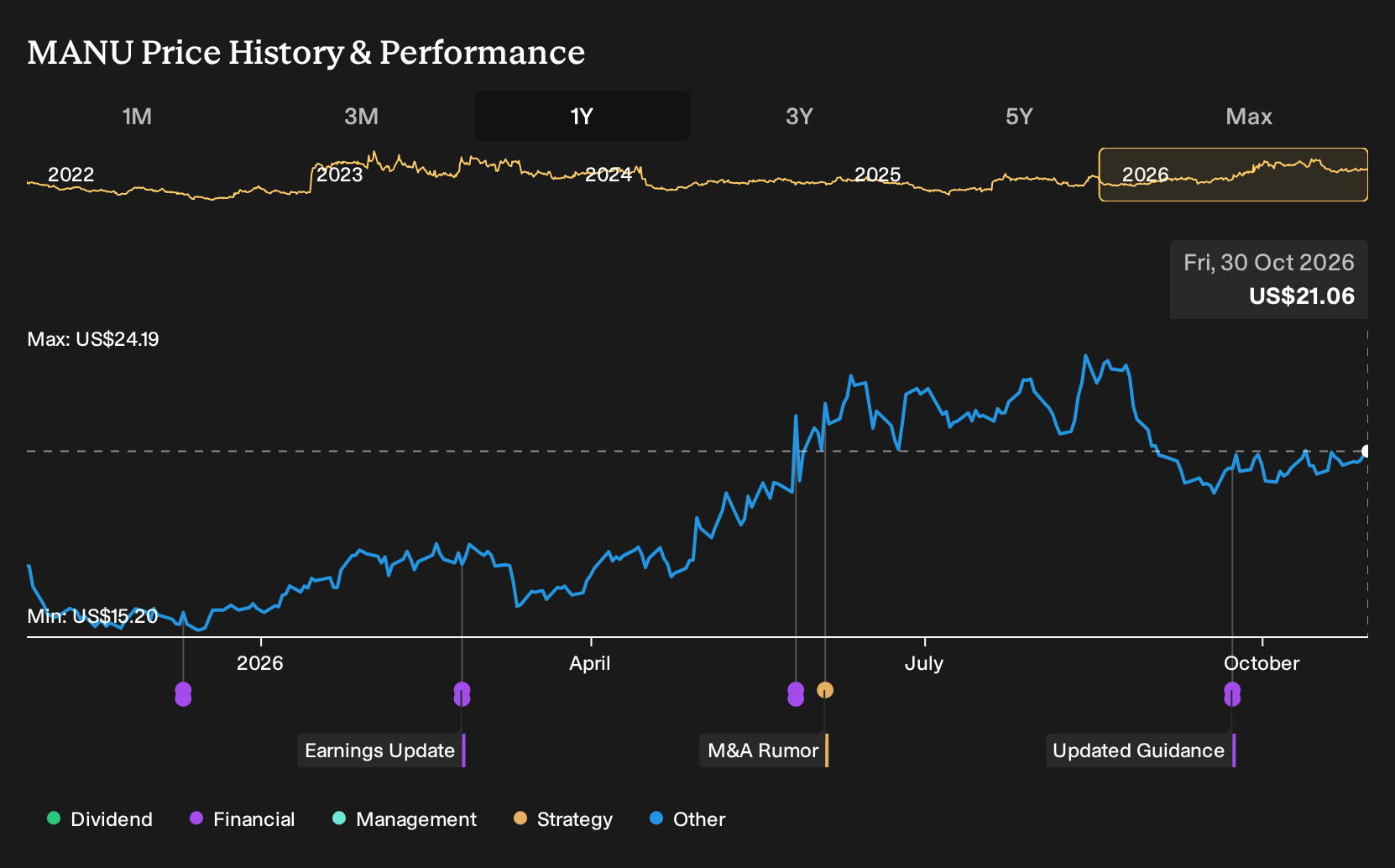
Exploring Other Perspectives
Some of the lowest ranked Manchester United analysts lean on debt risk instead of squad rebuild potential. They were working off a £820.5 million revenue line and £96.0 million earnings by 2029 before this week’s Carrick headlines. That is a more cautious story. Use this shock to compare several different narratives, not just consensus.
Explore 2 other Manchester United fair value estimates, including one that suggests as much as 10% downside from the current price.
The Verdict Is Yours
Don't just follow the ticker; dig into the data and build a conviction that's truly your own.
- A great starting point for your Manchester United research is our analysis highlighting 1 important warning sign that could impact your investment decision.
- See our latest analysis for Manchester United. The report includes a comprehensive fundamental analysis summarized in a single visual, the Snowflake, making it easy to evaluate Manchester United's overall financial health at a glance.
Looking for more investment ideas beyond Manchester United?
Once you have formed a view on Manchester United, it can help to compare it with other listed clubs and businesses that offer different combinations of quality, value and resilience. The Simply Wall St Screener lets you filter for these traits directly, so you are not relying only on headlines or hype.
- If you want potential bargains with stronger fundamentals, start by reviewing a focused group of 33 high quality undervalued stocks that may offer a cleaner mix of quality and price.
- For investors who care most about capital protection and steadier profiles, consider screening for 29 resilient stocks with low risk scores that score well on resilience and balance sheet strength.
- If you are hunting for early stage opportunities with tighter filters on quality, use the screener to surface 8 elite penny stocks with strong financials that still meet your standards on fundamentals.
Have feedback on this article? Concerned about the content? Get in touch with us directly. Alternatively, email editorial-team@simplywallst.com