


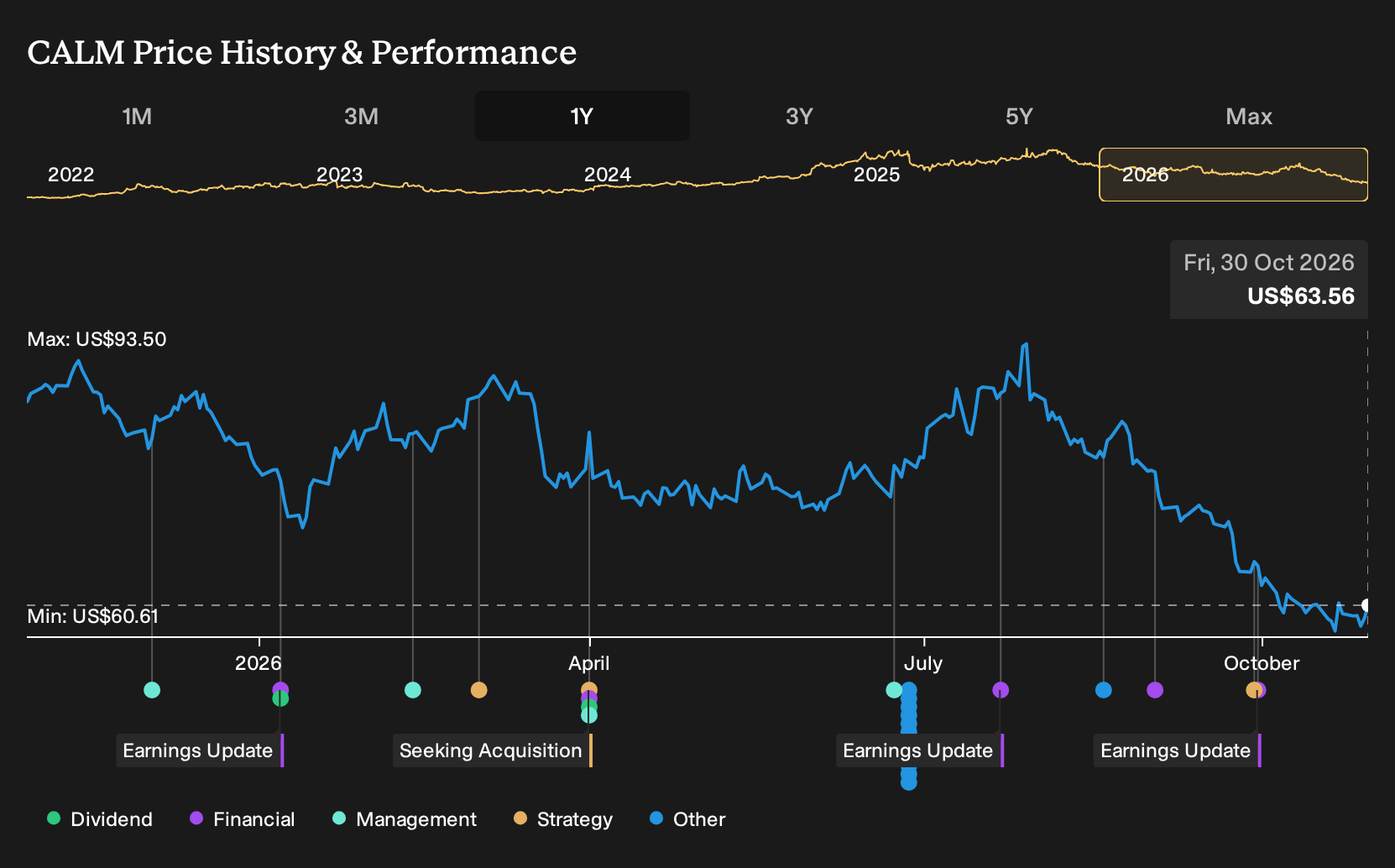
- Cal-Maine Foods recently faced earnings pressure as an oversupply of eggs led to weaker pricing and strained profitability across its conventional egg operations.
- An interesting angle is the company’s push into specialty eggs and prepared foods, which aims to smooth earnings swings without relying on higher commodity egg prices.
- We will examine how Cal-Maine Foods' investment narrative relates to recent oversupply-driven pricing pressure in the egg market.
Scan beyond Cal-Maine Foods and stress test your thesis on egg oversupply and balance sheet strength against our hand-picked list of solid balance sheet and fundamentals (24 results)
Cal-Maine Foods Investment Narrative Recap
Cal-Maine Foods appeals to investors who think egg demand stays resilient and that mix, not just volume, does the heavy lifting. The thesis leans on specialty eggs and prepared foods gradually taking a bigger share of sales, which can cushion commodity pricing swings. Recent oversupply and weaker egg prices pressure margins but also test how quickly that mix shift can matter.
Right now the main short term swing factor is how quickly supply and demand for conventional eggs rebalance. The key operational risk is that oversupply lingers while profit margins, already down to 2.3% from 28.9%, take time to rebuild. If pricing pressure proves temporary, the broader specialty and prepared foods plan remains largely intact.
With no fresh company announcements tied directly to the latest pricing pressure, the most relevant reference point is still Cal-Maine Foods’ disclosed balance sheet position. The group holds about US$924 million in net cash and investments. That financial cushion gives management room to keep investing in specialty and prepared foods even when conventional earnings feel squeezed.
For you as a shareholder, that cash and low leverage profile matters because it supports ongoing capital expenditures, modernization and potential M&A, such as Echo Lake style deals when opportunities appear. It also gives the business more breathing room if avian influenza, integration challenges or prolonged oversupply weigh on profitability, all of which sit on the current risk list.
Cal-Maine Foods' narrative projects US$2.8b revenue and US$124.8 million earnings by 2029. This is based on an assumed 3.5% yearly revenue growth and an earnings increase of about US$66 million from US$58.7 million today.
Uncover why Cal-Maine Foods' fair value indicates an 8% potential upside to its current price that could narrow quickly.
Exploring Other Perspectives
Four fair value estimates from the Simply Wall St Community span roughly US$16 to US$68 per share, with opinions scattered across the full range. That spread shows retail analysts looking at Cal-Maine Foods through very different lenses. When you also consider avian influenza and integration risk, there is plenty of reason to compare several contrasting viewpoints.
Explore 3 other Cal-Maine Foods fair value estimates, including one that suggests as much as 74% downside from the current price.
Form Your Own Verdict
Don't just follow the ticker. Dig into the data and build a conviction that's truly your own.
- A great starting point for your Cal-Maine Foods research is our analysis highlighting 1 key reward and 1 important warning sign that could impact your investment decision.
- See our latest analysis for Cal-Maine Foods. The report includes a comprehensive fundamental analysis summarized in a single visual, the Snowflake, making it easy to evaluate Cal-Maine Foods' overall financial health at a glance.
Looking for more Cal-Maine Foods style investment ideas?
Once you have a handle on Cal-Maine Foods, it can help to compare that thesis with other opportunities that share similar qualities, whether you care most about valuation support, resilience, or balance sheet strength.
- If you want quality and value to work together, start with a short list backed by fundamentals using the 33 high quality undervalued stocks.
- For investors who put capital preservation first, stress test your risk tolerance against the 29 resilient stocks with low risk scores.
- When financial strength is non negotiable, broaden your watchlist with a focused list of solid balance sheet and fundamentals (24 results).
Have feedback on this article? Concerned about the content? Get in touch with us directly. Alternatively, email editorial-team@simplywallst.com