


- Gates Industrial reported third quarter 2026 sales of US$903.6 million and net income of US$86.5 million, with basic and diluted earnings per share of US$0.34, alongside higher full year adjusted EPS and EBITDA guidance.
- The firm paired record adjusted EBITDA margins near 23.8% with a low net leverage ratio of about 1.8x. This provides more room for targeted acquisitions and continued investment in high growth areas such as data centers and personal mobility.
- The focus now is on how Gates Industrial's investment narrative aligns with this record margin performance and raised full year guidance.
See how Gates Industrial’s record-margin story compares with other industrials aiming for stronger cash generation by reviewing the hand picked 33 high quality undervalued stocks that may be pricing in less optimism.
Gates Industrial Investment Narrative Recap
To own Gates Industrial, you need to be comfortable with a story in which higher margin platforms gradually reshape a business that still leans on slower traditional auto and industrial demand. The Q3 report, with US$903.6 million in sales and US$86.5 million in net income, indicates that margin work and cost discipline are currently reflected in the income statement.
The key near term catalyst is execution in data center fluid solutions and personal mobility, supported by a low net leverage ratio that provides room to fund growth projects. The biggest risk remains prolonged weakness in core industrial OEM and construction markets in North America and EMEA. Recent numbers do not remove that exposure.
The Q3 2026 earnings release is the clearest operational marker for this narrative. Sales of US$903.6 million compared to US$855.7 million a year earlier, with basic and diluted EPS of US$0.34 versus US$0.32 and US$0.31, indicate that Gates Industrial is pairing higher profitability with a still modest top line.
Over the first nine months, revenue of US$2,696.3 million and net income of US$317.1 million compared with US$2,587.0 million and US$200.1 million. That step up in earnings, alongside record adjusted EBITDA margins and raised full year adjusted EPS and EBITDA guidance, supports the idea that margin initiatives and newer categories can offset pressure in legacy markets if execution stays tight.
What The Current Forecasts Assume For Gates Industrial
For anyone tracking Gates Industrial, the consensus view already sketches out a fairly specific earnings path that sits behind today’s valuation. Analysts are building their models around a business that leans on margin work and share repurchases as much as on headline growth. That mix matters if you are judging whether the current guidance and capital allocation policy give enough support to the long term story.
Forecasts in the latest report are straightforward. Analysts assume revenue grows by 5.0% a year over the next three years, while profit margins edge from 10.4% today to 10.7% by 2029. On earnings, the group expects US$435.2 million of profit, or US$1.72 per share, by 2029. That compares with current earnings of US$364.1 million, which implies an earnings increase of about US$71 million under the consensus case.
Behind those numbers sits a view on how the stock should trade. The implied 2029 P/E multiple of 23.8x on the forecast earnings is above the current 19.2x for Gates Industrial, yet slightly below the broader US Machinery sector at 24.5x. Analysts also bake in share count shrinking by roughly 1.99% each year for the next three years, which would support earnings per share even if operating profit grew more slowly than the total net income line.
Gates Industrial's narrative projects US$4.1b revenue and US$435.2 million earnings by 2029. This assumes 5.0% yearly revenue growth and an earnings increase of about US$71 million from US$364.1 million.
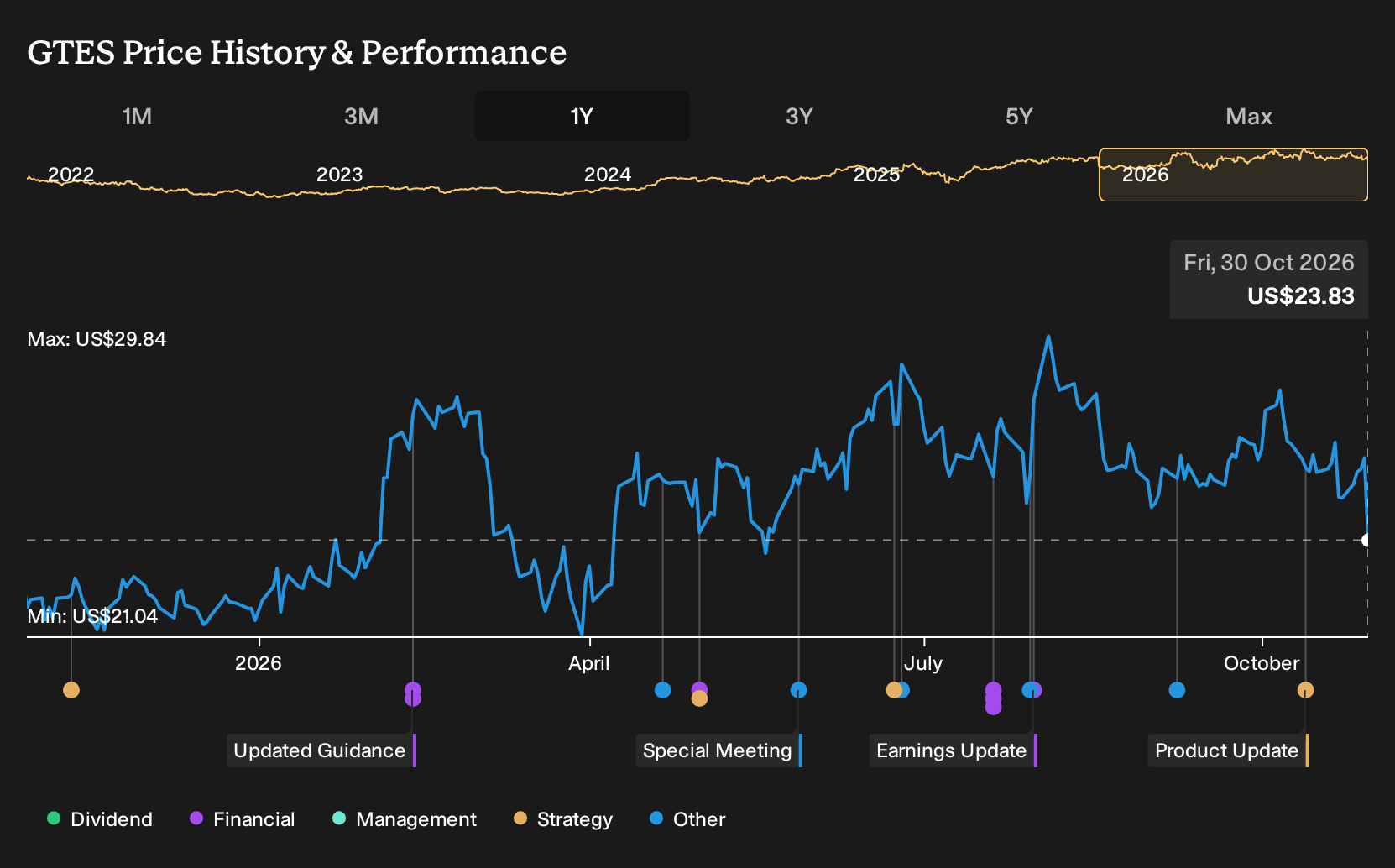
Targets around the equity reflect that set of assumptions. The consensus price target sits at US$33.33, with a spread between US$29.0 on the cautious side and US$39.0 at the high end. That range is based on those 2029 earnings of US$435.2 million, the US$4.1b revenue goal and a P/E of 23.8x, discounted back using a 9.3% rate in the source report. With the stock recently at US$27.65, the average target is 17.0% higher, so readers need to judge whether the underlying forecasts on growth, margins and valuation multiples feel reasonable.
Uncover why Gates Industrial's fair value indicates a 40% potential upside to its current price, which could narrow quickly.
Decide For Yourself
Disagree with existing narratives? Extraordinary investment returns rarely come from following the herd, so consider trusting your own analysis.
- A great starting point for your Gates Industrial research is our analysis highlighting 5 key rewards and 1 important warning sign that could impact your investment decision.
- See our latest analysis for Gates Industrial. The report includes a comprehensive fundamental analysis summarized in a single visual, the Snowflake, making it easy to evaluate Gates Industrial's overall financial health at a glance.
Looking For More Investment Ideas Beyond Gates Industrial?
If the Gates Industrial story has sharpened your view on margins, balance sheets and guidance, it can be useful to line that up against a wider watchlist built with the Simply Wall St Screener.
- For investors who care most about resilient business models and capital preservation, start with a curated set of 29 resilient stocks with low risk scores that aim to keep downside surprises in check.
- If dependable income streams matter to you, scan a focused group of 5 dividend fortresses that pair higher yields with fundamental checks on payout strength.
- When you want to spot potential early stage opportunities before they hit the mainstream, sort through a targeted pool of 19 high quality undiscovered gems that already show solid underlying metrics.
Have feedback on this article? Concerned about the content? Get in touch with us directly. Alternatively, email editorial-team@simplywallst.com