


- Insmed reported third quarter and nine month 2026 results that showed a smaller net loss and lower loss per share, while also raising full year revenue guidance for BRINSUPRI and ARIKAYCE and launching BRINSUPRI in Japan for non cystic fibrosis bronchiectasis.
- The combination of tighter losses, higher revenue guidance ranges and the first in class BRINSUPRI launch in Japan signals a company leaning harder into its respiratory portfolio as a commercial, rather than purely pipeline, story.
- We will look at how Insmed's investment narrative evolves as raised BRINSUPRI guidance reshapes expectations for the respiratory franchise.
Scan how Insmed’s respiratory push compares with other potential opportunities by reviewing a curated set of 34 healthcare AI stocks selected for their exposure to next generation healthcare treatments and tools.
Insmed Investment Narrative Recap
For Insmed, the core belief is that a focused respiratory portfolio around BRINSUPRI, ARIKAYCE and pipeline assets can eventually support a profitable specialty pharma model. The latest quarter points in that direction, with the firm reporting a smaller net loss and lower loss per share while still investing behind launches and clinical programs.
In the near term, the key catalyst remains execution on expanding treated bronchiectasis and MAC lung disease populations, including identifying more eligible patients in complex comorbid settings. The biggest current risk is that ex US markets outside Japan and slower diagnosis trends keep new starts below expectations. The recent results and guidance changes do not fully remove that concern.
The raised 2026 revenue guidance for BRINSUPRI to US$1.35b to US$1.4b and for ARIKAYCE to US$460m to US$470m is the announcement that ties most directly to this earnings update. That change indicates that management now anticipates more contribution from the existing respiratory portfolio within the current year, rather than only from future pipeline outcomes.
For catalysts, this matters because it tightens the link between near term performance and the broader respiratory franchise narrative built around shared pulmonology call points. It also raises the execution bar. If bronchiectasis diagnosis and MAC expansion efforts in the US and Japan slow, or if reimbursement outside those geographies remains difficult, these higher ranges could become harder to sustain.
Insmed's narrative projects US$4.4b revenue and US$1.2b earnings by 2029. This implies forecast revenue growth of 56.6% a year and an earnings swing of about US$2.08b from earnings today, from a US$875.3m loss.
Explore why Insmed's fair value points to a 74% potential upside relative to its current price, a valuation gap that could close quickly.
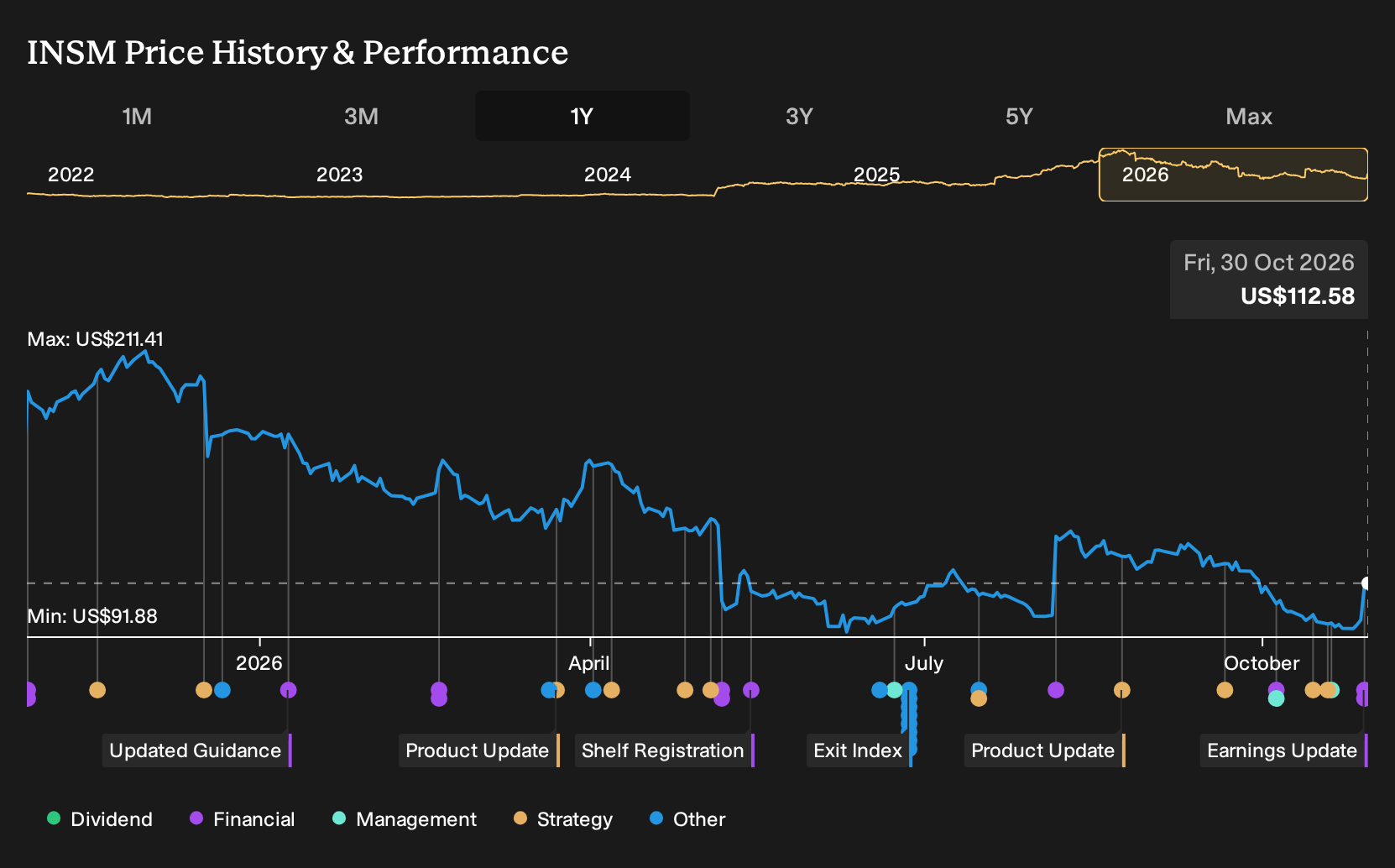
Exploring Other Perspectives
One alternate view on Insmed focuses on slower BRINSUPRI uptake in broader pulmonology. The most cautious analysts were assuming revenue growth of 38.1% a year and earnings of about US$659.8m by 2029, far below the US$1.2b consensus. That gap shows how widely opinions can differ, and why exploring multiple narratives after this guidance change can help you stress test your own expectations.
Explore 2 other Insmed fair value estimates, including one that suggests it could be worth just $193.95!
Form Your Own Verdict
Don't just follow the ticker; dig into the data and build a conviction that's truly your own.
- A great starting point for your Insmed research is our analysis highlighting 3 key rewards and 2 important warning signs that could impact your investment decision.
- See our latest analysis for Insmed. The report includes a comprehensive fundamental analysis summarized in a single visual, the Snowflake, making it easy to evaluate Insmed's overall financial health at a glance.
Looking for more investment ideas beyond Insmed?
If Insmed's story has sharpened your thinking about risk, reward and timing, it can help to line that up against a wider watchlist built with a consistent framework.
- If you want potential value with quality fundamentals, start by scanning a focused group of 33 high quality undervalued stocks that combine stronger balance sheets with cash generation.
- For readers who put capital preservation first, use the 29 resilient stocks with low risk scores to narrow in on businesses with more resilient risk profiles.
- To widen your opportunity set beyond well covered stocks, turn to a curated 19 high quality undiscovered gems that screens for solid fundamentals in under followed companies.
Have feedback on this article? Concerned about the content? Get in touch with us directly. Alternatively, email editorial-team@simplywallst.com