


The Zhitong Finance App learned that Onsemi Semiconductor (ON.US) will announce the results for the third quarter of 2026 after the US stock market on November 2 (Monday). The market currently anticipates that Ansemi Semiconductor's Q3 revenue will increase 10% year over year to US$1.7 billion, and adjusted earnings per share will increase by more than 39% year over year to $0.88.
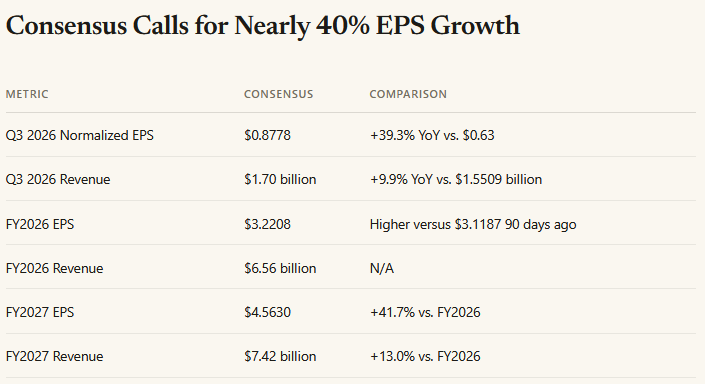
In addition to the third quarter results, the market is also concerned about the fourth quarter results guidance that Ansemi Semiconductors will give. According to current analysts' expectations, Ansemi Semiconductor's Q4 revenue was approximately US$1.74 billion, with adjusted earnings per share of approximately US$0.96.
In the current context where the market is beginning to re-examine the return on artificial intelligence (AI) capital expenditure and worry about whether huge investments by tech giants can be converted into actual revenue and cash flow, Ansemi Semiconductor's Q3 performance will become an important window for observing whether AI infrastructure demand can continue to be transmitted to upstream semiconductor suppliers.
The key to this financial report is not only whether revenue and earnings per share can exceed expectations, but also whether the AI data center power business can prove that demand is real, growth continues, and is being transformed into improvements in gross margin and cash flow. For investors, Q3 results provide validation of demand, and Q4 guidance determines whether this growth can continue.
1. Can the AI data center business continue to grow rapidly
According to the data, Ansemi Semiconductor's second-quarter revenue increased by about 9% year on year to 1.6 billion US dollars, slightly higher than analysts' general expectations of 1.59 billion US dollars; adjusted earnings per share increased by about 40% year over year to 0.74 US dollars, higher than analysts' general expectations of 0.71 US dollars.
Segment data further proves that growth is clearly being concentrated on the AI data center power semiconductor business. The power solutions business (PSG) revenue reached US$829 million, up 18.7% year on year and 13% month on month, accounting for more than half of the company's revenue from 47.5% in the same period last year to 51.7%, becoming the source of more than half of the company's revenue; analog and mixed signal business (AMG) revenue was approximately US$545.7 million, down 1.8% year over year; intelligent sensing business (ISG) revenue was US$228.8 million, up 6.6% year over year.
The strong Q2 performance of Ansemi Semiconductors shows that demand for AI chips is spilling over from GPUs, ASICs, and HBM units to power semiconductors, analog control, and monitoring signal chains. This is not an analog chip company simply “grasping the AI concept,” but rather a physical requirement inevitably brought about by increased computing power density.
In the field of analog/power chips and power semiconductors/discrete devices, the underlying core logic of achieving strong demand expansion following the unprecedented wave of AI is that AI racks are jumping from tens of kilowatts of traditional servers to over 100 kilowatts, and evolving to 600 kilowatts or even 1 megawatt, that is, the power consumption of a single next-generation GPU/TPU/ASIC may reach 2-4 kilowatts. This is why traditional 48V/54V architectures will generate thousands of amperes of current, and copper loss, heat generation, and bus volume will rise rapidly. Yasumori Miyo ±400V or 800V DC architectures jointly promoted by Nvidia.
Before electricity enters the GPU from the power grid, it must go through AC/DC rectification, PSU, BBU, high voltage distribution, 800V to 50V intermediate bus conversion, and then the multi-phase VRM reduces the voltage to less than 1V required by the GPU core; each level requires Si, SiC, or GaN power switches, gate drivers, digital controllers, power management ICs, and electronic fuses. What Ansemi Semiconductors, Texas Instruments, and Infineon sell are these “must for every watt” devices, so the higher the rack power and the more complex the conversion stages, the more valuable the single-cabinet semiconductor.
In this “grid-to-GPU” power tree, Ansemi Semiconductor can provide EliteSiC MOSFETs/JFETs, high and low voltage silicon MOSFETs, GaN devices, hot-plug smart fuses, multi-phase controllers, power levels, and PoL regulators, so that a single AI frame requires not only more chips, but also higher unit price, higher voltage resistance, and higher efficiency power devices. The Nvidia NVIDIA MGX platform can be described as the core strategic entry point for Onsemi Semiconductors' AI data center business. Ansemi Semiconductor has supplied power FETs, multi-phase power supplies, SiC JFETs, and GaN solutions for existing MGX systems, and directly serves PSUs, BBUs, and future 800V distribution board suppliers in the Nvidia and MGX ecosystem; MGX's standardized server and rack design will also make it easier for a certified power device to be copied and used by many OEMs and ODMs.
Ansemi Semiconductor has defined the AI data center business as the fastest growing segment, and expects related revenue to more than double in 2026. If the company's management confirms that the AI data center business continues to grow strongly, and that orders, customer imports, and product shipments improve simultaneously, investors may see that AI capital expenditure is being transferred to the wider semiconductor industry chain, not just focused on GPUs, memories, and advanced process chips.
Notably, AI business order visibility is particularly important. If management can confirm that customer demand is not only concentrated in the current few quarters, but that continuous platform design introduction and subsequent mass production opportunities have been formed, the market's valuation logic for Ansemi Semiconductors' AI business may shift from a short-term cyclical rebound to medium- to long-term growth.
Furthermore, progress in the recovery of traditional businesses may also become a focus of attention for investors. Can the automotive business continue to improve? When will industrial business resume growth? The answers to these questions may test the quality of Ansemi Semiconductors' performance growth.
2. Gross profit margin and cash flow are also key
Ansemi Semiconductors' Q2GAAP gross margin increased from 37.6% to 38.4%, and non-GAAP gross margin increased to 39.3%. The company previously said that the Q2 capacity utilization rate has increased from 77% in the first quarter to 83%, and management expects that every 1 percentage point increase in capacity utilization can contribute about 25 to 30 basis points to gross margin.
Ansemi Semiconductor's operating cash flow data as of July 3 increased 149.4% year-on-year to US$459.7 million. Free cash flow also increased wildly from US$106.1 million to US$425.4 million, about four times that of the same period last year, and the free cash flow rate rose from about 7% to 27%. In other words, although Q2 revenue increased by only about 9%, profit, cash flow data, and shareholder returns expanded several times faster, indicating that Ansemi Semiconductors' Fab Right production capacity optimization, cost discipline, and product portfolio upgrades have begun to form real operating leverage.
If Q3 gross margin reaches or exceeds the guideline limit of 42% and free cash flow continues to improve, it indicates that AI data center business growth, capacity utilization improvement, and product portfolio optimization may be jointly driving up profitability. Conversely, if revenue exceeds expectations, but gross margin remains stagnant, and is even dragged down by rising costs of raw materials, substrates, and external manufacturing, the market may question whether AI business growth actually has a high profit quality.
Additionally, Ansemi Semiconductor is moving ahead with the acquisition of Synaptics. After the transaction is completed, the company will expand its layout in the fields of connected computing, edge AI and related technologies, but investors will also pay attention to transaction financing arrangements, integration costs, synergy effects, and gross margin impacts. Synaptics' own gross margin is high, and is theoretically expected to improve Ansemi Semiconductors' product portfolio, but whether the acquisition can actually improve long-term profitability still depends on business integration and revenue synergy after the transaction is completed, and cannot be judged solely on the target company's historical gross margin.
3. Are AI orders crowding out traditional business supply capacity
Previously, Ansemi Semiconductor gave priority to meeting AI customer orders, and delivery arrangements for automotive and industrial customers were affected to a certain extent. Meanwhile, the company's product delivery cycle has reportedly been extended from about 27 weeks to about 32 weeks.
This reflects the growing demand for AI power semiconductors, but it also poses supply distribution issues. Investors need to pay attention to whether management expects the delivery cycle to continue to be extended and whether the company can maintain normal delivery of automotive and industrial businesses while meeting the needs of AI customers. If the AI business grows at the expense of other businesses, the overall quality of its growth needs to be reduced.
4. Q4 guidelines determine whether the market is willing to continue to pay a premium for AI growth
Compared to the Q3 results themselves, the Q4 guidance may have a more direct impact on Ansemi Semiconductors' stock price. According to current analysts' expectations, Ansemi Semiconductor's Q4 revenue was approximately US$1.74 billion, with adjusted earnings per share of approximately US$0.96. This means that the market has taken into account expectations for continued AI data center business growth, improved capacity utilization, and gross margin expansion to a certain extent in advance.
Therefore, even if Q3 revenue and earnings per share exceed market expectations, if the Q4 guidelines given by management only meet expectations, or if they tend to be cautious about the growth prospects of the AI business, stock prices may not be significantly boosted.
Taken together, the impact of Ansemi Semiconductor's current financial report on market sentiment may not be limited to the company's own stock price, but will also provide an important reference for investors to judge the extent of the AI infrastructure industry chain. The most important observation indicator is whether AI data center business growth can simultaneously drive improvements in revenue, gross margin, and free cash flow.
If the three improve simultaneously, Ansemi Semiconductor is expected to become a beneficial example of AI investment spreading from computing power chips to power infrastructure, and may also provide a positive demand verification for the AI industry chain in the context of the market questioning the sustainability of AI capital expenditure. However, if the AI business grows rapidly but overall gross margin and cash flow do not improve significantly, then the market may further differentiate between the real profit beneficiaries in the AI industry chain and suppliers that only enjoy increased demand.