


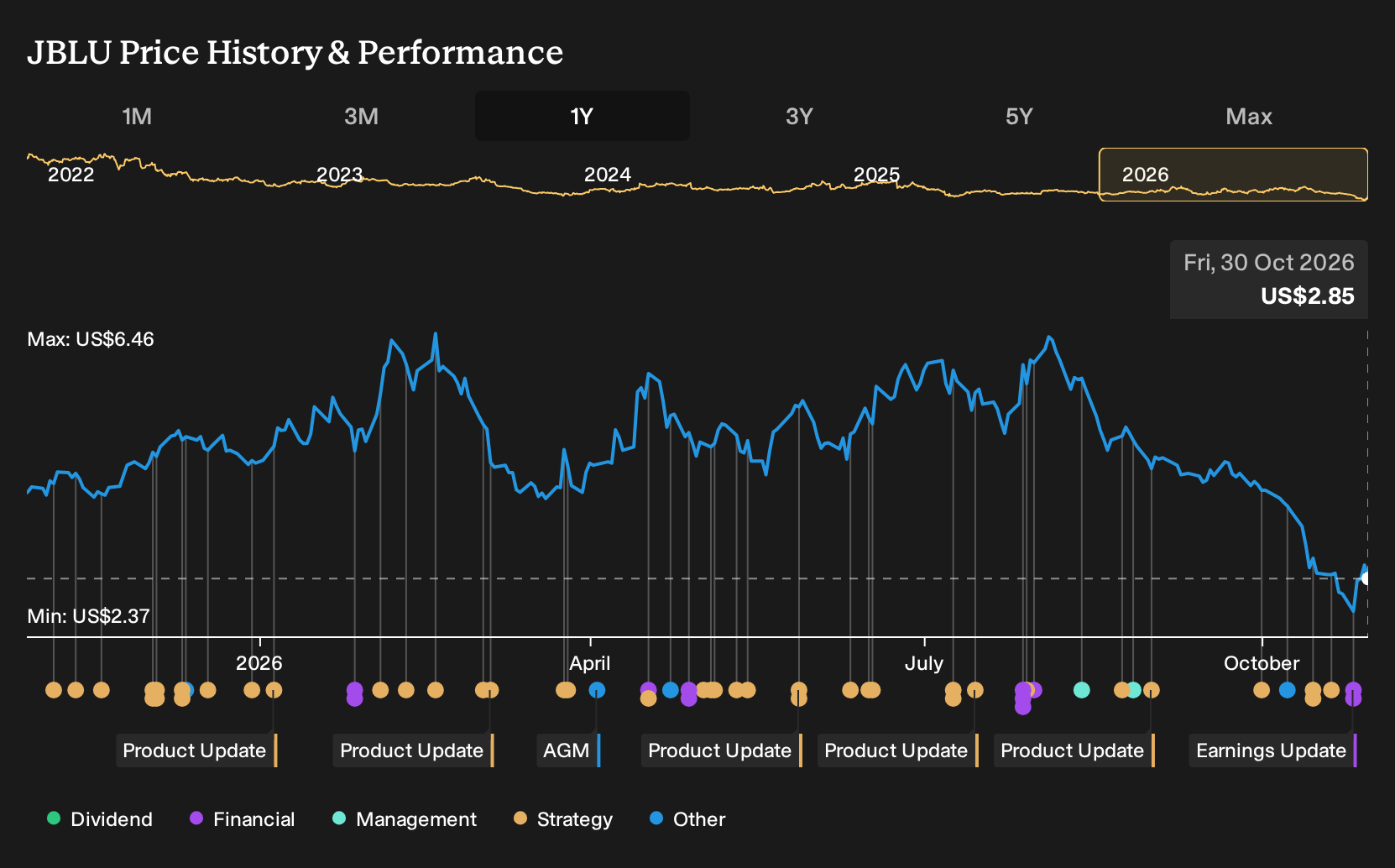
- JetBlue Airways reported third quarter 2026 revenue of US$2,812 million and a net loss of US$257 million, while also issuing new capacity and unit revenue guidance and outlining expectations for the rest of 2026.
- Bilt announced a new points transfer partnership with JetBlue TrueBlue at a 1:1 ratio, which connects rent payments to JetBlue’s loyalty ecosystem across more than 100 destinations and may influence how frequent flyers engage with the airline.
- This article examines how JetBlue’s widened quarterly loss and updated operating guidance may affect the investment narrative around its recovery path.
JetBlue Airways Investment Narrative Recap
To stay in JetBlue Airways, you need to believe the airline can turn growing revenue into a path toward smaller losses, then eventually consistent profitability. The latest quarter shows US$2,812 million in sales but a net loss of US$257 million, so the story still hinges on execution around cost control, pricing, and capacity discipline.
The most important short term catalyst lies in how well JetBlue meets its own Q4 and full year 2026 guidance on Available Seat Miles and RASM. The biggest risk is that higher labor and fuel costs, plus intense competition, keep eroding margins even if volumes and unit revenues remain in line with guidance.
The updated operating outlook on October 26 is central to this. Management guided Q4 2026 Available Seat Miles growth of 3.0% to 4.0% and RASM up 18.0% to 22% year over year. For a shareholder, the focus is on whether that mix of modest capacity growth and stronger unit revenue can start to stabilize financial performance.
For the full year 2026, JetBlue Airways expects ASMs up 1.5% to 2.5% and RASM up 13.5% to 14.5%. Those numbers connect directly to the key catalysts around network optimization and returning grounded aircraft. If actual results track close to this guidance, it supports the recovery narrative. If they fall short, it reinforces concerns about demand visibility and sustained margin pressure.
What The Analyst Forecasts Really Assume For JetBlue Airways
Analysts are sketching a very different version of JetBlue Airways a few years from now compared with what the income statement shows today. The current consensus builds in annual revenue expansion of 9.4% over the next three years and a swing in profit margin from a 10.0% loss today to a slim 0.3% profit by 2029. This would imply the business roughly breaks even after years of red ink.
On earnings, the shift in the model is even more striking. Forecasts call for JetBlue to move from a loss of about US$1.0b today to positive earnings of US$44.9 million by 2029, a change of just over US$1.0b. That projection is far from uniform. The most optimistic analyst pencils in US$366.8 million in profit, while the most cautious sits at US$34.6 million, which shows how wide the range of opinion is on the eventual earnings power of the airline.
Valuation assumptions add another layer of expectation. To line up with the average price target, the shares would need to trade at a P/E of 55.8x on those 2029 earnings, compared with a current P/E of 1.1x in loss territory and a reported 9.5x for the broader US airlines group. That is a rich multiple for a carrier that consensus still only has earning a small absolute profit in a few years, so it sets a high bar for both execution and investor confidence.
Long-term holders need to be comfortable with several moving parts at once. Revenue is modeled to rise at a mid single digit to high single digit rate, margins are expected to climb from clearly negative into slightly positive territory, and the share count is projected to expand at about 3.75% a year. All of that is being discounted back using a rate of 12.54%, which is intended to capture the risk profile of an airline that still carries meaningful cost and demand uncertainty.
JetBlue Airways' narrative projects US$13.1b revenue and US$44.9 million earnings by 2029. This rests on 9.4% yearly revenue growth and an earnings increase of roughly US$1.0b from a current loss of US$1.0b.
Discover why JetBlue Airways' fair value indicates a 46% potential upside to its current price, a gap that could narrow quickly.
Exploring Other Perspectives
One catalyst the more cautious analysts watch closely is JetBlue’s JetForward earnings plan. Before this latest earnings release, the lowest forecasts still assumed revenue reaching about US$12.4b and earnings of roughly US$32.9 million by 2029. That is a far more restrained profit story than consensus, and this new Bilt and guidance news could shift both views.
Explore 2 other JetBlue Airways fair value estimates, including one that suggests it could be worth just $4.17!
Decide For Yourself
Don't just follow the ticker; dig into the data and build a conviction that's truly your own.
- A great starting point for your JetBlue Airways research is our analysis highlighting 3 key rewards that could impact your investment decision.
- See our latest analysis for JetBlue Airways. The report includes a comprehensive fundamental analysis summarized in a single visual, the Snowflake, making it easy to evaluate JetBlue Airways' overall financial health at a glance.
Looking For More Investment Ideas Beyond JetBlue Airways?
If JetBlue Airways has you thinking about where risk and reward feel more balanced for your portfolio, it can help to scan a broader set of companies with different financial profiles and business models. The Simply Wall St Screener lets you filter by fundamentals so you can quickly shortlist potential additions that better match your own tolerance for volatility, income needs, and time horizon.
- For investors who want income strength with fewer surprises, review a curated set of companies described as 5 dividend fortresses and see which yields and payout records line up with your goals.
- If capital preservation and steadier financial profiles matter most, run your eye over a 29 resilient stocks with low risk scores to find businesses that score well on balance sheet resilience and risk factors.
- When the focus is on quality first, then price, scan a 19 high quality undiscovered gems that filters for robust fundamentals where the market may not be paying full attention yet.
Have feedback on this article? Concerned about the content? Get in touch with us directly. Alternatively, email editorial-team@simplywallst.com