


The Zhitong Finance App notes that Palantir (PLTR.US) will announce financial results for the third quarter of 2026 after the market on November 2 (Monday) EST. Against the backdrop of major technology stock earnings reports triggering sell-offs and investors re-examining the return on investment in artificial intelligence, this financial report is regarded as the most important test for “AI trading” in the market this week.
Revenue pre-increased by about 85%, and profit nearly doubled
According to the latest consistent market expectations, analysts expect Palantir's third-quarter revenue to be about US$2.18 billion, up about 85% year on year, and the forecast range is between US$2.16 billion and US$2.26 billion; adjusted earnings per share are about US$0.41, which is nearly double that of US$0.21 in the same period last year, and the forecast range is US$0.38 to US$0.45. Analysts surveyed by FactSet expected slightly higher, with revenue of around $2.22 billion and earnings per share of around $0.42.
As a reference, the company's second-quarter revenue of US$1.94 billion and adjusted earnings per share of US$0.41 were above market expectations. Over the past two years, Palantir has almost continuously beaten Wall Street forecasts in terms of revenue and profit. The average profit surprise margin for the past four quarters was about 15%. The record that has repeatedly exceeded expectations has also raised the threshold for this financial report.
The year-round guide is another highlight. In August, Palantir raised its revenue forecast for the full year of 2026 to US$8.15 billion to US$8.16 billion, corresponding to a growth rate of about 82%, and raised the annual growth rate guide for the US commercial business to at least 134%. At present, the market's consensus forecast has reached about US$8.22 billion, which is higher than the company's guidance range. Management's previous revenue guidance for the third quarter was 2.16 billion to 2.164 billion US dollars, which is lower than current market expectations. This means that “exceeding expectations and raising the guidelines again” is almost a necessary condition for stock prices to remain strong.
The growth rate of commercial business is the core
In this financial report, investors will focus on several types of operating indicators: the first is the growth rate of US commercial business revenue, which surged 149% year-on-year to US$764 million in the second quarter, which is the overall focus. It can maintain a growth rate of about 140% after raising the base figure by about 30 percentage points, directly testing the penetration rate of enterprise AI platforms (AIP); second, US government business, we need to observe whether the pace of federal contract implementation continues to recover; third is whether international commercial business can accelerate again as scheduled; fourth, profit quality indicators, including adjusted operating profit margins (reaching 2% in the second quarter)), Rule of 40 score and free cash flow performance.
Furthermore, capital allocation has become a new topic. According to RBC capital market statistics, investor questions about dividends, stock repurchases, and stock splits before the earnings report accounted for 46% of all weighted questions, up 30 percentage points from the previous quarter, reflecting that the market is beginning to pay attention to how the company will use its cash reserves of about 9 billion US dollars.
Citigroup and J.P. Morgan Chase are bullish; Morgan Stanley is cautious
On the eve of earnings reports, a number of Wall Street institutions raised their expectations. Citi maintained its “buy” rating and raised its target price from $245 to $250. Citibank analysts said that channel surveys showed strong partner demand, particularly in the US federal business. A federal sector professional partner said its overall technology business increased by more than 60% year over year. Palantir was one of the biggest beneficiaries, showing that the company clearly recovered from the impact of last year's Department of Government Efficiency (DOGE) spending cuts. Citi predicts that the US commercial revenue growth rate is expected to exceed 140%, that international business will accelerate again, that the US government business will also achieve double-digit growth that exceeds expectations, and that the company will raise the annual revenue growth rate guide by another 10 percentage points.
J.P. Morgan analyst Brian Essex covered Palantir for the first time, gave it an “gain” rating, and placed on the “Positive Catalysts Watch List” with a target price of $262 in December 2027. He believes that the focus of AI adoption by enterprises is shifting from technology deployment to the pursuit of actual return on investment, and Palantir's platform has been able to effectively transform customer business processes, making it a direct software beneficiary in this round of AI investment cycle.
Morgan Stanley also believes that the channel has strong momentum and that the demand environment is healthy, but it only gives a “hold and see” rating. The target price is 205 US dollars, and the attitude is relatively restrained.
Guidelines should only be amazing, not excellent
If the business-level disagreement is only the difference between looking more and looking more bullish, then the valuation level dispute is the real dark line of this financial report. Most analysts acknowledge that Palantir's current pricing is out of the conventional valuation framework.
Let's look at the numbers first. Palantir's current expected price-earnings ratio is about 89 times, while the S&P 500 index is about 19 times; based on consistent market expectations, the profit ratio is about 121 times its price-earnings ratio in 2026, even if the profit is expected in 2027 is still as high as 75 times; the corporate value is about 61 times the expected revenue in 2026.
In a horizontal comparison, Nvidia (NVDA.US), which is also at the center of AI storytelling, is expected to have a price-earnings ratio of around 30 times. Since the last financial report in August, Palantir's stock price has accumulated a cumulative increase of about 60%, and the pace of valuation expansion is even faster than the rate of increase in profit expectations. This means that a significant portion of the stock price increase comes from “faith recharge” rather than the fulfillment of fundamentals.
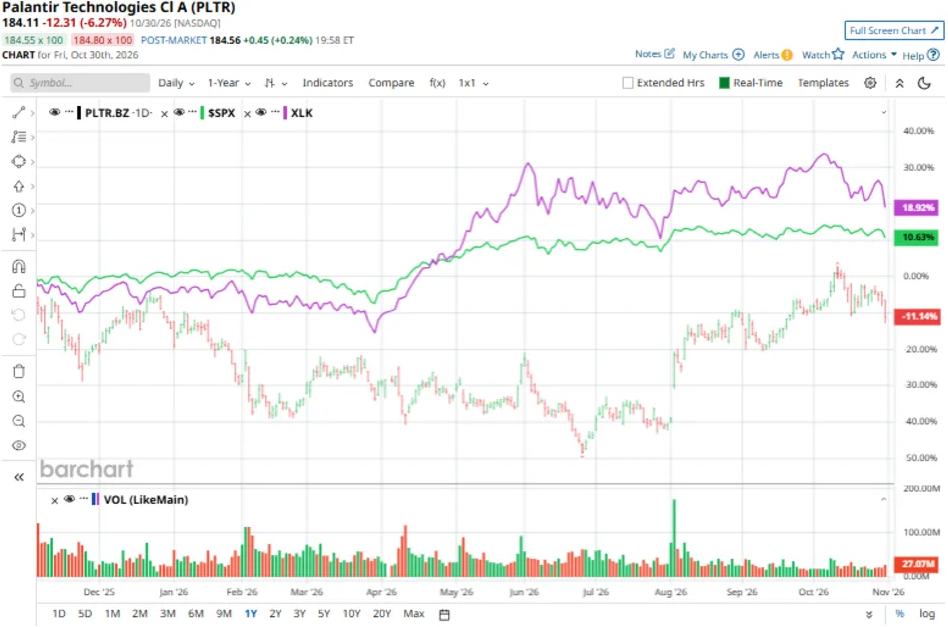
The sell-side analysts' target price distribution itself revealed this embarrassment. Citibank's bullish targets of $250 and J.P. Morgan Chase's $262 are certainly impressive, but Morgan Stanley only gave a “hold and see” rating of $205. Previously, the conservative target prices of some institutions were even lower than the current price.
Analyst Future Stack Investment warns that the increase in Palantir's stock price has outperformed profit growth. The valuation premium requires the company to continue to exceed expectations in terms of both growth and profit margin, and that there is “almost zero” room for fault tolerance at the execution level. In other words, what the market is currently buying is not Palantir's present, but the future where it must double its cash every year.
This valuation structure determines a high degree of asymmetry in the financial response: if the company only hands over an “excellent” report card, and the guidelines are slightly raised, the stock price may fall because these have already been included in the price; only by providing “super amazing” guidelines that far exceed expectations, such as drastically raising the annual revenue target and increasing the growth rate of the US commercial business to the next level, can push the stock price to continue to rise. Similar screenplays have been staged over and over again during this earnings season.
According to Jefferies data, the technology company's stock price fell by an average of 3% the day after announcing its results, the worst performance since the agency began counting 12 years ago; the Nasdaq Composite Index fell 2% last week, falling for the third week in a row. The market's punishment for those who fall short of high expectations is clearly heavier than the reward for those who exceed expectations.
According to LSEG IBES data, the overall profit of about half of the S&P 500 companies that have announced results still increased 31% year on year, indicating that corporate fundamentals are not bad. The crux of the decline is that expectations are too full. For Palantir, whose valuation multiples are much higher than the market, this risk has been further amplified. Some market observers have begun to suggest signs of technical loosening, believing that the stock price showed signs of falling below key support levels before earnings reports.
For Palantir, the third-quarter revenue figures themselves are just the starting point. The growth rate of US commercial business, government contract performance, the increase in annual guidelines, and management's statement on shareholder returns will jointly determine whether this financial report is a “proof of faith” or a “trigger for a return to valuation.” In a market that only rewards “amazing,” “good” is probably the most dangerous answer.