


Menlo Park, California-based Meta Platforms, Inc. (META) operates as a social technology company. The company develops products that enable people to connect and share with friends and family through mobile devices, personal computers, virtual reality headsets, and wearables. With a market cap of $1.6 trillion, Meta is also involved in advertisements, augmented, and virtual reality.
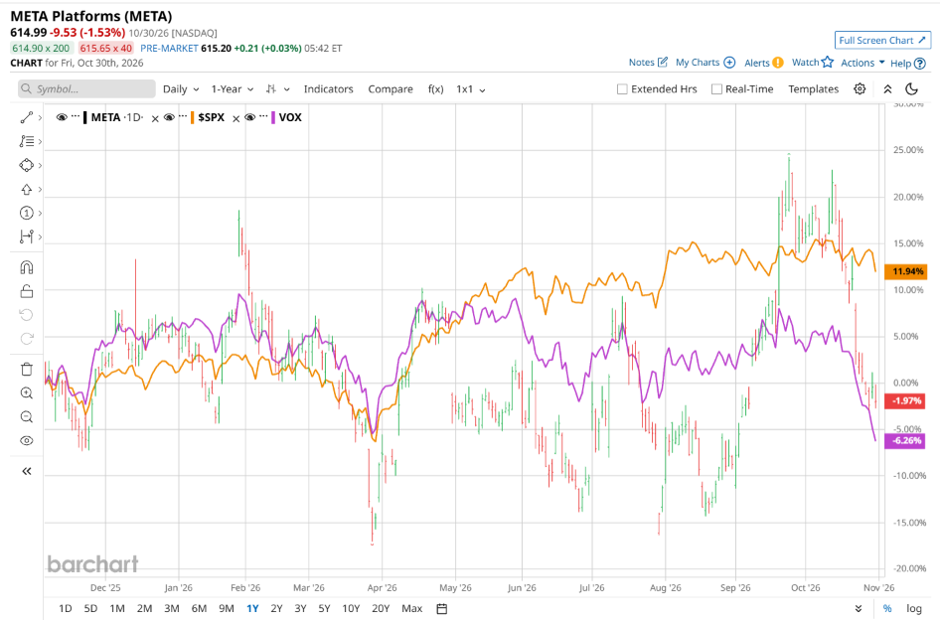
Shares of this social media giant have underperformed the broader market over the past year. META has declined 7.7% over this time frame, while the broader S&P 500 Index ($SPX) has rallied nearly 11.1%. In 2026, META stock is down 6.8%, compared to the SPX’s 10.7% rise on a YTD basis.
Narrowing the focus, META’s outperformance is apparent compared to the Vanguard Communication Services Index Fund ETF (VOX). The exchange-traded fund has declined about 8% over the past year. Moreover, META’s single-digit dip on a YTD basis outshines the ETF’s 11.5% losses over the same time frame.
META’s performance was driven by strong top-line growth, fueled by record video engagement, ad impression increases, and the rapid adoption of its Muse personal AI agent, which surpassed 10 million users in North America within six weeks. However, operating margins plunged to 20.1% due to a $9.9 billion multi-state legal charge and heavy capital expenditures on AI data centers and infrastructure. Looking ahead, management expects sustained revenue expansion through global Muse scaling, enhanced commerce and subscription monetization, and AI tool rollouts for small and enterprise businesses, while pivoting Reality Labs toward AI-integrated hardware like Meta Glasses.
On Oct. 21, META reported its Q3 results, and its shares closed down by 7% in the following trading session. Its adjusted EPS of $7.40 surpassed Wall Street expectations of $6.52. The company’s revenue was $64.6 billion, beating Wall Street forecasts of $63.4 billion. For Q4, META expects revenue in the range of $73 billion to $76 billion.
For the current fiscal year, ending in December, analysts expect META’s EPS to fall 2.3% to $29.01 on a diluted basis. The company’s earnings surprise history is mixed. It beat the consensus estimate in three of the last four quarters while missing the forecast on another occasion.
Among the 55 analysts covering META stock, the consensus is a “Strong Buy.” That’s based on 46 “Strong Buy” ratings, two “Moderate Buys,” and seven “Holds.”
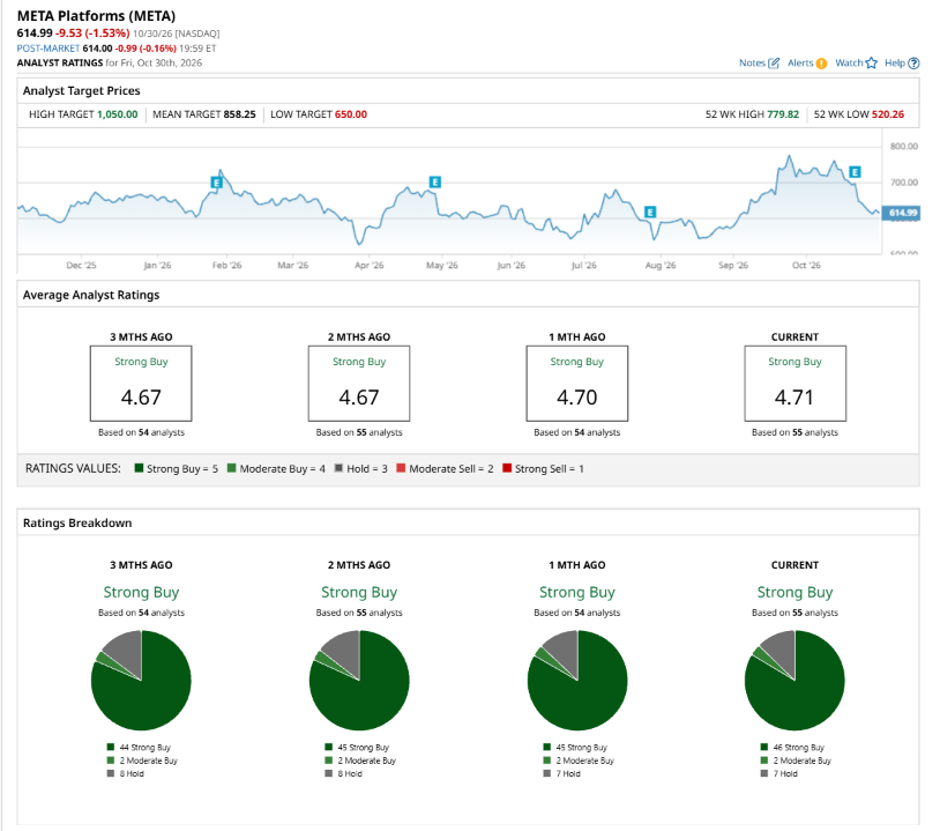
This configuration is more bullish than a month ago, with 45 analysts suggesting a “Strong Buy.”
On Oct. 28, John Blackledge from TD Cowen maintained a “Buy” rating on META, with a price target of $850, implying a potential upside of 38.2% from current levels.
The mean price target of $858.25 represents a 39.6% premium to META’s current price levels. The Street-high price target of $1,050 suggests an ambitious upside potential of 70.7%.
On the date of publication, Neha Panjwani did not directly have a position in any of the securities mentioned in this article. All information and data in this article is solely for informational purposes. For more information please view the Barchart Disclosure Policy here.