


The AI memory boom just hit a wall of worry as big as China this month. When word broke that Chinese chipmaker ChangXin Memory Technologies (CXMT) had achieved a breakthrough in DRAM technology, it triggered shockwaves through the industry. Fears surged that a strong new rival might soon shake up established players, spark a price war, and flood the market with fresh supply. Investors wasted no time dumping top memory stocks like Micron Technology (MU) and SanDisk (SNDK), even though each faces a very different threat from this news.
The reaction highlights just how high the stakes have become in an industry powering the AI revolution, where soaring demand has sent both stocks rocketing to triple-digit gains in 2026. But is China’s advance a real threat to their profits, or is the market jumping the gun? For investors anxious about the future of these memory stocks, understanding the differences between Micron and SanDisk’s business models could reveal which is the smarter pick for the decade ahead.
The Case for Micron (MU)
The selloff followed reports that China's CXMT is developing a breakthrough DRAM design that packs more memory into the same space. With plans to launch its server-focused technology by the end of 2026, the company has sparked concerns that Chinese manufacturers could soon disrupt the market, challenge established players, and drive prices down.
MU stock fell 16% in October alone, despite surging 213% year-to-date (YTD).
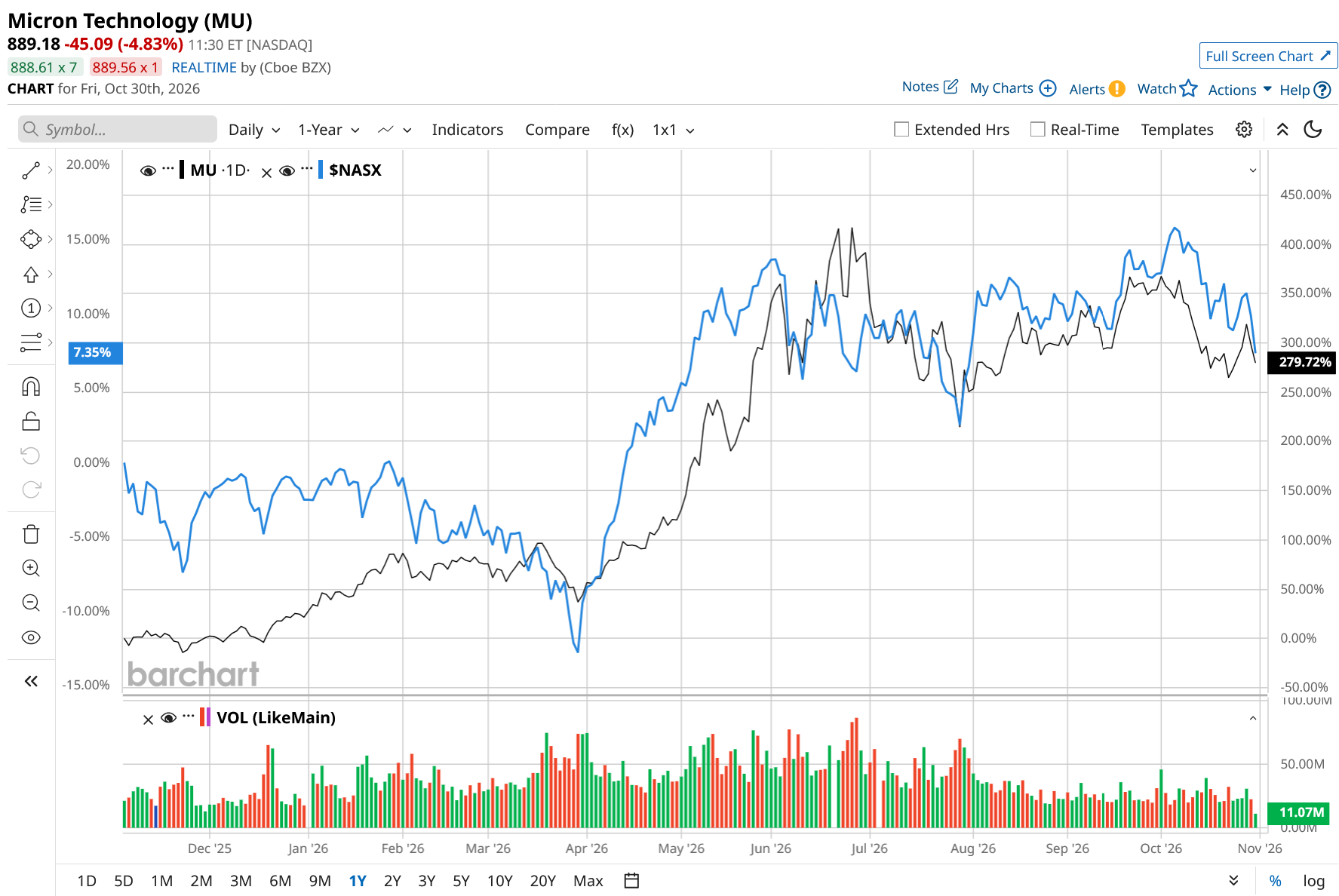
Micron is a major manufacturer of DRAM, NAND flash memory, and high-bandwidth memory (HBM). Its products power computers, smartphones, data centers, and AI accelerators. NAND provides long-term data storage, DRAM serves as working memory, and HBM delivers the high-speed data access that demanding AI workloads require. This broad product portfolio gives Micron multiple ways to benefit from AI spending. However, this same advantage has also exposed it directly to China's ambitions in DRAM.
In the fourth quarter of fiscal 2026, Micron's revenue soared to a record $54.23 billion, up 379% year-over-year (YoY) and 31% sequentially. DRAM generated a record $39.8 billion, making up 73% of total sales. NAND contributed $14.1 billion, about 26% of revenue. DRAM revenue rose 27% sequentially, while NAND revenue climbed 42%. Since DRAM makes up nearly three-quarters of Micron's sales, any sustained increase in competing supply could pressure its pricing power and profitability.
But DRAM is not a single, interchangeable product. Micron also delivers HBM, the powerhouse fueling AI computing by channeling data to processors at lightning-fast speeds. HBM revenue is included in Micron's DRAM total. Micron's Q4 earnings call highlighted HBM's growing importance as AI demand expands. Management said the company secured agreements covering the vast majority of its HBM bit supply for calendar year 2027. These commitments provide greater visibility into future demand and reflect the strategic significance of advanced memory to AI customers.
Investors should understand that China's progress in conventional DRAM does not automatically translate into the ability to match Micron's advanced HBM products. HBM production requires demanding manufacturing processes, sophisticated packaging, and strict performance standards.
However, the bigger vulnerability is pricing. Micron's DRAM revenue soared 27% sequentially in fiscal Q4, driven by average selling prices that climbed sharply into the high teens. This stresses just how much pricing still drives the company's revenue engine. If CXMT accelerates production and rolls out attractive alternatives at tempting prices, a flood of new supply could chip away at Micron's hard-won pricing power in conventional DRAM.
That said, Micron has spent years perfecting its processes and forging strong ties with leading tech giants. It has built a formidable HBM business that may be harder to replace in the near term. Still, this advantage cannot fully shield the company from any new shifts that may reshape the DRAM supply-and-demand landscape.
For now, Micron’s financial results offer investors plenty of reassurance. Adjusted gross margin reached 87%, while adjusted diluted earnings per share climbed to $33.42. The company generated $43.97 billion in operating cash flow and $33.20 billion in adjusted free cash flow in Q4. Management expects momentum to continue into fiscal year 2027 because memory supply could remain tight through calendar years 2027 and 2028. That outlook reveals that the current upcycle still has room to run even as investors begin to price in tougher competition ahead.
The Case for SanDisk (SNDK)
SanDisk's selloff tells a somewhat different story. Distinguished for its NAND flash memory and storage expertise, the company powers data centers, computers, and countless other devices with its solid-state drives (SSDs).
Unlike Micron, SanDisk doesn't manufacture DRAM, yet it still suffered the fear-driven consequences of a widespread selloff across the memory sector. SNDK stock is down 31% this month alone, even though it has soared 405% so far this year.
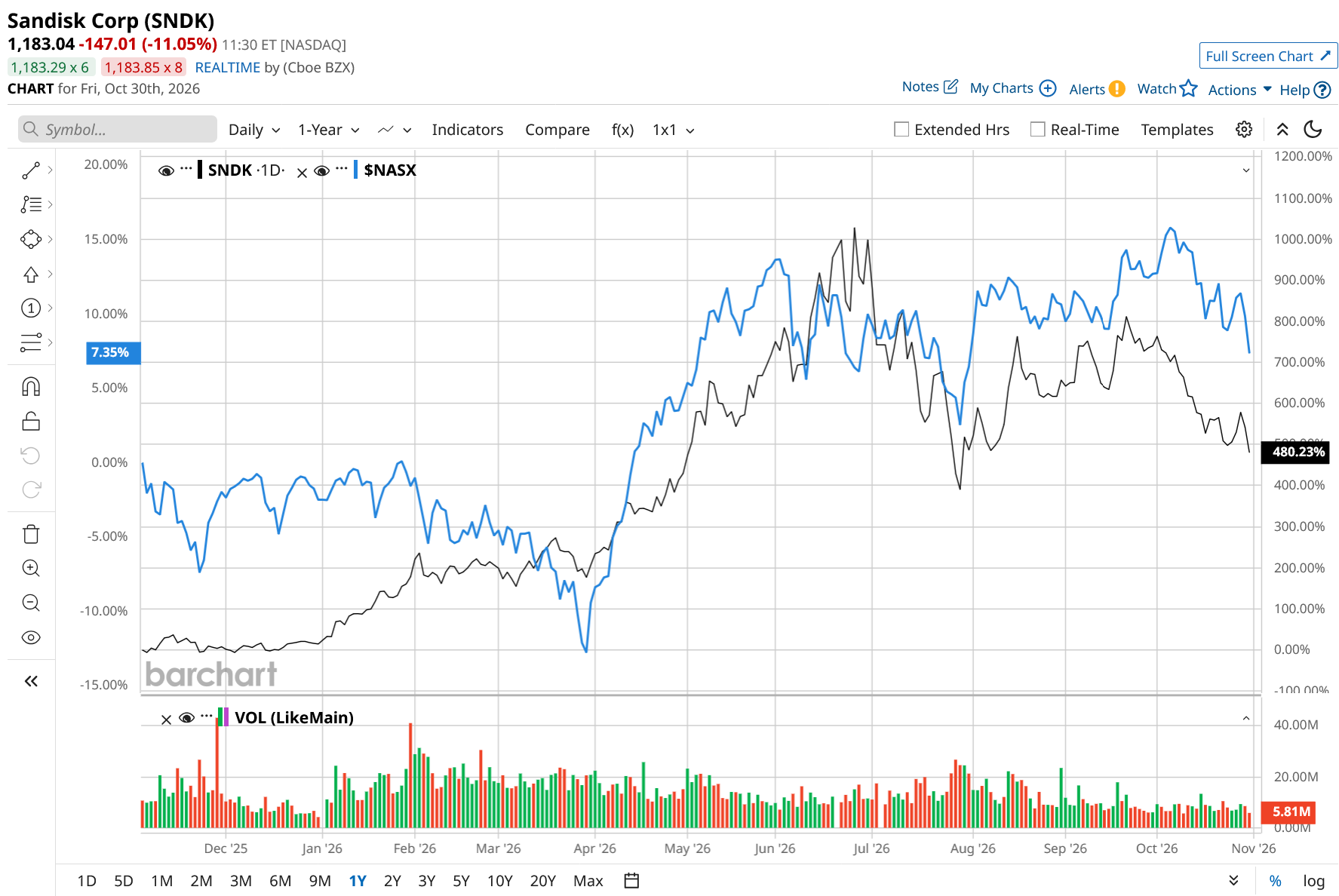
SanDisk's recent fiscal Q1 earnings show why the selloff wasn’t justified. Revenue reached $11.03 billion, up 23% sequentially and 378% YoY. Adjusted earnings climbed to $49.51 per share from $39.25. About 60% of the sequential increase came from higher bit shipments, and 40% came from pricing. Data center revenue rose 61% sequentially to $4.8 billion, reflecting the increasing contribution of AI-related demand.
As AI inference workloads expand, data centers need more capacity to store and retrieve information. SanDisk believes NAND will play an increasingly important role in meeting these needs and is developing High Bandwidth Flash (HBF) to complement HBM. It expects to provide samples of its first HBF products in 2027. A key pillar of SanDisk's strategy rests in its New Business Model (NBM) agreements. By forging these long-term partnerships, the company locks in customer commitments and protects itself from the uncertainty of fluctuating quarterly orders. Management says these agreements already account for roughly half of its bits in fiscal 2027 and will cover two-thirds by fiscal 2028. This approach gives SanDisk a much clearer view of future demand.
On the balance sheet, SanDisk ended the quarter with $5.1 billion in cash and no debt. It also generated $5.7 billion in adjusted free cash flow and repurchased $5 billion worth of shares during the quarter. The memory maker remains committed to using all excess cash for shareholder returns.
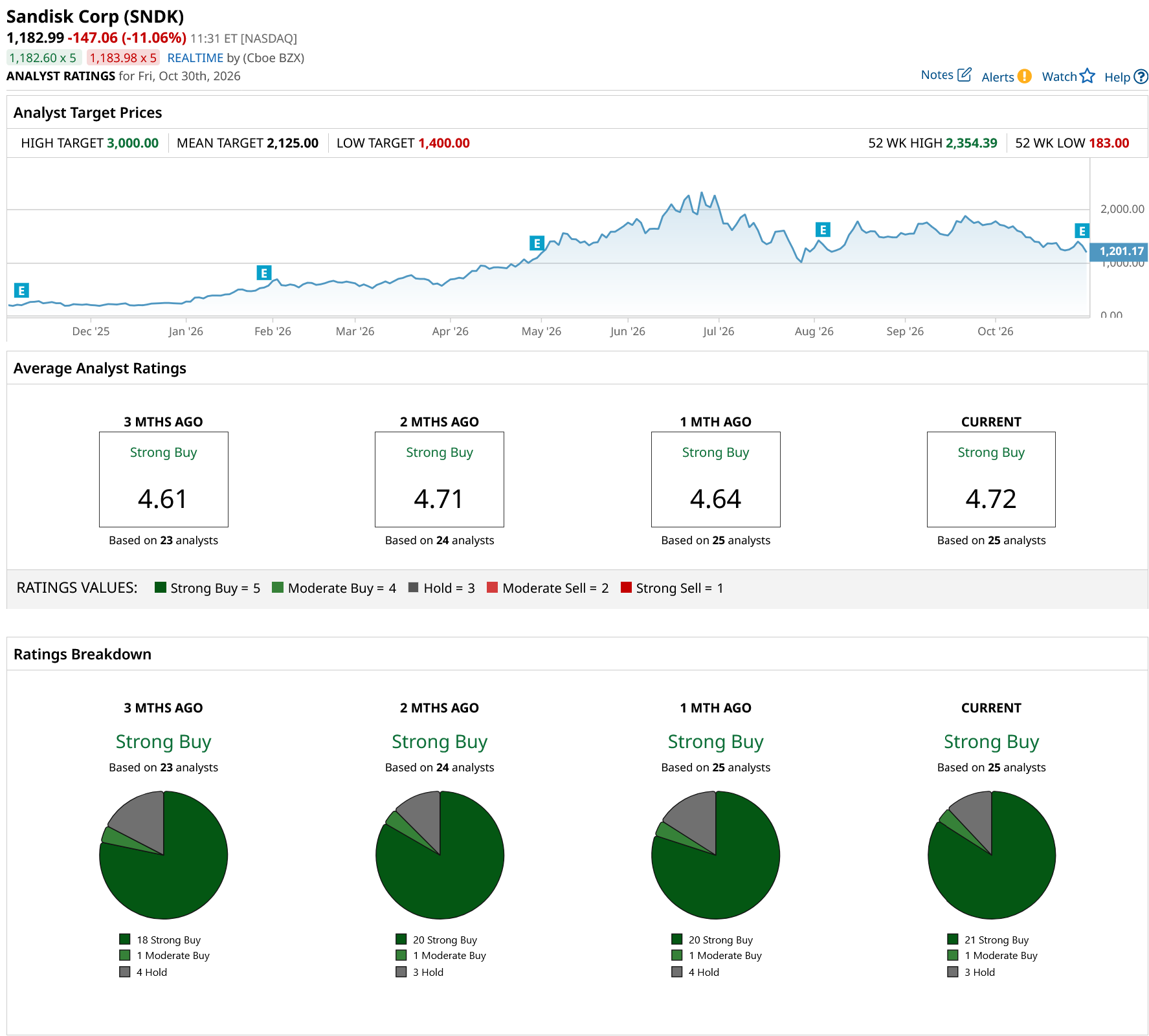
Overall, SNDK stock holds a consensus “Strong Buy” rating on Wall Street. Of the 25 analysts covering the stock, 21 recommend “Strong Buy,” one recommends “Moderate Buy,” and three suggest “Hold.” Based on its average target price of $2,125, analysts expect the stock to rise 77% from current levels. Its high price estimate of $3000 suggests the stock could climb 150% over the next 12 months.
Which Is the Better Buy for the Next Decade?
While SanDisk is less directly exposed to CXMT's DRAM advances, its business remains more concentrated in NAND. Therefore, Micron remains the better buy for investors seeking diversified exposure to AI memory. With its blend of DRAM, HBM, and NAND, Micron unlocks opportunities in multiple market segments. Its strong cash flow and enduring customer partnerships further reinforce its edge over competitors.
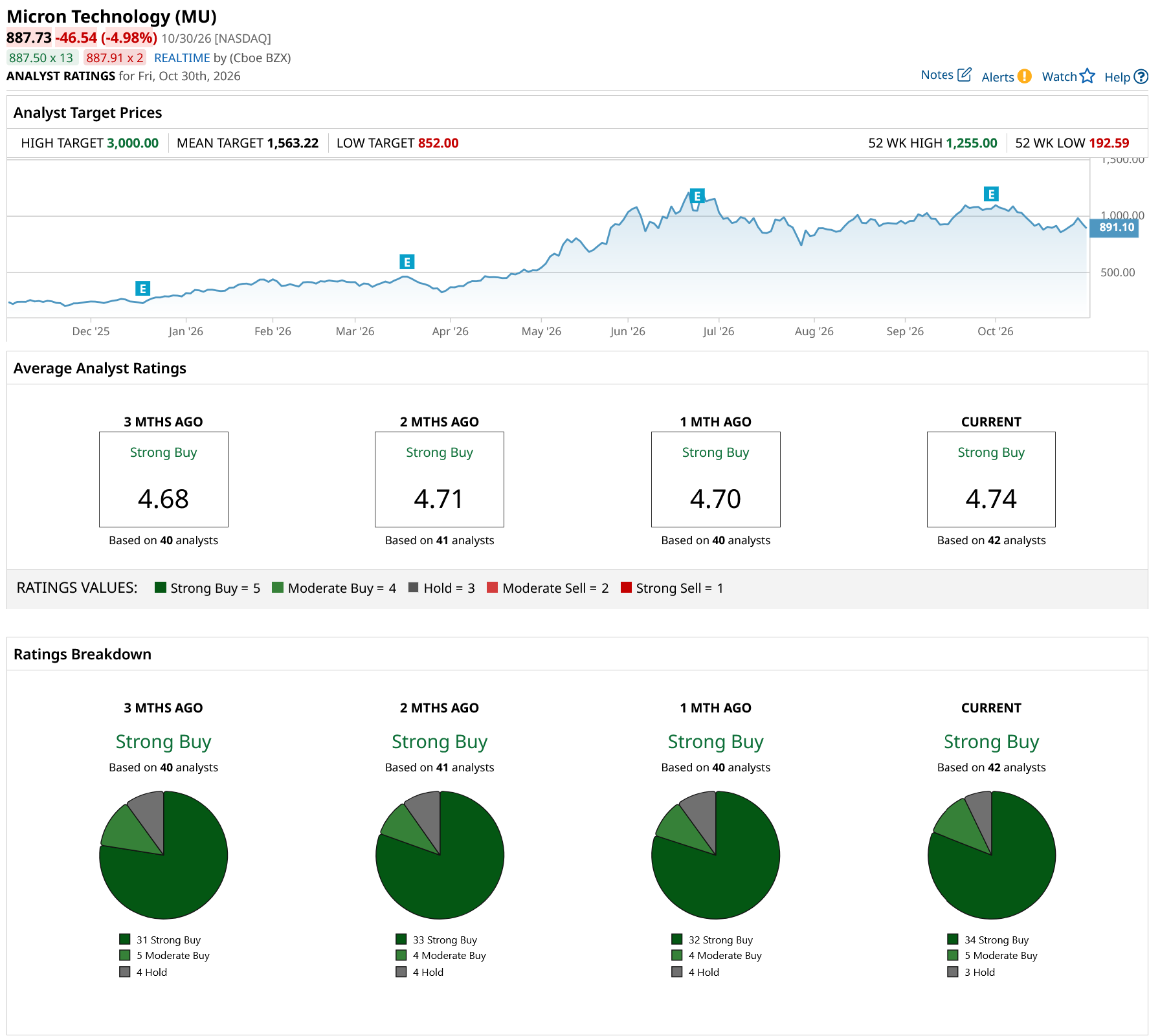
On Wall Street, MU stock holds a consensus “Strong Buy” rating. Out of the 42 analysts covering MU, 34 rate it a “Strong Buy,” five rate it a “Moderate Buy,” and three recommend a “Hold.” Its average target price of $1,563.22 still gives it room for 76% more growth. And the high price target of $3,000 suggests MU stock has an upside potential of 238% from current levels.
On the date of publication, Sushree Mohanty did not directly have a position in any of the securities mentioned in this article. All information and data in this article is solely for informational purposes. For more information please view the Barchart Disclosure Policy here.