


- Cardinal Health is set to report fiscal first quarter 2027 results on 5 November 2026, with Wall Street expecting earnings of $2.92 per share and revenue of about $66.96 billion, both higher than the figures reported for the same period a year earlier.
- The gap between stronger expectations for pharmaceutical and specialty operations and ongoing cost pressure in the medical distribution unit highlights how different parts of Cardinal Health may be pulling earnings in opposite directions.
- We will now look at how Cardinal Health's investment narrative could be affected by these higher earnings projections for the upcoming quarter.
Scan how Cardinal Health's setup compares to other potential earnings movers by running the same playbook across our curated list of 36 high quality undervalued stocks.
Cardinal Health Investment Narrative Recap
To own Cardinal Health, you need to be comfortable with a story built on large scale drug distribution, a growing mix of higher value services, and a repaired but still sensitive medical products arm. The upcoming quarter matters most as a temperature check on that mix. Stronger pharmaceutical and specialty activity could support the near term earnings catalyst, while medical distribution costs remain the swing factor.
The biggest operational risk right now is that inflation linked inputs in the Global Medical Products and Distribution segment squeeze a business that already runs on thin margins. Any renewed quality or recall issues would add another layer of pressure. The earnings setup does not fundamentally change the long term thesis. However, it does sharpen focus on execution in specialty and cost control in medical.
Recent commentary around Global Medical Products and Distribution profit improvement and incremental guidance is especially relevant against these earnings expectations. Investors are effectively being asked to trust that this repaired segment can hold its gains even as oil linked commodities and fuel costs stay volatile. That is where the next leg of margin progress, or disappointment, is most likely to show up.
For you, the key question is whether Cardinal Health can keep growing higher margin services like Biopharma Solutions, Nuclear and Precision Health, OptiFreight and at Home Solutions while GMPD holds the line. The coming results and management outlook on fiscal 2027 profit for that unit will be a clear read on both near term risk and the durability of the broader catalyst mix.
Cardinal Health Long Term Assumptions
Analyst models around Cardinal Health line up around a few clear anchors. Revenue is assumed to grow by about 5.4% each year over the next three years, with profit margins moving from 0.7% today to 1.0% by roughly 2029. On those inputs, earnings are projected to reach about US$3.0b, or US$12.85 per share, compared with US$1.7b in earnings today, with some forecasters penciling in as much as US$3.4b.
Cardinal Health's narrative projects revenues of about US$297.6b and earnings of roughly US$3.0b by 2029. This rests on revenue expanding at around 5.4% per year and an earnings increase of about US$1.3b from the current US$1.7b base.
Those forecasts sit alongside some clear guardrails. Analysts assume the share count trims by roughly 2.11% a year for the next three years, which would lift earnings per share even if total profit only tracks the base case. The P/E multiple embedded in many price targets steps down from about 30.6x today to 24.7x on projected 2029 earnings. This is slightly above the current 24.0x multiple cited for the broader US healthcare group.
Valuation Anchors Around 2029 For Cardinal Health
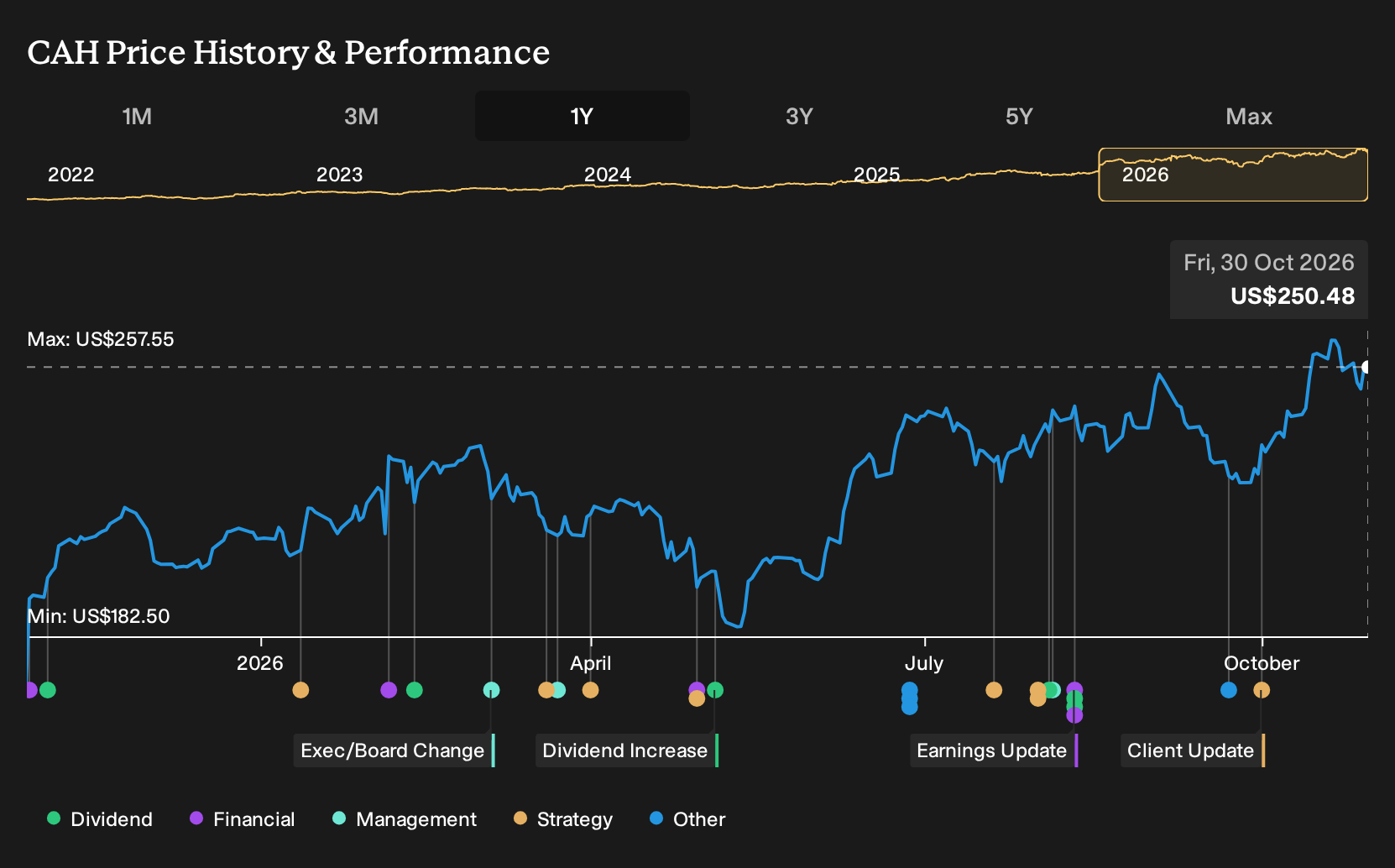
Price targets in the current research stack cluster around a consensus of US$270.94 per share. The most optimistic view lands at US$292.00, while the most cautious comes in at US$235.00, so the spread is meaningful. Against a recent share price of US$225.38, that central target sits about 16.8% higher, which reflects how much weight the Street is putting on the longer term earnings mix.
To line up with that consensus outlook, you would be assuming Cardinal Health can reach roughly US$297.6b in revenue and US$3.0b in earnings by 2029 while trading on about 24.7x those profits, using a discount rate in the 7.2% to 7.24% range. Those numbers effectively tie the investment case to disciplined execution in higher value services and specialty distribution, steady margin progress from 0.7% to 1.0%, and a measured reduction in share count rather than a dramatic shift in the business model.
Uncover why Cardinal Health's fair value indicates an 8% potential upside to its current price that could narrow quickly.
Exploring Other Perspectives
Three fair value views from the Simply Wall St Community span from about US$270.94 to roughly US$731.68 per share, so some retail investors see Cardinal Health as only slightly mispriced while others expect a very large re rating. Consider those opinions alongside recall headlines and earnings expectations, then explore the full range before deciding where you sit.
Explore 2 other Cardinal Health fair value estimates, including one that suggests as much as 192% upside from the current price.
Reach Your Own Conclusion
Disagree with existing narratives? Extraordinary investment returns rarely come from following the herd, so trust your own analysis.
- A great starting point for your Cardinal Health research is our analysis highlighting 3 key rewards and 3 important warning signs that could impact your investment decision.
- See our latest analysis for Cardinal Health. The report includes a comprehensive fundamental analysis summarized in a single visual, the Snowflake, making it easy to evaluate Cardinal Health's overall financial health at a glance.
Looking For More Ideas Beyond Cardinal Health?
Once you have a view on Cardinal Health, it often helps to compare that thesis with a few other opportunities that fit different risk and income profiles. A focused screener can narrow thousands of listings down to a small set that actually matches what you care about.
Here are three angles you can use to broaden your watchlist without drowning in noise.
- If resilience is top of mind, start with companies that pair steadier balance sheets with lower risk scores by scanning our 29 resilient stocks with low risk scores.
- If you prefer a mix of quality and potential mispricing, look for strong fundamentals with room for re rating through our 19 high quality undiscovered gems.
- If reliable finances matter more than a specific theme, filter for businesses with healthier leverage and liquidity using the list of solid balance sheet and fundamentals (24 results).
Have feedback on this article? Concerned about the content? Get in touch with us directly. Alternatively, email editorial-team@simplywallst.com