


Key Points
Joby Aviation is building air taxis for short hops in cities.
Joby has yet to realize its commercial potential, leaving considerable room for the stock to grow if the company succeeds.
If you have $1,000 to invest, the industrial sector is an attractive place to leave it for the next five to 10 years. From aerospace and defense to companies building the systems, equipment, and data centers for AI infrastructure, there has perhaps never been a more exciting time to invest in the industrial side of the modern economy.
That said, if I had to single out one growth stock in this varied sector, I would pick Joby Aviation (NYSE: JOBY). Here's why.
Missed AI’s "Act 1"? Act 2 Could Be 15x Bigger. Most investors think they missed the AI boat because they didn't buy Nvidia in 2005. But according to our analysts, we’re only at the end of "Act 1"—the R&D phase. "Act 2" is the global rollout. Continue »
Why Joby is an interesting speculative investment
Joby Aviation is trying to build a flying taxi. Imagine a big drone you and a few friends can sit in that takes off straight from the ground, flies across the city over all the traffic, and lands you near where you want to go. That's what Joby's electric taxi aims to do. It's quiet, doesn't pollute while it flies, and could offer faster transportation than public transit and traditional ride-hailing.
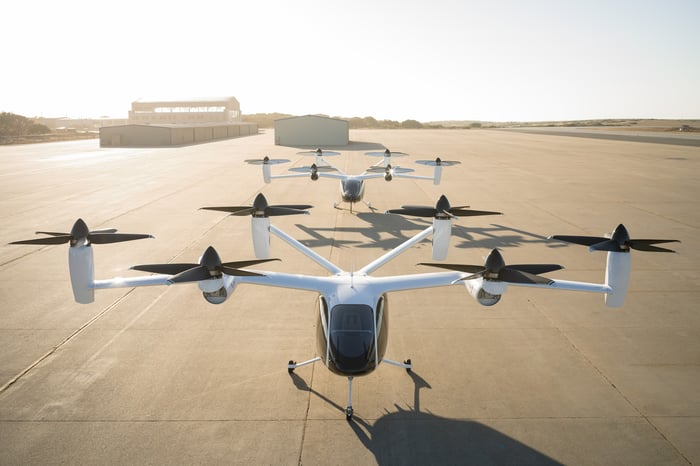
Image source: Joby Aviation.
If you're wondering why you haven't seen these eVTOL (electric vertical takeoff and landing) aircraft skimming the sky in a city near you, it's because Joby doesn't have the certification to fly passengers. In fact, no eVTOL company in the U.S. has obtained certification. That's part of the risk in investing in Joby, but also part of the opportunity.
The thing is, Joby's getting close to commercial operations. It's working through the fifth and final stage of the FAA's type certification process, a key step for getting the commercial green light. In September, Joby conducted demonstration flights around Dallas-Fort Worth as part of the government-backed program to introduce eVTOL into U.S. airspace. It's also preparing to manufacture eVTOLs at scale with help from its partner Toyota, which has also invested nearly $650 million in Joby, with another $250 million committed.
As production kicks off, Joby's revenue is expected to grow substantially over the next two years, as the chart below illustrates.

Data by YCharts
Why it's not all smooth sailing for Joby investors
Joby, in a nutshell, offers investors an opportunity to buy into emerging aviation technology (eVTOLs) before that technology has entered commercial service. The upside on Joby, therefore, could be substantial.
On the other hand, I don't want to make Joby's path to commercialization sound easier than it is -- because it won't be easy. Not by a long shot. The FAA isn't going to rush the regulatory process, and if there's an accident that injures someone, it could delay Joby's certification, or worse, scare off potential passengers.
There's also Joby's valuation to consider. Today, it trades below $5 per share and has a market cap of $5 billion. That might sound cheap, but consider this: Joby trades at more than 40 times trailing revenue. By comparison, Delta Air Lines, one of the largest airlines in the world, trades at less than one times sales. Granted, Joby has considerably more room to grow than Delta, but investors are already paying a steep premium for future growth.
Still, I think Joby's progress toward commercialization makes it a risk worth taking. As long as you have patience, a long investing horizon, and a willingness to stomach short-term volatility, investors can be rewarded if Joby succeeds.
Steven Porrello has positions in Joby Aviation. The Motley Fool recommends Delta Air Lines. The Motley Fool has a disclosure policy.