


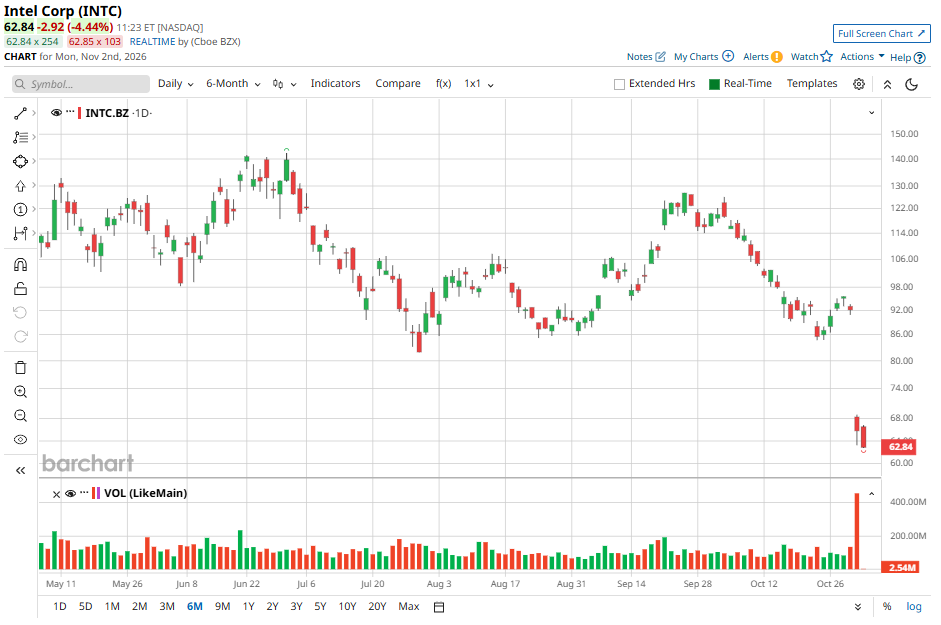
Intel (INTC) stock has come under heavy selling pressure, with shares down about 48% over the past month and trading 57% below the 52-week high of $142.35. Despite the sharp correction, Wall Street sentiment remains largely subdued, with most analysts not yet convinced INTC stock offers an attractive recovery opportunity.
Intel's weaker-than-expected fourth-quarter guidance largely triggered the latest selloff. Although the company reported solid Q3 results, its forward outlook fell significantly short of analyst expectations.
Looking ahead, persistent revenue pressures, margin-related challenges, and uncertainty surrounding the near-term earnings trajectory could cap a sharp recovery in INTC stock.
Intel Faces Near-Term Challenges Despite Strong AI Demand
Intel delivered a strong Q3 performance, with revenue reaching $16.5 billion, largely driven by growing demand for artificial intelligence (AI) and data-center products. Improved execution across its manufacturing facilities and external supply chain also helped the company increase production and meet higher customer demand. However, despite the positive overall performance, challenges in Intel's PC business and ongoing supply constraints continue to weigh on its near-term outlook.
The Data Center and AI (DCAI) segment remained the biggest growth driver, generating $7.3 billion in revenue, up 17% sequentially and 78% year-over-year (YOY). Growth was broad-based across hyperscale, enterprise, and neocloud customers.
Revenue from purpose-built silicon rose more than 50% sequentially and doubled YOY. Reflecting these favorable trends, Intel expects DCAI revenue in 2026 to exceed its initial projections by nearly $10 billion.
Intel's Client Computing and PC Group (CCPG) faced challenges, with revenue declining 9% sequentially to $8.1 billion. Memory shortages, tighter IT budgets, and weaker PC purchasing activity weighed on customer demand, particularly toward the end of the quarter. Nevertheless, the segment saw some positive developments. AI PC revenue grew 35% YOY, while shipments of Intel's Wildcat Lake processor increased 70% sequentially.
Intel's Q4 guidance indicates challenges ahead. Intel expects Q4 revenue between $15 billion and $16 billion, implying a sequential decline to $15.5 billion at the midpoint. Adjusted EPS is projected at $0.25, while gross margin is likely to face pressure from lower revenue, an unfavorable product mix, and manufacturing-related disruptions.
In particular, the shutdown of Intel's Israel facility is expected to reduce revenue by approximately $300 million and weigh on gross margin by around 200 basis points. While DCAI revenue is expected to grow at a mid-teens rate sequentially, CCPG revenue could decline by more than 20% as customers reduce inventory and adjust purchases in response to weaker PC demand.
The broader outlook for 2027 also suggests that the recovery may take longer to materialize. Intel anticipates continued contraction in the PC market, with the downturn expected to be more pronounced during the first half of the year. The anticipated decline limits the scope for a broad-based recovery in revenue.
Overall, while strong AI demand provides a significant growth opportunity, supply limitations, manufacturing challenges, and a weaker PC market are likely to remain key concerns in the near term, limiting a sharp recovery in Intel stock.
What Do Analysts Recommend for Intel Stock?
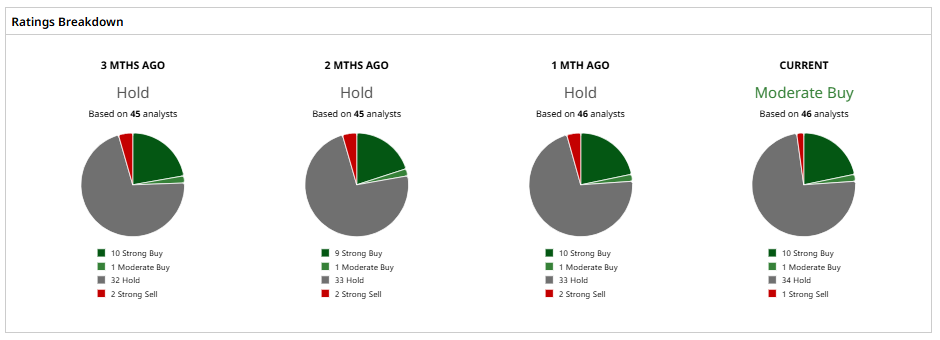
Despite the significant pullback, Wall Street analysts remain largely cautious about Intel's prospects. Although Intel stock carries a consensus “Moderate Buy” rating overall, most analysts recommend a “Hold."
Of the 46 analysts covering INTC stock, 10 have a “Strong Buy” rating, one recommends a “Moderate Buy” rating, and 34 analysts have a “Hold,” indicating investors should wait for business improvement before turning more bullish. Lastly, one analyst has a “Strong Sell" rating.
Intel Stock Still Lacks a Strong Buy Case
Intel’s sharp share price decline doesn’t make it a compelling bet. While robust growth in its DCAI segment offers a meaningful long-term opportunity, ongoing supply constraints, margin pressure, and weakness in the PC market could delay a recovery in the price of INTC stock.
With 34 of the 46 analysts with coverage maintaining a “Hold” rating, analysts do not view the recent correction as a buying opportunity.
On the date of publication, Amit Singh did not directly have a position in any of the securities mentioned in this article. All information and data in this article is solely for informational purposes. For more information please view the Barchart Disclosure Policy here.