


- Pottery Barn Kids and Pottery Barn Teen, both part of Williams-Sonoma, rolled out ten new licensed holiday collections featuring well known entertainment franchises, fashion labels, and interior designers, along with curated digital gift guides by age, price, and interest.
- The broadened collaboration roster points to Williams-Sonoma leaning on differentiated, character driven assortments and personalization to compete for holiday home and gifting budgets in a sluggish home furnishings market.
- We will now look at how Williams-Sonoma's expanded licensed holiday collections could influence the broader investment narrative for the retailer.
Scan beyond Williams-Sonoma and identify other retailers leveraging brand partnerships and gifting demand by reviewing our hand picked list of 19 high quality undiscovered gems
Williams-Sonoma Investment Narrative Recap
To own Williams-Sonoma, you need to believe the retailer can keep taking share in a slow home furnishings market while protecting its margins. In the near term, the story leans heavily on digital tools, brand extensions, and higher growth adjacencies like B2B. The new Pottery Barn Kids and Teen holiday collaborations help, but they do not fundamentally change the short term thesis.
The key near term catalyst remains execution on digital engagement and personalization, where management reports much stronger conversion. The biggest risk still sits with external costs and macro sensitivity. Prolonged tariff or fuel pressure, combined with a stagnant housing backdrop, could weigh on merchandise margin and comparable sales even with strong product stories.
The freshest development that ties directly into this is the expanded set of ten licensed holiday collections at Pottery Barn Kids and Pottery Barn Teen. These collections, tied to franchises like Harry Potter, Pokémon, and Minecraft, push Williams-Sonoma further into character driven assortments, gifting, and year end demand capture across younger demographics.
Those launches intersect with the existing catalysts around digital and mix. Curated gift guides by age and price plug directly into Williams-Sonoma’s online ecosystem, where AI tools are already lifting conversion. The opportunity is that higher engagement gifting helps offset a weak housing market. The risk is that heavy reliance on licensed partners and seasonal demand concentrates performance into narrower windows.
What The Holiday Push Means Against Williams-Sonoma’s 2029 Targets
Williams-Sonoma's long term story now ties holiday licensed collections back to some very specific analyst expectations. Consensus models assume revenue rises by about 5.4% a year over the next few years, profit margins ease from 14.7% today to 14.0%, and earnings move from US$1.2b now to US$1.3b by 2029. On those forecasts, the stock would trade on a P/E of 27.1x 2029 earnings compared with 24.0x today and a sector level of 17.0x, with analysts looking for revenues of US$9.4b and earnings of US$1.3b in that same year.
Williams-Sonoma's narrative projects US$9.4b revenue and US$1.3b earnings by 2029. This implies 5.4% yearly revenue growth and an earnings increase of about US$0.1b from US$1.2b today.
Uncover why Williams-Sonoma's fair value indicates a 3% potential downside to its current price, which leaves little room for error.
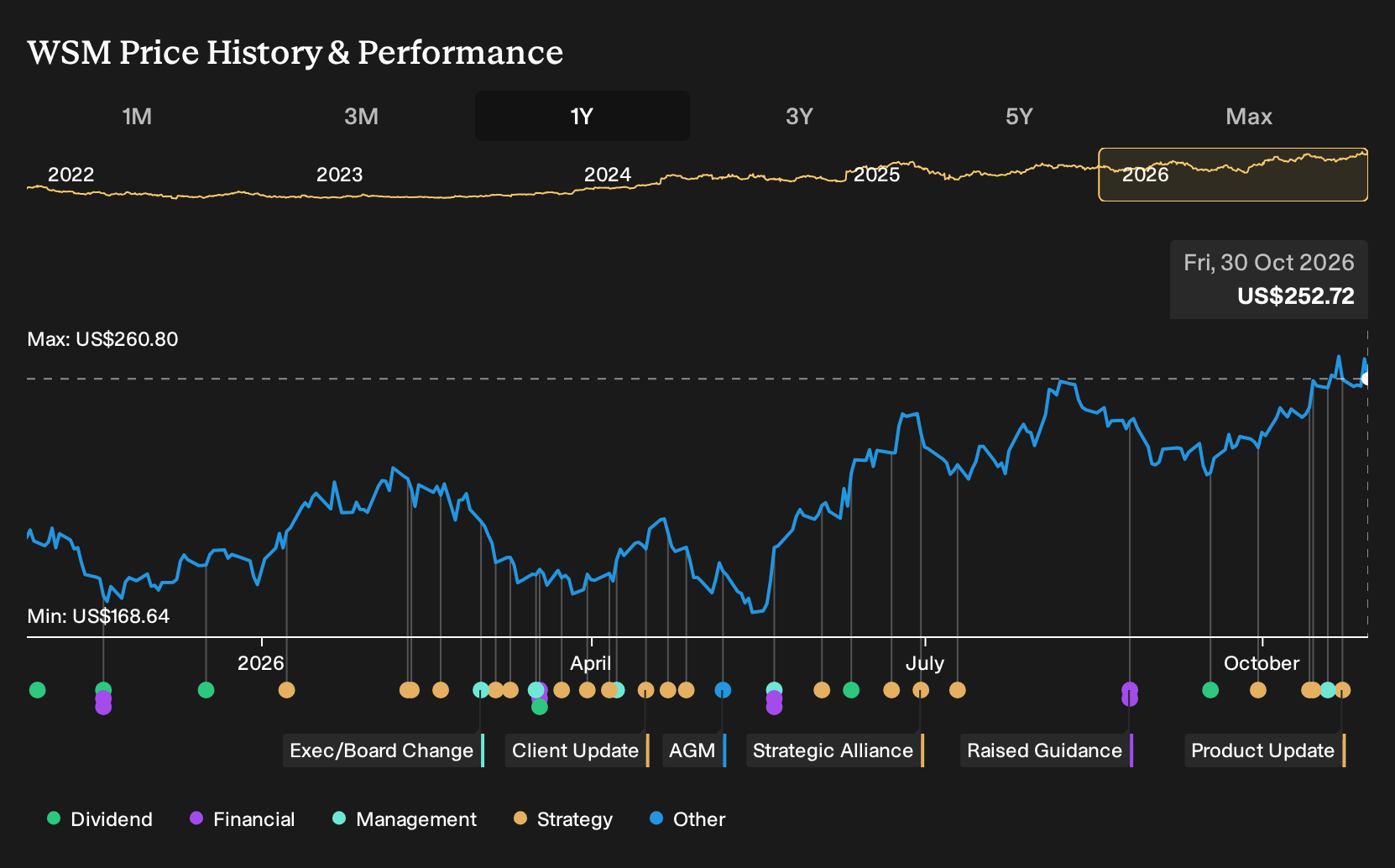
Exploring Other Perspectives
One alternate view says the real swing factor is margin pressure rather than digital upside. The most bearish analysts, who were assuming about US$9.3b in revenue and US$1.3b in earnings by 2029 before this news, see tariffs and fuel costs squeezing Williams-Sonoma more sharply. Use that more cautious setup as a reference point when deciding whether these new holiday collaborations eventually shift the story.
Explore 2 other Williams-Sonoma fair value estimates, including one that suggests it could be worth just $246.35.
Decide For Yourself
Don't just follow the ticker, dig into the data and build a conviction that's truly your own.
- A great starting point for your Williams-Sonoma research is our analysis highlighting 2 key rewards that could impact your investment decision.
- See our latest analysis for Williams-Sonoma. The report includes a comprehensive fundamental analysis summarized in a single visual, the Snowflake, making it easy to evaluate Williams-Sonoma's overall financial health at a glance.
Looking For More Investment Ideas Beyond Williams-Sonoma?
If the Williams-Sonoma story has you thinking about portfolio balance, use the Simply Wall St Screener to widen the opportunity set and compare this retailer with other businesses that fit the kind of profile you want to hold.
- For investors focused on quality at a sensible price, start by scanning a curated set of 36 high quality undervalued stocks that combine stronger fundamentals with more modest expectations.
- If resilience and balance sheet strength matter most to you, narrow the field to a list of solid balance sheet and fundamentals (24 results) that can help anchor your holdings when conditions get tougher.
- Income seekers can zero in on reliable cash returns by reviewing a focused group of 5 dividend fortresses that prioritize yield and sustainability.
Have feedback on this article? Concerned about the content? Get in touch with us directly. Alternatively, email editorial-team@simplywallst.com