


The Zhitong Finance App learned that Apple (AAPL.US)'s quarterly report for the 2026 fiscal year was flourishing — revenue, EPS, and iPhone all surpassed expectations in records, but the stock price turned down after the market. The real pricing of the market is not this “explosive” financial report, but the three cracks hidden behind the numbers: negative expectations between Greater China and service revenue for two consecutive quarters, weakening gross margin guidelines under storage cost compression, and a December quarter that has yet to occur. At a historically high price-earnings ratio of 36 times, this defensive asset, which was pushed by safe-haven funds to a market value of 5 trillion US dollars due to “not participating in the AI money burning competition,” is being reverse eroded by the same AI wave from the cost side — its safety needs to be re-verified for the first time.
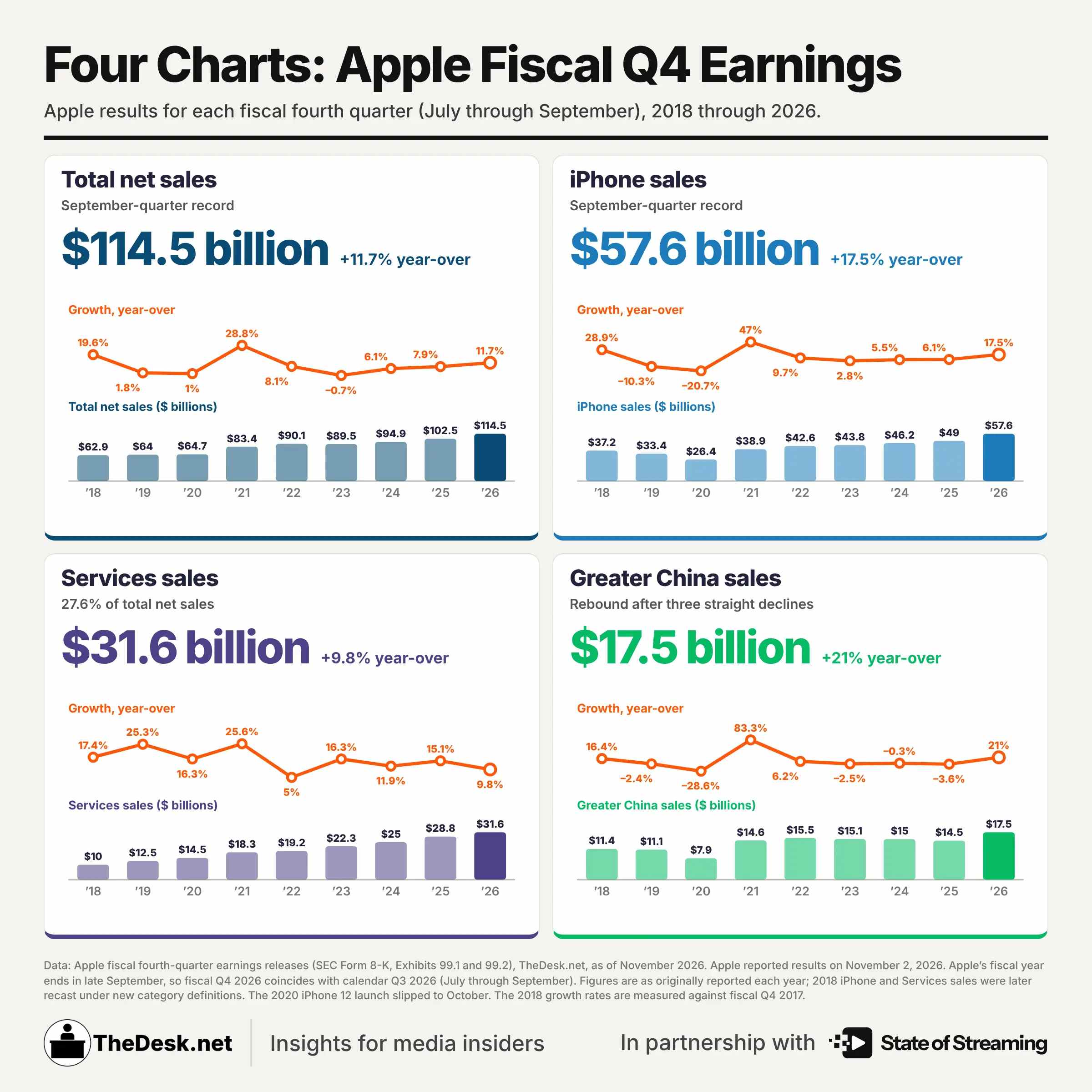
Apple released results for the fourth quarter of fiscal year 2026 as of September 26: total revenue of US$114.477 billion, up 12% year over year, higher than analysts' expectations of US$113.39 billion in LSEG statistics, and above the upper limit of the 9% to 11% guidance range previously given by the company; diluted earnings per share of $2.10, up 14% year over year, higher than expected $1.99, even after excluding the tariff refund contribution of approximately $0.05 per share; iPhone revenue US$57.583 billion, up 17% year over year, setting a record for the September fiscal quarter. With annual revenue of $479 billion, the company called its “best fiscal year ever.”
However, after the results were announced, Apple briefly rose by about 0.5% after the market, then fell by about 1%, and the decline widened further during the phone call — down about 3% as of press release. This isn't a performance storm; it's a transaction with poor expectations, and it's also a stress test of the safe haven narrative.
The top line is solid, and the cracks are in three other places
The top-line numbers almost completely surpassed expectations. With the exception of iPhone, Mac revenue was $10.792 billion, up 24% year over year, far exceeding expectations of about 9.6 billion to 9.7 billion US dollars; revenue in the US was 48.68 billion US dollars (expected 48.51 billion) and Europe was 30.1 billion US dollars (expected 30.21 billion), all better than expected. The gross profit margin was 47.9%, higher than the forecast of 47.5%.
The rift appeared in three other items
Greater China's revenue was $17.539 billion, up 21% year over year, but was more than $1 billion lower than market expectations. Service revenue of $31.573 billion, up 9.8% year over year, is basically the same as LSEG's caliber and expectations ($31.58 billion), but this growth rate was the lowest since 2022 — it was not “falling short of expectations,” but “falling behind schedule.”
The gross margin guide for the December quarter was 45% to 46%. The company clearly stated that the forecast took into account the impact of memory chip costs and Siri AI costs. At the same time, it also gave guidelines for revenue growth of 7% to 10% and service revenue growth of 8% to 9%, and indicated that third-party licensing and exchange rates constituted adverse factors. The revenue guide itself was higher than Wall Street's average estimate of 6.1%, but the gross margin guidance fell below the market's implied expectations.
The three flaws aren't fatal if you look at them alone, but when they appear simultaneously on a report that has taken the “safe” price to the extreme, the weight was amplified.
For two consecutive quarters, manufacturing expectations for the same group of sectors were poor
What really warns the market is not this season, but the shape of this season is almost the same as last season.
For the third quarter of fiscal year 2026, which was announced in July this year, Greater China had revenue of 18.82 billion US dollars, lower than the forecast of about 19.5 billion to 19.6 billion US dollars, and service revenue of 30.74 billion US dollars, lower than the forecast of about 31.2 billion to 31.4 billion US dollars. After a quarter, the same two sectors once again created negative expectations.
The difference in expectations for one quarter was flawed. The difference in expectations for the same group of sectors for two consecutive quarters became a pattern.
The sources of pressure in both sectors are structural. Greater China faces high-end local competition: Third-party statistics show that Apple's share in China's $600 and above price range has fallen from about 75% in 2022 to about 50%; the localization of superimposed services is limited, and the implementation of AI functions in the Chinese market is delayed, and the pressure cannot be fixed in one quarter.
Service is another curve. App Store growth is slowing, regulatory changes are preventing Apple from extracting 15% to 30% commissions on transactions outside the App Store, and Google Search license revenue is slowing down — these are ongoing rather than a one-time drag. The significance of the service is that it is Apple's profit buffer: when the gross margin of hardware is squeezed by storage costs, the high gross profit cost of the service is offset; when the service growth rate falls to the back of a single digit, this cushion is getting thinner.
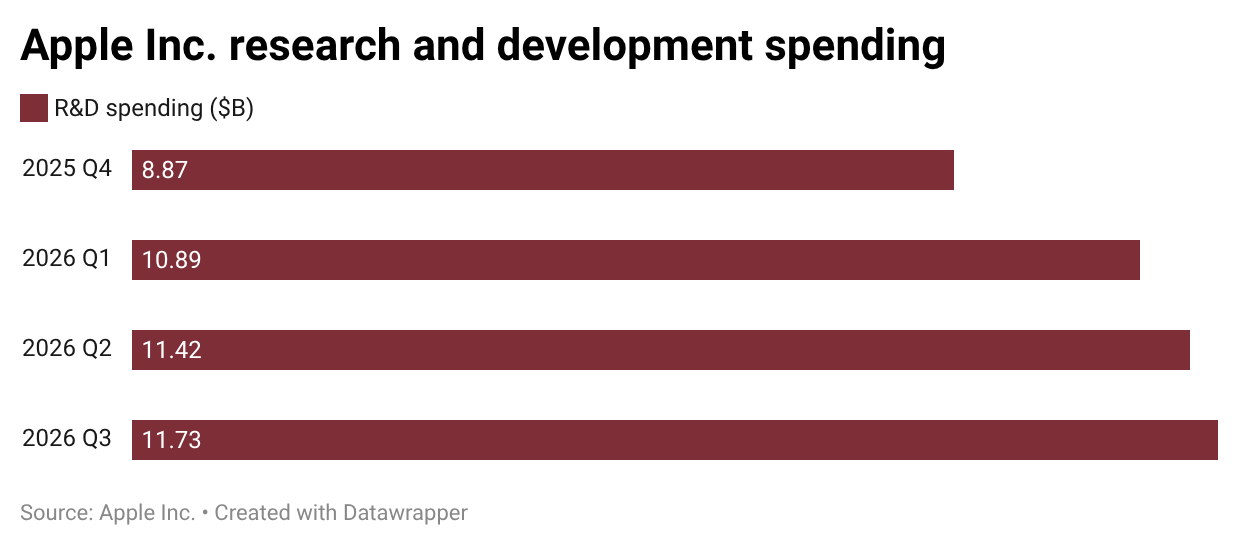
It is possible to estimate when the cushion becomes thinner. Cook previously said that the low-cost DRAM/NAND pre-purchased by the company will gradually expire from June, and stocks will be exhausted; CFO Kevin Parek said in a July conference call that memory costs can explain more than 100% of the month-on-month change in adjusted gross margin. The September quarter was the season when the protective layer began to peel off. The December quarter — that is, the season when the gross margin guidelines fell to 45% to 46% — was a season where the peeling deepened: the iPhone 18 Pro was only included for about 9 days in the September quarter. The benefits of price increases have not yet been fully reflected, but higher storage costs have already entered sales costs.
The safe haven paradox: defensiveness comes from “doing nothing”
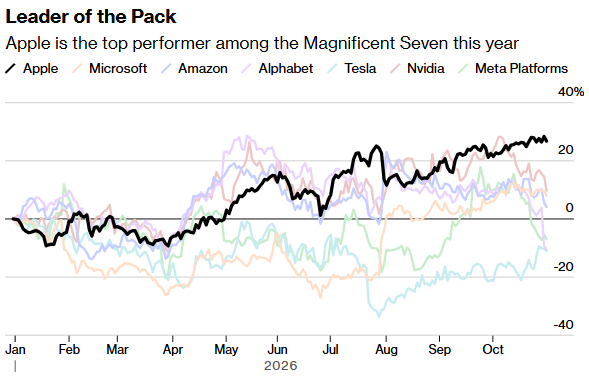
Apple's relative strength this year is essentially someone else spending money. In the last four fiscal quarters that have been announced, the combined capital expenditure of Microsoft, Amazon, Google-A, and Meta exceeded 600 billion US dollars, and the vast majority invested in AI data centers; Apple's capital expenditure for the same period was only about 10 billion US dollars, less than one-sixth of the total of the four companies. The costs are already showing up in opponent's statements: Alphabet, Amazon, and Meta recently disclosed free cash flow in negative values, forced to shift more to the debt market, while interest rates are rising. Apple's 2026 free cash flow is expected to grow 38% to $142 billion.
As a result, the choice of capital became mechanical: in 46 trading days where the Philadelphia Semiconductor Index fell 2% or more in a single day, Apple rose for 30 days, accounting for about two-thirds; from 1994 to last year, Apple only rose about one-sixth of the days during such trading days. The correlation between Apple and the semiconductor index turned negative in July and hit an all-time low in September. On October 30, Apple overtook Nvidia's $4.93 trillion with a market capitalization of $5.03 trillion.
The problem is that this defensive attribute comes from “what Apple didn't do” rather than “what Apple did.”
More sharply, the expansion of AI computing power is inverse entering Apple's income statement through the cost side. Estimates show that two years ago, the flash memory capacity purchased by Apple was nearly double that of Microsoft, Amazon, Meta, and Google, and now the four companies purchased twice that of Apple; Apple is expected to spend about 25 billion US dollars on flash memory this year, while it will only cost about 6 billion US dollars to buy storage of the same size in 2025. According to TechInsights data, AI data center demand over the past year has driven flash memory prices up to five times the original price. Cook compared the increase in memory prices to a “once-in-a-century flood,” and according to people familiar with the matter, Apple's senior management did not prepare enough in advance for this.
In this transfer of bargaining power, Apple is sitting on the squeezed side for the first time in 20 years. This means that Apple's defensive nature includes both opposing exposures: it doesn't participate in capital expenditure contests, so cash flow is not questioned; but it purchases storage, so it directly bears component prices driven up by the expansion of AI computing power. And the safe-haven funds flowing to it are itself tactical and reversible — once the semiconductor sector rebounds, there is no reason for this money to stay at Apple.
36x price-earnings ratio: zero tolerance for “safety expectations” under high valuations
The immediate context of the post-market decline was valuation. Prior to this financial report, Apple's expected price-earnings ratio was about 36 times, the highest level since 2008; the purchase rating accounted for less than 60%; among the “Big Seven,” Apple was the only company with an implied negative return based on the seller's target price. The round of gains since the end of June has added about $1 trillion to Apple's market capitalization, and investors are betting on a “bursting” performance.
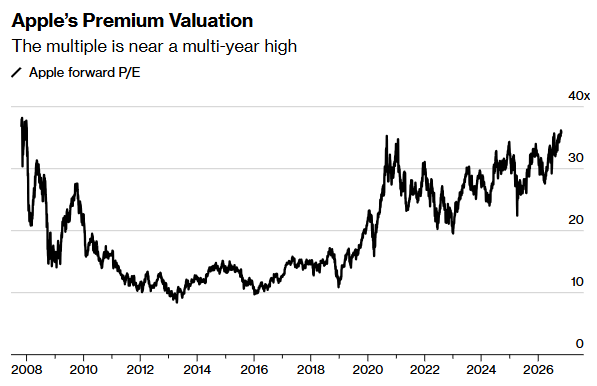
At this starting point, the fault tolerance space is close to zero. The top line exceeds expectations; it is not a plus; however, the marginal pricing weight of each of the three items of poor expectations in Greater China, falling service growth, and weak gross margin guidelines has been amplified by valuation multiples. What is more noteworthy is the asymmetry in direction: the revenue guide (+7% to 10% vs. 6.1% consensus) was actually higher than expected, but failed to bring back the stock price — indicating that the market actually prices the quality of growth, not the magnitude of growth.
There's also a more technical reason hidden here: the market may have been using the wrong calendar to model Apple. Bank of America analyst Wamsi Mohan bluntly stated in the October 30 report that Wall Street had “modeling mistakes” — Apple placed the iPhone 18 Pro, Pro Max, and Duo in September, and the basic model and iPhone Air in March of the following year, and the model used to cram one generation of products into the same watch. Based on this, Bank of America lowered the 2027 iPhone shipment forecast by 9 million units to 247 million units (about 260 million units on Wall Street), and expected revenue of 113 billion US dollars and EPS 1.97 US dollars for the current quarter, both falling short of consensus.
As a result, Bank of America was cautious and conservative about this season — Apple's actual revenue was about 1.5 billion US dollars higher than its forecast. However, Mohan's judgment points not to this season, but to modeling revenue and gross margin for the December and March quarters. Part of the post-market fluctuation is that the market is repricing the “analyst model error” itself.
Tenus debuted: signal fault caused by a shift in product rhythm
This is John Tenus' first earnings report since taking over as CEO on September 1, and the first time he has hosted a conference call.
His background determined how the market was read: a background in mechanical engineering, 25 years at Apple, and leading the Mac migration to Apple Silicon. A few weeks into office, he pushed to reduce dependence on the Spring and Autumn release pace, abolish some middle levels, and shorten reporting levels — one of the side effects of this organizational restructuring is that the financial reporting rhythm itself has become difficult to model: in the past few decades, the revenue curve soared during the holiday season and declined at the end of the following summer. Now Apple wants to flatten this shape, at the cost of the market losing seasonal extrapolation tools.
This season was the first time the market was forced to face this scene. There are three simultaneous time mismatches in the financial report: the iPhone 18 Pro is only included for about 9 days; the regular iPhone 18 and the new iPhone Air will not go on sale until the first half of 2027; the folding screen iPhone Duo will only go on sale on October 23, which is not included in this quarter's statement at all.
Duo thus became “silent evidence.” According to data from third-party bloggers and statistics agencies, Duo recorded about 125,000 activations in just 3 days after the W43 launch (October 19-25), ranking fifth in the weekly sales list for that week. In the same period, the iPhone 18 Pro Max had about 724,000 units and the iPhone 18 Pro had about 335,000 units. According to Morgan Stanley, the waiting time for online pre-orders for some models is about 14 weeks, the longest in ten years according to statistics; J.P. Morgan expects supply restrictions, and the Duo will ship about 8 million to 9 million units in 2026.
But none of these numbers are in the report. The market can only read it from management's tone — which is why the signal weight of this conference call is higher than the confirmed numbers.
The information given by Tenus was qualitative only. He said that a “very small percentage” of Duos have been returned due to display issues, the company is being replaced, and it is currently impossible to determine when supply and demand will be balanced: “Duo is currently limited, and the climb is progressing smoothly. We are working hard to deliver to more customers as soon as possible, but it is currently impossible to predict when supply and demand will reach balance.” At the same time, he confirmed that memory costs in the September quarter were higher than in the June quarter, partly offset by inventory earnings and a decrease in the cost of some non-memory components, while the iPhone 17 price increase of $100 and the price increase of some MacBooks “provided some hedging.” He said the new version of Siri now processes 2.5 billion requests per day.
As a result, the pricing logic for the night went upside down: the confirmed figures (revenue, EPS, iPhone, Mac) all surpassed expectations, but what determined the stock price was unheard of — whether the gross margin for the December quarter could hold 46%, when Duo's supply climbed, and whether the pace of the basic iPhone 18 would continue to disrupt the model.
Conclusion: Defensiveness comes from “not spending money,” and “not spending money” is not a growth engine
Apple's current core tension is clear: it is being passively promoted as a defensive asset because it does not participate in the AI capital expenditure competition, but AI computing power expansion is eroding its profit sheet in reverse through storage costs; its defensive nature comes from restraint, not from a new growth engine; and this kind of defensive funding is tactical and reversible.
Growth rift and cost pressure appeared on the same report — manufacturing expectations in Greater China and services fell short for two consecutive quarters, and gross margin guidelines for the first time included storage and AI costs in a forward-looking perspective. At the starting point of 36 times the expected price-earnings ratio and the highest valuation since 2008, “safety” itself needs to be re-validated rather than default.
Tenus now has a defensive narrative window: the holiday season product lineup is the most intense in recent years (touchscreen MacBook Pro, updated iMac, new entry-level MacBook Pro shipped on November 6, HomeView home hub, AirPods 5 are already on sale), Siri has been delivered, and the Duo's demand signal is strong enough but supply is limited — the supply itself can be described as “demand is too good” in terms of narrative. How long this window will last depends on several sets of indicators: whether Greater China continues to experience poor expectations in the December quarter; whether the service growth rate stabilizes in the 8% to 9% guidance range; whether gross margin guidance confirms the continuation of storage pressure into the 2027 fiscal year; whether Apple's AI capital expenditure caliber changes; and whether Duo's demand and supply guidelines can change from “unpredictable” to “give a point in time.”