


The Zhitong Finance App learned that crude oil exports from major Middle Eastern oil producers have recovered to roughly the same level as before the war, bringing a wave of supply to the global market and helping to curb oil prices. According to tanker tracking data compiled by energy analysis companies, total crude oil exports from Saudi Arabia, the United Arab Emirates, Iraq, and Kuwait increased 10% in October to 15.53 million barrels per day, roughly returning to export levels at the beginning of this year. Meanwhile, under the US Navy blockade, Iran's crude oil exports remained at zero level for the second month in a row.
The recovery of crude oil flow from the Arab oil producing countries in the Gulf proved that the secret “shuttle transportation” operation of oil tankers through the Strait of Hormuz has been effective. This practice was first implemented by the UAE, then Saudi Arabia began to adopt it.
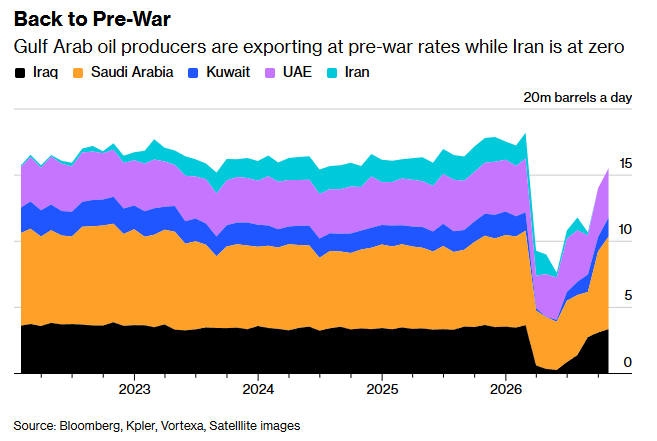
Crude oil exports from the Gulf Arab oil producers have returned to pre-war levels
At a critical time when high fuel costs such as gasoline and diesel are squeezing consumers, driving up inflation, and posing political risks to US President Trump as American voters are about to participate in the midterm elections, this trend helps maintain sufficient supply in the physical crude oil market and curbs oil prices.
According to tanker tracking data, satellite images, and data from Kpler and Vortexa, Saudi Arabia led the latest round of export growth. Crude oil exports rose to 7 million barrels per day in October, an increase of 13% over the previous month. The Saudi Ministry of Energy did not immediately respond to a request for comment.
Oil prices fell sharply on Monday as both Washington and Tehran sent signals that they might continue to seek a diplomatic solution. However, fears that the military conflict may escalate again still support the market. Brent crude oil futures are currently hovering around $106 per barrel.
Keep up with progress
Saudi crude oil exports have lagged behind the UAE for most of the conflict. After an attack launched by Iraq in September caused an alternative east-west oil pipeline to be temporarily closed, Saudi Arabia, the leader of OPEC, increased the amount of crude oil transported through the Strait of Hormuz, and exports began to pick up as a result.
With the east-west oil pipeline resuming operation, Saudi Arabia now benefits from both traditional Persian Gulf shipping routes and Red Sea detours. Last week, images taken by the EU's “Sentinel 2” (Sentinel 2) satellite showed that 9 supertankers were anchored at berths at Saudi Arabian Persian Gulf ports, indicating a marked acceleration in loading activity. In October, Saudi exports increased mainly from Yanbu Port, which is located on the Red Sea coast. Crude oil exports increased 35% to 3.07 million barrels per day.
As many ships turn off transponders to avoid detection and attack, the visibility of tanker transportation is still limited, which means actual crude oil flow may be higher than currently observed.
According to data, Iraq was the country with the second-largest increase in crude oil exports last month. Export volume increased by 9.5%, reaching 3.35 million barrels per day, close to pre-war levels. Crude oil shipments from the southern port of Basra have increased, while exports via Turkey's northern shipping route have almost doubled. Iraq said last month that its crude oil exports are close to pre-war levels.
The UAE, which spearheaded export growth a few months ago, also increased its crude oil exports slightly, increasing by 50,000 barrels per day, reaching an average of 3.74 million barrels per day, the highest level since July.
According to International Energy Agency (IEA) data, the UAE set a new record for crude oil production in September. UAE Energy Minister Suhail Al Mazrouei said at a conference in Abu Dhabi on Monday that during the conflict, the country's crude oil exports “at some point” had surpassed pre-war levels, but he did not specify the current export volume.
According to Kpler and tanker tracking data, Kuwait's crude oil exports increased by one-third in October, reaching 1.44 million barrels per day, the highest level since the war began. The country transports crude oil outward through an expanding fleet of tankers. The State Oil Company of Kuwait said last month that its crude oil exports had returned to about pre-conflict levels.
In addition to making up for lost sales and revenue due to the war, the three Gulf countries that are still members of OPEC may have additional incentives to maximize exports as the organization's members prepare to negotiate production targets for 2027. OPEC and its allies are evaluating how much crude oil member states can actually produce in order to adjust production quotas when ministers meet on November 29.
Iran is one notable exception. As the US continues to implement the blockade, tanker tracking data shows that exports of Iranian crude oil and condensate — a type of light oil — have not been detected for the second month in a row. Images from EU “Sentinel 1” (Sentinel 1) and “Sentinel 2” (Sentinel 2) satellites showed no loading activity at Iran's Kharg Island pier or Soroosh and Jask export terminals in October. However, this picture may not be complete. Most tankers carrying Iranian crude oil do not send location signals when sailing within the Persian Gulf, making it more difficult to track how these vessels pass through the Strait of Hormuz.