


- Southwest Airlines reported Q3 2026 revenue of US$8,422 million and net income of US$270 million, with higher earnings per share versus a year earlier.
- The airline paired stronger profit metrics with operational data that showed broadly steady load factors and passenger activity across both the quarter and year to date.
- This article will examine how Southwest Airlines' Q3 profitability and margin expansion may influence the existing investment narrative around execution.
Scan beyond Southwest Airlines and compare its Q3 story with other carriers and travel stocks using our curated list of solid balance sheet and fundamentals (24 results), which puts balance sheet strength and fundamentals front and center.
Southwest Airlines Investment Narrative Recap
For a shareholder in Southwest Airlines, the core belief is that consistent demand, disciplined costs and a simpler all Boeing 737 fleet can support earnings through fuel and pricing swings. Q3 results, with higher revenue and net income alongside steady load factors, point to a business that is currently executing on that thesis rather than reshaping it.
The near term swing factor is whether fuel costs and fare levels keep margin gains intact while new products and channels, such as Expedia distribution and seating changes, ramp. The biggest risk remains persistently elevated jet fuel and any reputational hits that weaken booking trends when capacity has already been trimmed.
The recent fixed income offerings are particularly relevant here. Southwest Airlines issued US$599.616 million of 5.750% notes due 2029 and US$648.115 million of 6.000% notes due 2031, both senior, unsecured and callable, adding roughly US$1.25 billion in new bond financing at fixed coupons.
For you as an investor, that extra debt stacks directly against the catalyst list. Fleet modernization, operational efficiency projects and product changes all need funding, yet higher interest costs and fully unsecured borrowings increase financial risk if fuel or demand move in an unfavorable direction. Execution on cost savings and revenue mix now matters even more.
What Analysts Are Baking Into The Southwest Airlines Story
Southwest Airlines' narrative projects US$35.8 billion in revenue and US$2.6 billion in earnings by 2029. This aligns with analyst assumptions of 6.0% yearly revenue growth and implies an earnings increase of about US$1.8 billion from US$837.0 million today.
Discover how Southwest Airlines' fair value indicates a 12% potential upside to its current price, which may not last much longer.
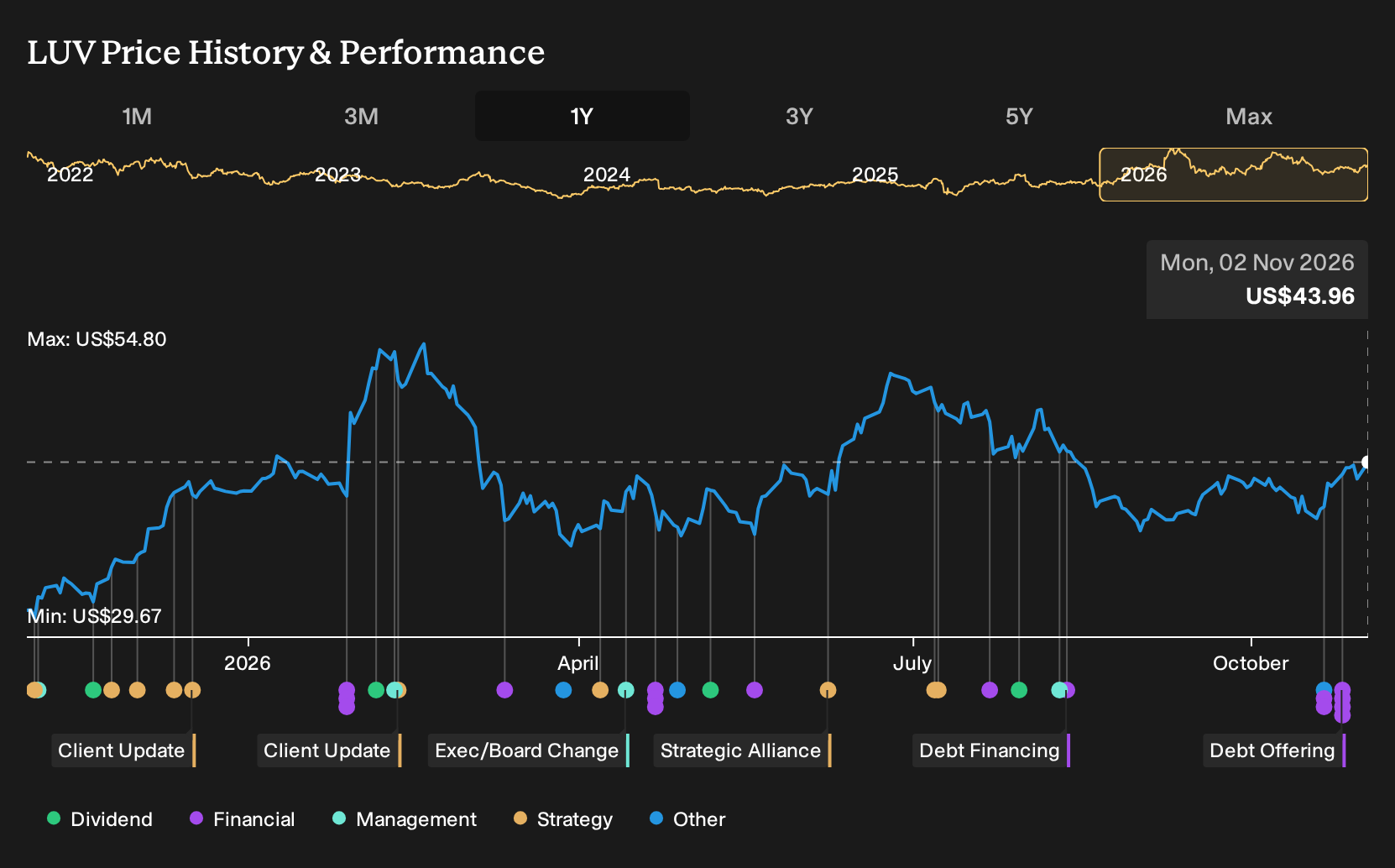
Exploring Other Perspectives
Some of the most optimistic analysts focus on Southwest Airlines' new ancillary fees as the key catalyst. Before this Q3 update and the US$1.25b in fresh notes, that bullish group was already penciling in US$38.6b of revenue and US$3.7b in earnings by 2029. You can see how sharply opinions differ and decide which assumptions feel more realistic for you, knowing this latest financing round may push forecasts in either direction.
Explore 4 other Southwest Airlines fair value estimates, including one that suggests as much as 140% potential upside from the current price.
Reach Your Own Conclusion
Don't just follow the ticker; dig into the data and build a conviction that's truly your own.
- A great starting point for your Southwest Airlines research is our analysis highlighting 3 key rewards and 1 important warning sign that could impact your investment decision.
- See our latest analysis for Southwest Airlines. The report includes a comprehensive fundamental analysis summarized in a single visual, the Snowflake, making it easy to evaluate Southwest Airlines' overall financial health at a glance.
Looking For More Investment Ideas Beyond Southwest Airlines?
If Southwest Airlines has sharpened your view on what quality execution looks like, you can extend that lens to a wider watchlist using the Simply Wall St Screener. You can filter for balance sheet strength, income potential or lower risk profiles and build a shortlist that fits your own approach.
- For investors who want resilient businesses with room to rerate over time, you can scan through our curated set of 34 high quality undervalued stocks and see which ones merit a closer look.
- If reliable income is a key part of your plan, you might focus on companies that aim to combine higher yields with stability by reviewing the 4 dividend fortresses.
- When capital preservation matters as much as upside, you could narrow your search to companies with stronger financial footing using the 29 resilient stocks with low risk scores.
Have feedback on this article? Concerned about the content? Get in touch with us directly. Alternatively, email editorial-team@simplywallst.com