


- Lakeland Financial reported third quarter 2026 results with net interest income of US$60.72 million and net income of US$28.86 million, along with higher basic and diluted earnings per share from continuing operations compared with the prior year period.
- The bank also recorded US$2.97 million of net charge offs in the quarter, largely tied to a previously reserved nonperforming commercial credit, which reflects both improved earnings and the ongoing cost of resolving legacy credit issues.
- Attention now turns to how Lakeland Financial's stronger earnings, together with elevated credit charge offs, shape the broader investment narrative for the business.
Scan beyond Lakeland Financial and compare how other hand picked regional banks handle earnings strength alongside credit clean ups with the 29 resilient stocks with low risk scores in focus.
What Is Lakeland Financial's Investment Narrative?
The big picture with Lakeland Financial is simple. You need to believe this Indiana focused lender can keep pairing measured balance sheet growth with high quality earnings and a steady dividend, without taking on outsized credit risk. The latest quarter fits that story. Net interest income and net income for both the quarter and year to date moved higher versus 2025, while basic EPS from continuing operations ticked up as well. At the same time, management pushed through a US$2.97 million net charge off tied to a previously reserved commercial exposure, which looks like more of a clean up than a new surprise.
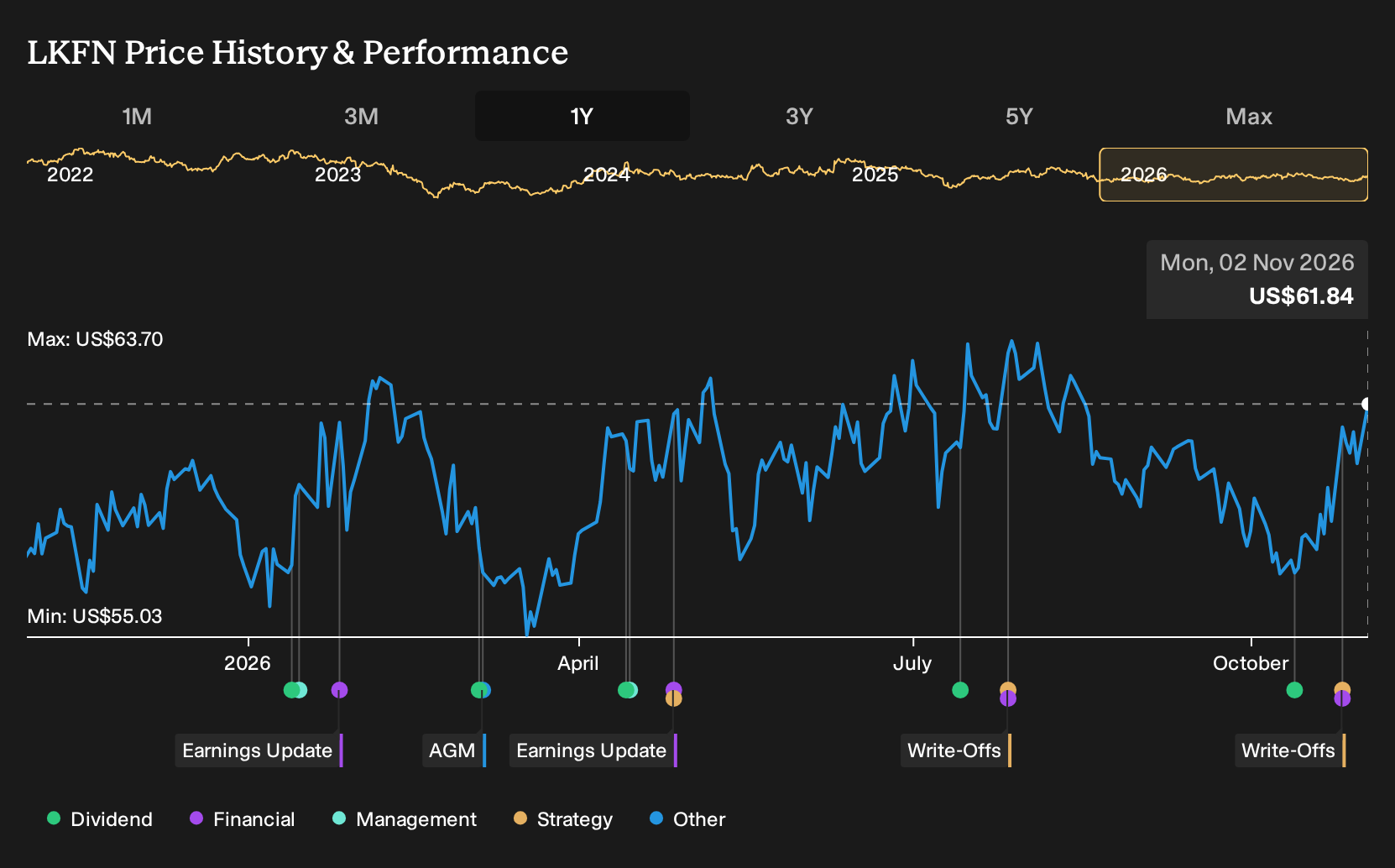
In the short term, the key swing factors remain loan demand, pricing on both loans and deposits, and how much capital Lakeland Financial has to keep tied up in reserves and problem credits. The Q3 results suggest the bank is still generating enough earnings power to absorb a chunky charge off, although the jump from US$384,000 in net charge offs a year ago is a reminder that credit costs can move sharply. The stock trades on a P/E of 13.4x, below peer averages but above one estimate of fair value. As a result, a lot rests on execution rather than a cheap headline multiple or aggressive growth assumptions.
One caveat belongs in the same frame as the good news, and it sits in how Lakeland Financial balances that earnings stability with ...
There's only one way to know the right time to buy, sell or hold Lakeland Financial. Head to Simply Wall St's company report for the latest analysis of Lakeland Financial's Fair Value.
Form Your Own Verdict
Don't just follow the ticker. Dig into the data and build a conviction that's truly your own.
- A great starting point for your Lakeland Financial research is our analysis highlighting 3 key rewards that could impact your investment decision.
- See our latest analysis for Lakeland Financial. The report includes a comprehensive fundamental analysis summarized in a single visual, the Snowflake, making it easy to evaluate Lakeland Financial's overall financial health at a glance.
Looking For More Investment Ideas Beyond Lakeland Financial?
If Lakeland Financial has sharpened your interest in regional banks and income plays, it can be useful to widen the lens and compare it with other businesses that meet clear, disciplined criteria. The Simply Wall St Screener lets you filter for financial strength, value and income, so you can build a watchlist that actually fits your own risk and return preferences.
- For investors who care most about capital strength and lower volatility, start with a curated 29 resilient stocks with low risk scores that aims to pair resilient balance sheets with more measured risk profiles.
- If value is your priority, scan a focused 34 high quality undervalued stocks that combines solid fundamentals with share prices that sit below internal quality metrics.
- Income focused readers can zero in on a targeted 4 dividend fortresses that aims to balance higher yields with business models built around sustaining regular payouts.
Have feedback on this article? Concerned about the content? Get in touch with us directly. Alternatively, email editorial-team@simplywallst.com