


Interest rates in Australia are now at levels not seen since 2008, and that shift is quietly reshaping which bank and financial services stocks could gain from a wider margin and which might feel more pressure from stretched borrowers. Investors who ignore this turning point risk missing where capital may quietly realign. This article walks through three Australian-listed financial stocks exposed to the latest RBA move and explains how the new rate path may matter for each one.
The three stocks highlighted below are only a sample from the wider universe, and the full screen surfaced 8 more Australian bank and financial services companies with equally detailed stories that are not covered here. If you want to move beyond the shortlist and actively identify, compare, and analyze candidates with your own filters, head straight to the Australian Bank and Financial Services Stocks screener.
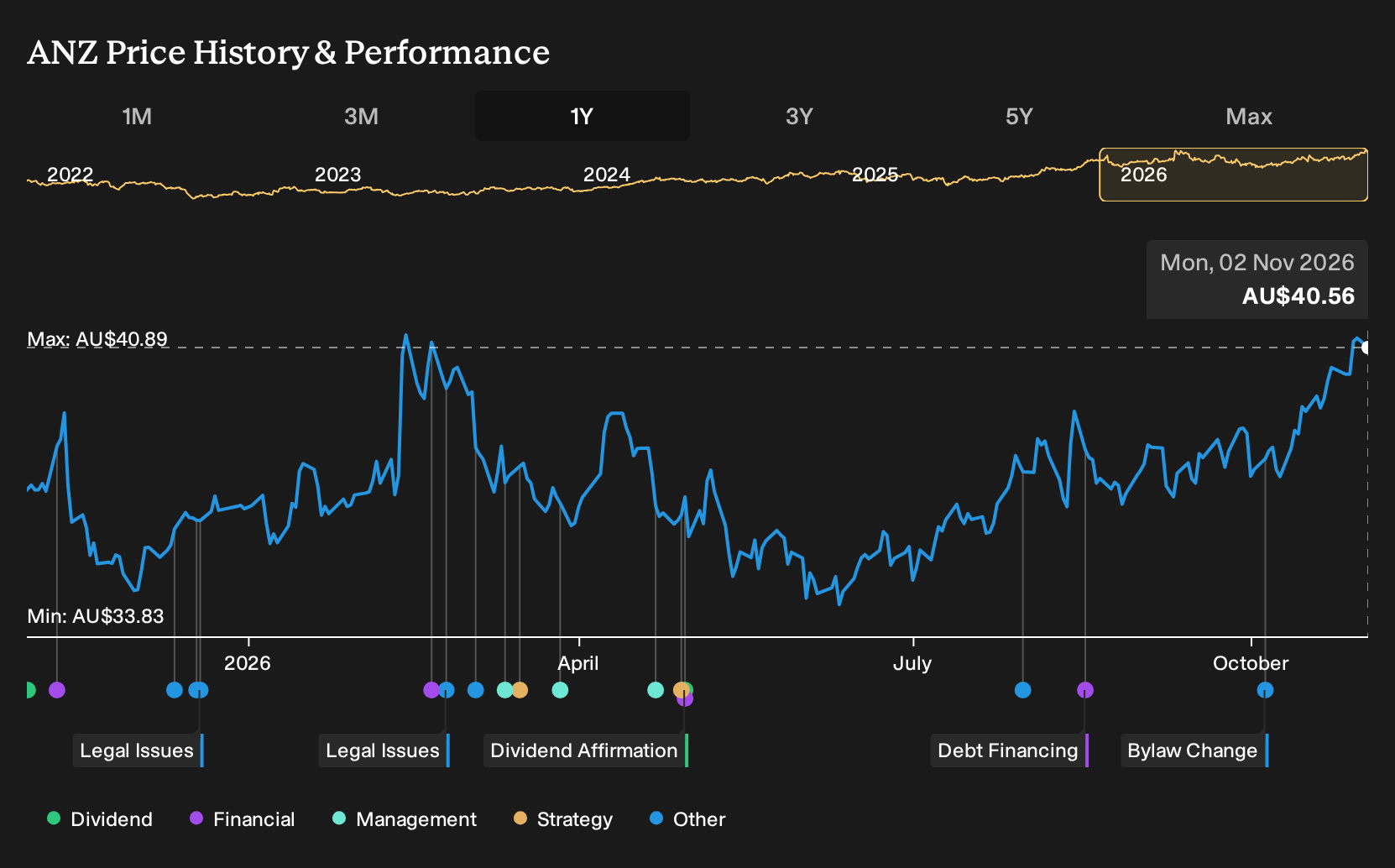
ANZ Group Holdings (ASX:ANZ)
Overview: ANZ Group Holdings is a big four Australian bank that earns most of its money by providing loans, deposits and financial services to households, businesses and institutions across Australia, New Zealand and selected international markets.
Operations: ANZ generates A$6.6b from Institutional banking, A$5.7b from Australia Retail, A$3.4b from Australia Commercial and A$3.6b from New Zealand, with smaller contributions from Suncorp Bank, Pacific and Group Centre segments.
Market Cap: A$122.2b
ANZ Group Holdings is one of the clearest expressions of the higher rate theme in this screen, because its core lending and deposit engine directly links to the RBA cash rate and the interest spreads that can open up when benchmark rates stay elevated.
"These firms may be positioned to benefit if rising benchmark rates lift net interest margins. Inclusion reflects the filter criteria above, not a guarantee of exposure or future performance."
For ANZ, what happens when one unseen pressure on those spreads finally bites will matter far more than headline rate moves.
When that pressure finally shows, the full narrative for ANZ Group Holdings explains how ANZ Group Holdings could see margins shift, risk repriced and borrower behavior quietly reshape the story.
MyState (ASX:MYS)
Overview: MyState is a regional Australian bank that offers everyday banking, home loans, equipment finance, insurance and wealth products to households and businesses.
Operations: MyState generates about A$235 million from the MSF Group and A$16 million from Wealth Management, almost entirely within Australia.
Market Cap: A$862 million
MyState gives investors exposure to how a smaller regional lender can use higher interest rates and a more focused footprint to turn wider loan spreads into profit growth.
"The successful merger with Auswide has already delivered substantial realized synergies and is targeting $20–25 million in annual pretax cost synergies. This is expected to significantly increase operating leverage and support double-digit EPS growth as integration continues, positively impacting earnings and margins."
What happens if one pressure point in that integration story shifts, for better or worse, will go a long way to deciding future margins.
If that pressure point is on your radar, the full narrative for MyState explores how MyState’s merger, funding mix and margin risks could be quietly accelerating or masking value.

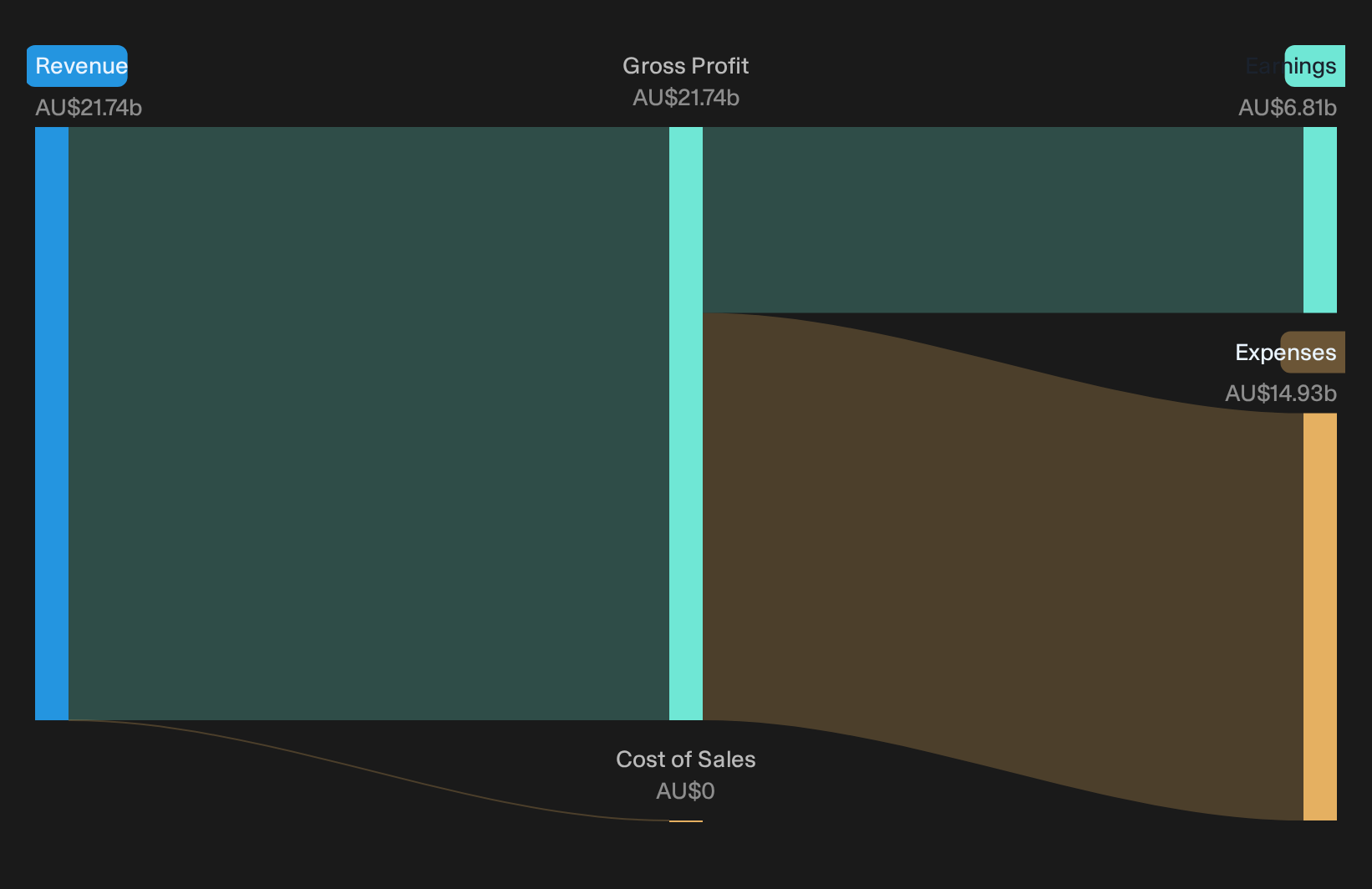
Westpac Banking (ASX:WBC)
Overview: Westpac Banking is a major Australian bank that earns most of its income from interest on loans and deposits across retail, business and institutional customers.
Market Cap: A$127.0b
Westpac Banking is one of the purest plays on the screener’s rate theme because its loan and deposit engine is tightly linked to where the RBA sets the cash rate and to the duration of higher funding costs and wider spreads.
"Continuation of the multi year UNITE systems simplification program with an unchanged scope, timeline and around A$3.5b budget, along with green progress on most initiatives, is expected to support lower structural costs and a smaller cost to income gap, which would influence earnings resilience."
The way an unseen pressure on those costs and spreads ultimately shifts will likely decide how durable Westpac Banking’s margins feel.
That pressure point is exactly what the full narrative for Westpac Banking unpacks, separating short term noise from areas where Westpac Banking’s earnings engine could be quietly accelerating next.
Seeking Alternatives Before Others Catch On
Fresh opportunities do not wait. Breakout trends, early momentum and quietly dropping valuations often get caught by screens first. Scan what others miss while it matters and act now.
- Spot smaller movers before they start flying by running the 18 elite penny stocks with strong financials that filters for stronger balance sheets and cleaner financials, not just hype.
- Ride structural shifts in computing power by checking the curated 25 quantum computing stocks that zeros in on businesses tied to real-world quantum infrastructure and research pipelines.
- Target income opportunities while prices are still under the radar for now by reviewing the hand picked 4 dividend fortresses focused on resilience and higher yields.
Have feedback on this article? Concerned about the content? Get in touch with us directly. Alternatively, email editorial-team@simplywallst.com