


Before the market on November 2, Huajian Future-B (06132) issued an announcement announcing that the board of directors of the company has decided to exercise the share repurchase authorization and plans to repurchase H shares on the open market from time to time during the validity period of the share repurchase authorization (share repurchase is recommended), with a total amount not exceeding HK$100 million.
This is the first time since the company went public that it has announced a share repurchase, and the feedback from the secondary market is also obvious. The Zhitong Finance App observed that Huajian's future stock price jumped higher with a 2.61% increase on the same day, rising all the way from a gap in early trading to an intraday high of 18.96% in the afternoon, and finally closed up 12.54%.
Why did the buyback “blow up stock prices”?
Judging from the market, after jumping high in early trading, Huajian's future stock price will continue to rise unilaterally until it hits an intraday high of HK$31.70 in the afternoon.
During the period when Huajian opens the market on the same day until it hits a high, the intraday selling pressure on the company's stock price will be almost zero, which means that buyers will complete the price increase at a small cost. In terms of volume performance, Huajian's future stock trading volume for the same day was 187,000 shares, which is only 77.46% of the October 13 trading volume, yet achieved the biggest single-day stock price increase since July 21 this year. In other words, at this point, the buyer power required for Huajian's future stock price rise is clearly less than the seller power required for the decline. This may indicate that the current bearish power in Huajian's future market is drying up, and a small amount of buying can push the price up sharply.
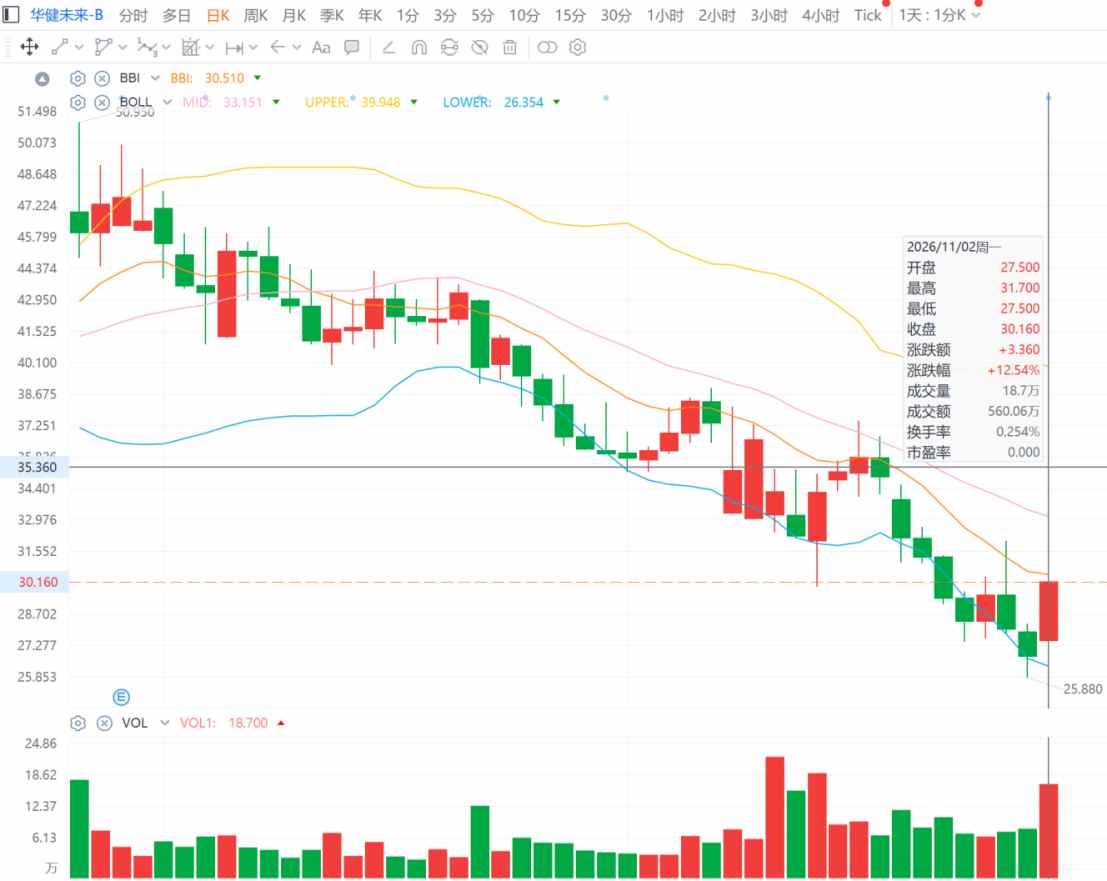
The bottom signal above was also cross-validated by multiple technical indicators.
According to the Zhitong Finance App's observation, in terms of trend indicators, Huajian's future stock price successfully crossed the 5-day EMA of HK$28.59 on November 2 and deviated more than 6% upward, indicating that its short-term EMA breakthrough was effective; at the same time, after closing for many consecutive days near or even falling below the downtrend, the company's stock price left the extreme oversold region on November 2.
In terms of momentum indicators, on November 2, Huajian's future KDJ index showed a classic bottom reversal signal in the oversold area (<20). Its KDJ-J value rebounded from a very low level of -0.73 on October 30 to 26.15; at the same time, on the same day, its MACD green bar drastically converged from -1.10 on the previous trading day to -0.61, indicating a 55.4% decline in bears' kinetic energy. If subsequent DIF continues to converge to form a gold fork after turning upward, it is expected to form a confirmation signal for a mid-term reversal.
In fact, Huajian's future stock price elasticity is rooted in its extremely low concentration of circulating chips. Since the company's IPO was issued using “Mechanism B”, its international placement was oversubscribed by only about 7 times, and the share of cornerstone investors reached 45.7%, so the company's shares in free circulation at the beginning of the listing were only about 10%.
Until November 2, Huajian Future Hong Kong stocks maintained the characteristics of a small circulation market. Previously, the average daily turnover was only about 97,000 shares, the average daily turnover was about HK$2.79 million, and the turnover rate was between 0.12% and 0.18% for a long time, so million-level capital can drive up to 20% of stock price fluctuations in a single day.
Although the repurchase authorization announcement issued by Huajian in the future this time does not constitute certainty that a repurchase has occurred, the company currently has cash and cash equivalents of $11.069 billion, and has the ability to execute the repurchase, and the management launched a repurchase when the stock price had dropped more than 60% from the issue price of HK$81.80, which clearly boosted market confidence. However, the company's buyback announcement just happened to be at the inflection point of Huajian's future technical extreme overselling, so it formed positive feedback on market performance due to the dual effects of short compensation and multiple testing in the market.
The innovative medicine sector resonates with sentiment and fundamentals
It's easy to see that Huajian's future stock price broke out of a textbook-level reversal on November 2. In terms of external factors, the beta boost of the innovative drug sector in Hong Kong stocks is indispensable.
Statistics show that in the first three quarters of this year, China's innovative drug licensing amount was about 130 billion US dollars, close to the full level of last year; on the other hand, during the three quarterly reports of this year, the foreign licensing revenue of many domestic pharmaceutical companies increased significantly year-on-year, and the industry is moving towards commercialization; in addition, at the recent ESMO 2026 conference, domestic innovative pharmaceutical companies accounted for 29 of all 90 LBA studies, and their innovation strength was recognized globally.
However, in terms of valuation, the data shows that as of October 20, the China Securities Hong Kong Stock Connect Innovative Drug Index PE-TTM was 35.26 times, lower than the median of 45.39 times in the past ten years. It can be seen that after the correction in the Hong Kong stock pharmaceutical sector, its configuration cost ratio is becoming more prominent. Under the continuous catalysts of industry fundamentals, Southbound Capital has achieved net purchases for 4 consecutive months, of which net purchases reached HK$60.776 billion in September. From the beginning of the year to date, Southbound Capital's net purchase amount for the pharmaceutical and biological sector of Hong Kong stocks has been around HK$80 billion. On the afternoon of November 2, the Hang Seng Hong Kong Stock Connect Innovative Drug Selection Index once rose by more than 1%, providing a certain boost to Huajian's stock price in the afternoon.
In addition to this, Huajian will soon reach a key fundamental catalytic point.
The Zhitong Finance App learned that Huajian's future pipeline is mainly divided into three main lines: preventing skin diseases, metabolic diseases, and tumors. The three core products are HJ787, HJ178, and HJ891, all of which are self-developed small-molecule class 1 innovative drugs. Among them, HJ891 is the company's current core product that is closest to NDA fulfillment.
As an oral KRAS G12C inhibitor, HJ891 is mainly targeted at KRAS G12C mutant NSCLC which progressed after previous first-line standard treatment, and is also exploring the use of first-line non-squamous NSCLC in combination with Junshi treprilimab. Currently, Huajian Future is evaluating its efficacy and safety in patients with KrAS G12C mutation non-small cell lung cancer (NSCLC) who have failed to be treated with first-line standard therapy in a phase IIb clinical trial.
The study showed that in terms of efficacy, among patients with KRAS G12C positive NSCLC who underwent first-line standard treatment, HJ891 had a CORR of 48.7% and a MoS of 19.8 months, showing good long-term benefits.
In terms of safety, in the phase IIb study, HJ891 showed outstanding safety advantages. The incidence rate of grade 3 or above TRAE was 19.9%, while the incidence of grade 3 or higher TRAE for similar drugs that have already been marketed was about 33%-50%. Furthermore, the incidence of serious adverse events related to the studied drug, adverse events leading to dose reduction, and adverse events leading to suspension of medication use are all significantly lower than those of KRAS G12C inhibitors that have already been marketed, so they are more conducive to long-term medication use. At the same time, the incidence of HJ891's hematologic toxicity, hepatotoxicity, and gastrointestinal toxicity related TRAE was significantly lower than that of approved similar drugs, which is more conducive to long-term medication use and ensuring patients' quality of life.
Furthermore, the phase Ib portion of the phase IB/III clinical trial of hj891 combined with treprilizumab showed that in patients with non-squamous non-small cell lung cancer with PD-L1 ≥ 50%, Hj891 plus treprilizumab had a Corr of 92.9%, and the 12-month OS rate was 85.7%.
Judging from the 2026 interim results recently disclosed by the company, the key phase IIb clinical trial of HJ891 monotherapy for second-line KRAS G12c mutant non-small cell lung cancer has now completed patient enrollment, and the company plans to submit an NDA within the next year.
Looking at the current market, although HJ891's confirmatory phase III is still in progress, the repurchase announcement issued by the company has undoubtedly strengthened the market's judgment that “management is confident to support the fulfillment of the data/declaration”, which also drives the market's expectations for early trading of the “HJ891 NDA window” in the short term.