


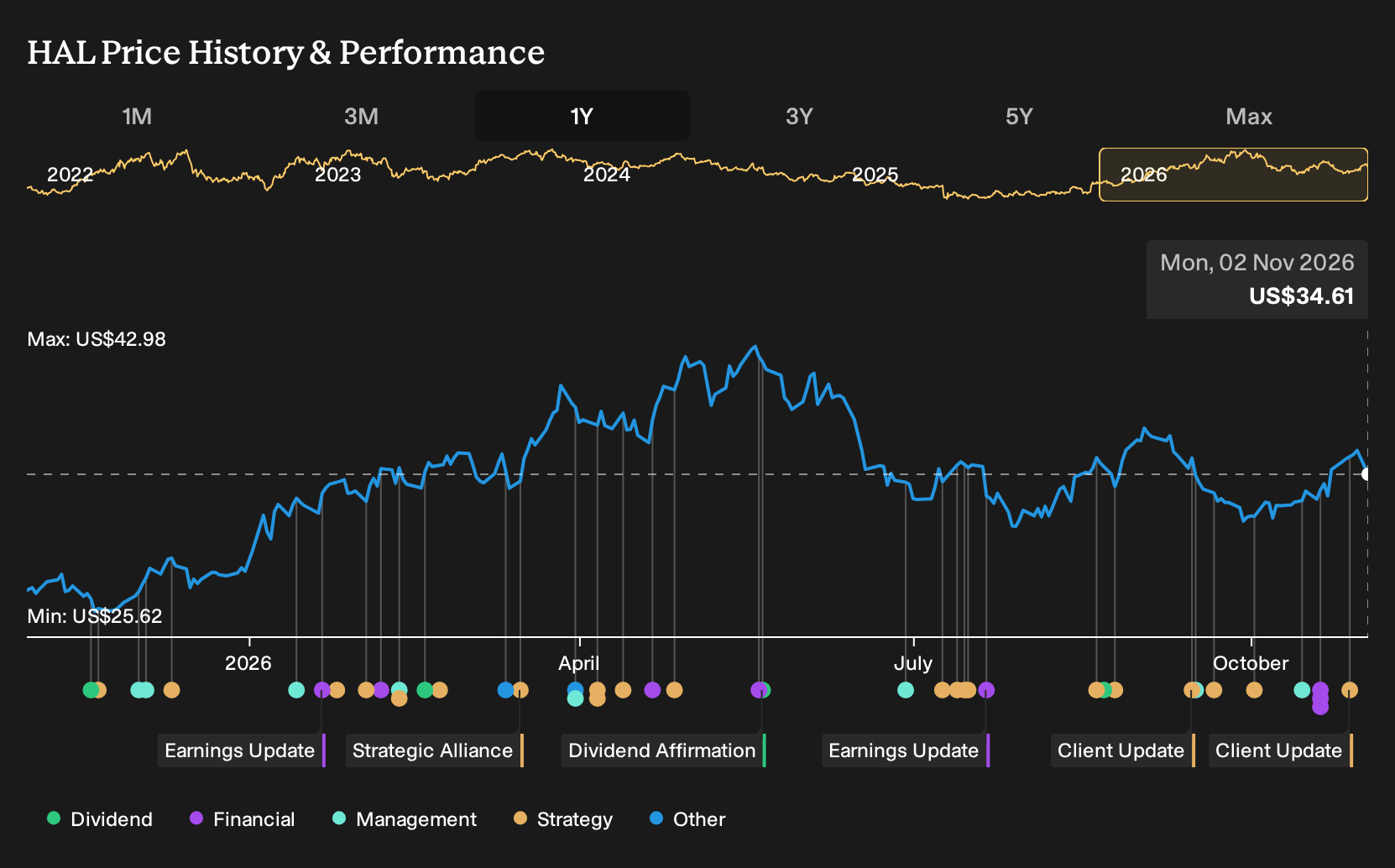
If Halliburton had sat on your watchlist instead of in your portfolio, the result might feel like a missed call. Holding Halliburton over the past year would have returned 29.9%, including dividends. That outcome invites a simple question. Back on 2 November 2025, when bullish and bearish analysts were split over automation driven international growth versus long term decarbonization risk, what business clues could have helped you judge whether Halliburton’s push into higher tech, higher margin services would actually stick?
Halliburton is not the only name tied to this theme. Zero in on 43 power grid technology and infrastructure stocks and compare how each one is priced.
The Argument Halliburton Investors Were Really Having
The shares cost US$26.84 at the start of the period, and anyone looking at Halliburton then had to decide which story felt more convincing.
The bullish narrative saw a Fair Value of US$35, a price implied by expectations of stronger earnings, built on international automation and digital tools like ZEUS IQ, along with an assumed 1.7% annual revenue increase and profit margins rising from 8.4% to 10.4% by 2028.
The bearish camp argued for a Fair Value of US$20, based on decarbonization and regulation curbing demand, with revenue assumed to decline 3.1% a year and margins edging down from 8.4% to 8.0%.
What The Halliburton Evidence Actually Showed
Halliburton’s Q3 2026 report did the most to test the two stories. Revenue was US$5,703m and net income reached US$417m, compared with US$5,600m and US$18m a year earlier, so net margin moved from 0.3% to 7.3%. That shift in profitability leaned toward the optimistic case, although decarbonization and regulatory risks from the cautious view did not disappear.
The key lesson is simple. When a pitch rests on higher margins rather than just higher sales, treat net income and net margin as the primary scorecard, and check whether each quarterly report is actually moving those two lines in the direction the thesis needs.
What Halliburton’s Price Now Asks You To Believe
Halliburton trades at US$34.61, and this Narrative’s Fair Value sits above that level, which signals a more optimistic read on the current setup than the market price alone implies.
The argument leans on international contracts, North America as a cash engine, and higher margin digital work. The key question is whether Halliburton can keep turning that mix into sustained free cash flow that funds ongoing buybacks.
"Key Takeaways: Bullish analysts expect Halliburton to turn its expanding international contract base, tighter North American frac market and higher margin digital offerings into stronger earnings power that is not yet fully reflected in the stock. The main thing that has to go right is that Halliburton converts its ahead of schedule international growth engines, higher margin software and automation work, and capital disciplined North American cash generation into sustained free cash flow that supports ongoing buybacks."
One Narrative disagrees with today's price. → See where this Narrative says Halliburton should trade
Halliburton And The Fuel Question
Halliburton earns its fees helping others pull hydrocarbons from the ground. Your view there probably depends on how long that work stays busy.
Step sideways and you get a different angle on the same fuel question. One large producer is investing heavily to expand liquefied gas and offshore oil output.
It is also reshaping its portfolio, trimming weaker assets and concentrating on projects it expects to earn stronger returns.
If that producer succeeds, the result is a larger, longer lived stream of barrels and cargoes.
For investors, that becomes a different way to approach the same energy story you were testing with Halliburton.
The case is on the record, with the assumptions it rests on. → See the Narrative that values this company 22% above its price
Have feedback on this article? Concerned about the content? Get in touch with us directly. Alternatively, email editorial-team@simplywallst.com