


- NatWest Group completed a buyback tranche announced in February 2026, retiring 61,900,000 shares, or 0.78% of share capital, for £397.91 million, alongside Q3 results that reported £3,559 million of net interest income and £1,614 million of net income.
- The third quarter update combined higher net interest income and a larger loan book with pressure on earnings per share and questions about the resilience of future net interest income, as funding costs, credit risk and the upcoming Bank of England rate decision all weigh on expectations.
- This review considers how NatWest Group's investment narrative is being tested by Q3 net interest income trends and concerns about margin pressure.
Scan how NatWest Group's buyback and net interest margin story compares with other UK and global banks by reviewing our hand picked list of list of solid balance sheet and fundamentals (10 results).
NatWest Group Investment Narrative Recap
To own NatWest Group, you need to be comfortable with a simple idea. The bank is leaning on net interest income, cost control and a bigger loan book, while accepting that margins may face pressure as cheaper mortgages and commercial lending weigh on spreads.
The main near term swing factor is net interest margin resilience, as the Bank of England decision on 5 November and rising funding costs shape both asset yields and deposit pricing. The biggest current risk is that loan growth running ahead of deposits forces more wholesale funding and compresses the 2.5% margin faster than fee income or efficiency gains can offset.
The Q3 2026 earnings release is the clearest lens on this. NatWest Group reported quarterly net interest income of £3,559 million with a 2.5% margin on a £464.9b loan book, alongside net income of £1,614 million and basic EPS of £0.193, slightly lower than a year earlier despite higher net interest income.
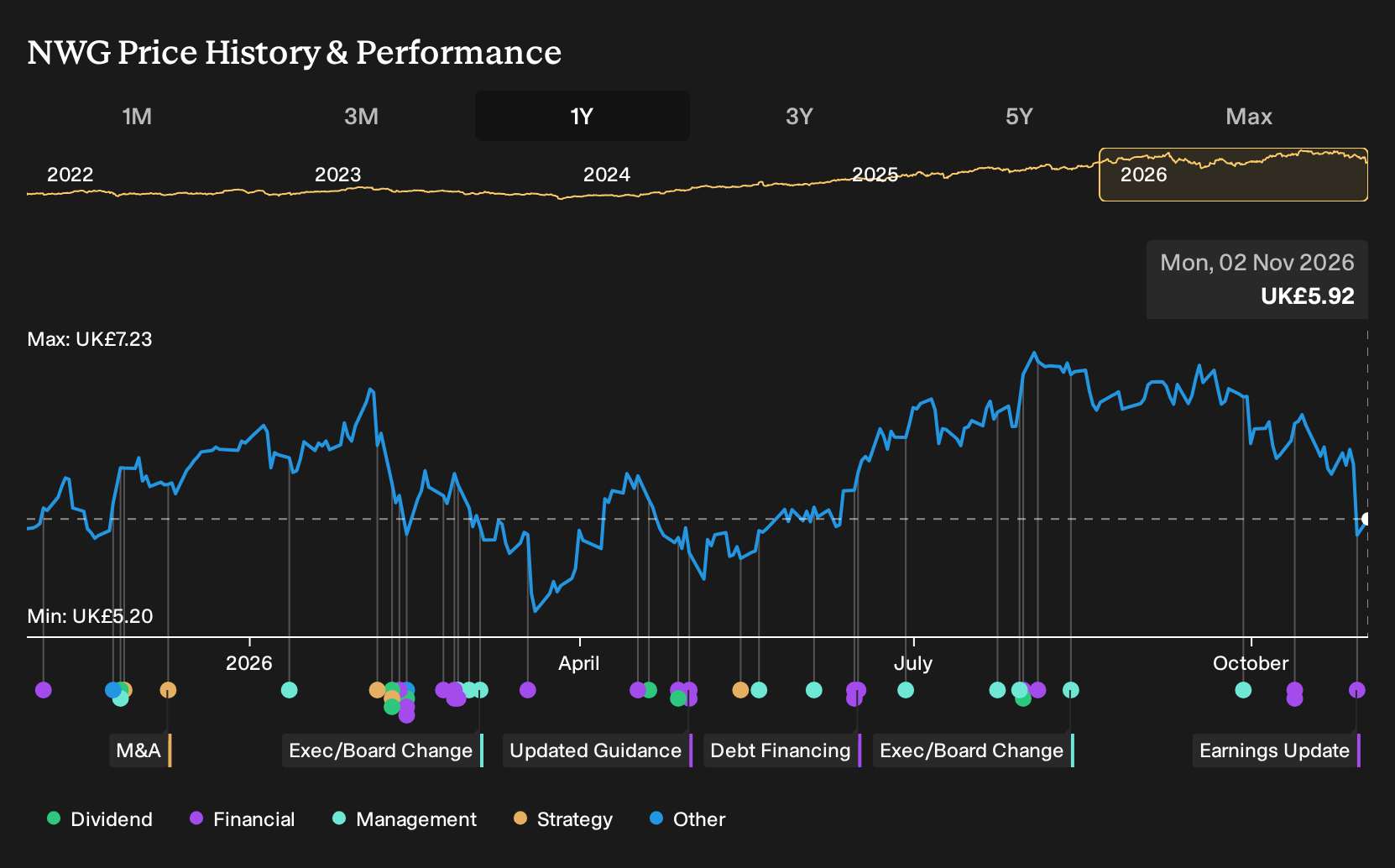
That mix matters for your thesis. Higher nine month net interest income of £10,449 million and net income of £4,798 million sit against investor concern about future margin flattening, credit risk on a larger loan book and the sector wide impact of any rate move to 4%. This is why the share price reaction was sharp after results.
What The NatWest Group Forecasts Really Assume
NatWest Group's analyst narrative leans on a fairly straightforward set of numbers. The sell side is modelling 7.2% yearly revenue growth over the next few years, while profit margins soften from 35.9% today to 33.4% in three years. Earnings today are put at £6.0b and the consensus view looks for £6.9b of profit by 2029, with some analysts pencilling in as much as £7.7b. That central case implies about a £0.9b rise in earnings versus current levels and asks you to accept a higher 2029 P/E of 11.5x compared with 8.4x now, along with a 0.9% yearly reduction in the share count through continued buybacks.
NatWest Group's narrative projects £20.7b revenue and £6.9b earnings by 2029. This requires 7.2% yearly revenue growth and about a £0.9b earnings increase from £6.0b today.
Uncover why NatWest Group's fair value indicates a 35% potential upside to its current price, which could narrow quickly as sentiment shifts.
Exploring Other Perspectives
Three fair value views from the Simply Wall St Community cluster between £7.88 and £13.40, so some investors see NatWest Group as tightly priced, while others pencil in far more headroom. When you set those retail models against margin risk from cheaper mortgages and higher wholesale funding, you get a wide spread of possible outcomes worth exploring.
Explore 2 other NatWest Group fair value estimates, including one that suggests potential upside of as much as 126% from the current price.
Form Your Own Verdict
Disagree with existing narratives? Extraordinary investment returns rarely come from following the herd, so go with your instincts.
- A great starting point for your NatWest Group research is our analysis highlighting 5 key rewards and 3 important warning signs that could impact your investment decision.
- See our latest analysis for NatWest Group. The report includes a comprehensive fundamental analysis summarized in a single visual, the Snowflake, making it easy to evaluate NatWest Group's overall financial health at a glance.
Looking for more investment ideas beyond NatWest Group?
If the NatWest Group story has sharpened your thinking, use that same lens across a broader watchlist by scanning companies through the Simply Wall St Screener.
- If you want to focus on quality at a discount, start with a curated pool of 13 high quality undervalued stocks that combine strong fundamentals with more modest pricing.
- For income focused investing, anchor your watchlist around 5 dividend fortresses that may appeal if you care about sizeable yields and balance sheet strength.
- When capital preservation matters most, narrow your attention to a 5 resilient stocks with low risk scores that may offer relatively resilient profiles based on Simply Wall St's risk scoring.
Have feedback on this article? Concerned about the content? Get in touch with us directly. Alternatively, email editorial-team@simplywallst.com